The fish of the Herati pattern, the cypress in a boteh, the mosque dome in a medallion: many Persian rug motifs come with readings handed down for generations. These are traditions, not a code. One motif can be seen several ways, and a village weaver may have had a story of their own in mind. Still, a pattern says much about where and how a rug was made, and knowing what it is said to mean draws you closer to the rug you live with.
Three families of Persian rug designs: floral, geometric and Herati
Most Persian rug designs belong to one of three families. Floral designs, all flowing curves of blossom, leaf and vine, dominate the city workshops of Tabriz, Kashan, Isfahan and Kerman. Geometric designs, built from straight lines into diamonds, hexagons and stepped forms, are older and remain the language of village and tribal looms, where many shapes are said to carry meanings from the weavers’ own lives. The third family is the Herati pattern, one repeating motif so widespread that it stands in a class by itself.
Any of the three can be set around a central medallion or spread over the whole field. The drawing also hints at the knot density: a finely drawn floral needs enough knots to stay crisp, while bold geometry comes through clearly at modest counts.
Medallion: the center of the design
The medallion is the large motif at the heart of the field, with the rest of the design arranged around it. In a floral rug, tradition sees it as a lotus flower, sacred in Persian rug lore; another reading finds in it the inner dome of a mosque.
Floral medallions, ringed by fine branches and smaller medallions, are typical of city workshops; angular, often hexagonal ones belong to village and tribal weaving, as in Heriz. Many come with matching corner pieces, and on a runner the medallion may repeat down its length, its inner drawing changing each time. A medallion rug wants centering: on the room, a seating group or the dining table.
All-over design: no single center
An all-over design covers the field with no single center, though a faint one is often implied. Floral all-overs join big blossoms on sturdy branches with a web of vines, where a bird may perch; the Mina Khani sets small round blossoms in a diamond lattice. Geometric all-overs repeat one shape row after row, like the gul of Turkmen rugs, or let it change as they go. With nothing to line up, an all-over rug works anywhere in a room.
Herati pattern: fish around a lotus
The Herati pattern covers the field with small repeating diamonds, each with a flower in the middle and a curved leaf at either side. Tradition sees those leaves as fish swimming around a lotus, hence its other names, the fish or Mahi design (mahi is Persian for fish). The name points to Herat, now in Afghanistan, the design’s reputed birthplace. It fills a field alone or surrounds a medallion.
Boteh: the paisley motif
The boteh is a rounded drop tapering to a bent tip, most often repeated in rows. The Persian word is usually taken to mean a budding plant or flower, and tradition makes the shape an emblem of growth and renewal. It is also seen as a flame or as a cypress, a tree that yields to the wind yet rarely snaps: a picture of resilience. The West calls it paisley, after the Scottish town whose 19th-century mills copied the shawls of Kashmir.
Tree of life: one great tree
A tree of life rug gives most of its field to one great tree, with birds, animals and flowers among its branches. It is said to stand for the bond between the earth and all that lives on it, and to bridge heaven and earth: a sign of strength, wisdom and long life. The same tree also turns up in one square of a garden panel design, or along a border.
Garden panel design: a grid of gardens
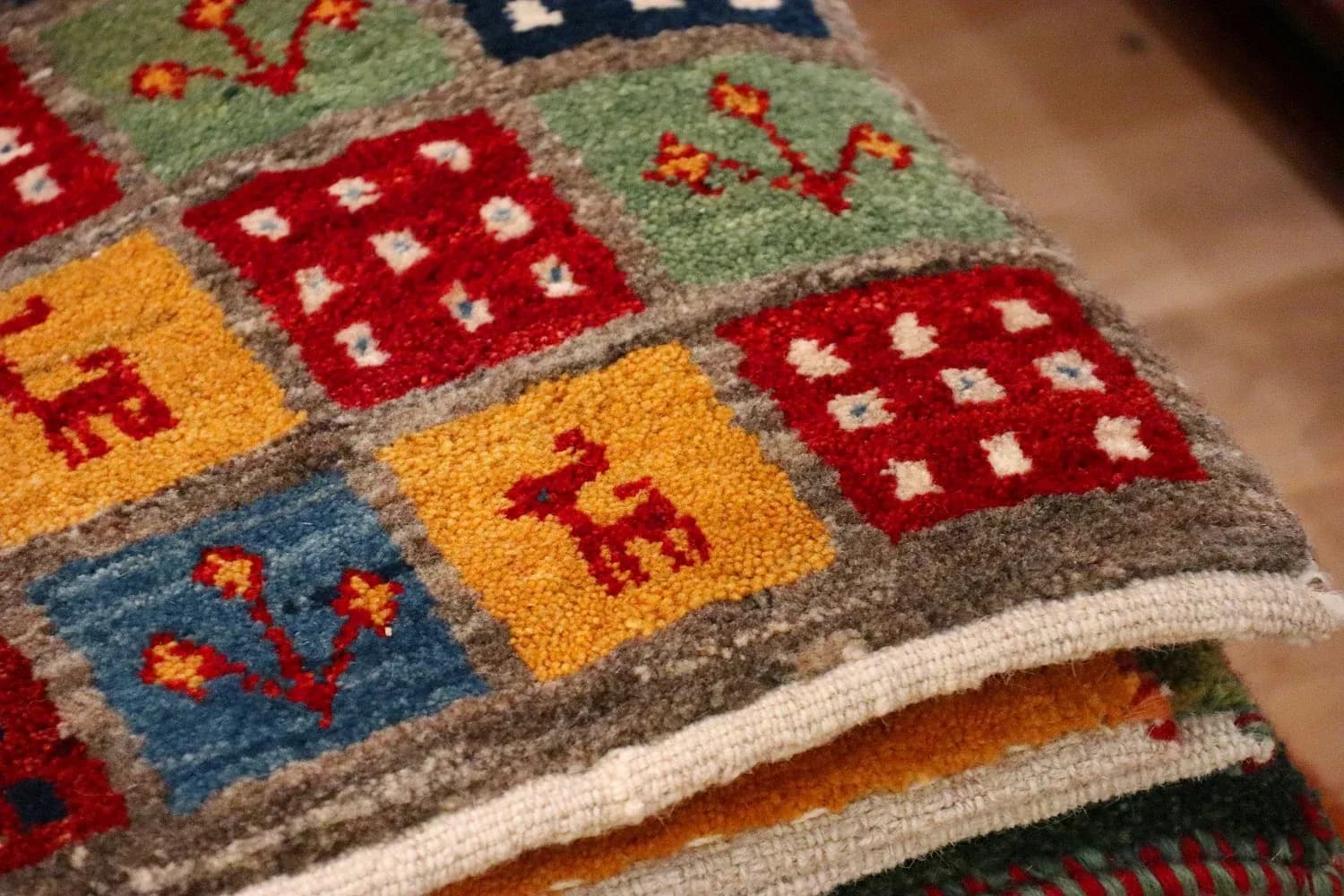
The garden panel design divides the field into a grid of framed squares, hence its Persian name, kheshti, from khesht, a brick. Each holds an imagined garden of flowers, cypresses and birds on its own ground color, and weavers are said to treat every panel as a glimpse of paradise. Bakhtiari rugs are its best-known home. Floral fields can carry the same idea without the frames: their vines are said to bring the gardens of paradise indoors in a dry land.
Vase design: flowering vases
In the vase design, vases of flowers stand across the field. Often one large vase holds the center, the place a medallion would take, with smaller ones around it, and the group may repeat like an all-over design. The flowering vase is taken to stand for growth and opportunity, and for abundance; like the garden panels, it is also linked with paradise. Kashmar rugs are known for it.
Shah Abbasi: the court design
Shah Abbasi is named after Shah Abbas, the Safavid ruler from 1588 to 1629, and began as a design of his court. Feathery palmette leaves and lotus blossoms, by tradition an emblem of long life, are balanced around a medallion at the center, often a rosette, so that each half mirrors the other. Many floral rugs borrow from it, and its lotus, the flower tradition also sees in a floral medallion, is said to date from the earlier Ilkhanid period.
Mihrab: the prayer arch
A prayer rug is built around the mihrab, an arched doorway at one end of the field echoing the niche in a mosque wall that faces Mecca. The arch, a bare outline or full architecture with columns, is meant to remind whoever kneels there that they stand on sacred ground. Such rugs are small, often no larger than about 0.9 × 1.5 m (3 × 5 ft), and are drawn to face one way. Any small rug will do for prayer, but only one with the arch is a prayer rug in the trade’s sense.
Open field design: a plain ground
The open field design leaves most of the field one plain color, with a few flowers on curving stems, and is said to take after the cover of a Quran. It comes with a single medallion, with repeating medallions or as an all-over scatter of motifs set wide apart. Mostly a city design, it hides nothing: any unevenness in the wool or the dye shows at once, and so does abrash, a natural trait in an older rug.
Pictorial rug: a woven picture
A pictorial rug is woven as a picture: a landscape, a moment from history or a story such as Layla and Majnun, laid out as a painter plans a canvas. Such rugs are among the hardest tests of a master weaver and come from city workshops, above all in Tabriz. The hunting design, its field full of animals in the chase, is a close relation.
Who draws the pattern
Until the Safavid era the weaver was usually also the designer. As designs grew more intricate, specialist designers, many of them miniature painters, began setting each pattern out as a weaving cartoon for the weavers to follow. City workshops still work this way, hence their near-perfect symmetry: each knot goes where the cartoon puts it.
Village and tribal weavers, the Bakhtiari and Qashqai among them, mostly weave from memory, with designs handed down in the family and drawn from their surroundings. It shows in a motif that changes size or a border that does not quite turn the corner: marks of the hand, not faults.
A short history of Persian rug patterns
The first rugs were woven against cold and damp, and pattern followed. By the 5th century BC it was well established: the Pazyryk rug, the oldest knotted rug known, frames its field with borders of deer and horsemen. Much later, the Ilkhanid period of Mongol rule is credited with bringing Chinese and Islamic art together in Persian design, and with them the lotus, the cloud band, the phoenix and the dragon.
The Safavid dynasty, from 1501 into the 1730s, was the golden age: royal patronage brought the large central medallion, curving floral drawing and richer vines, and patterns were standardized for export. In the 19th century, under the Qajar dynasty, output peaked and workshop designs grew uniform enough to show a rug’s origin at a glance.
Can the pattern date a rug?
A pattern places a rug more readily than it dates it. A few designs do belong to a period: Ziegler Mahal began in the late 19th century as a design for the European market, and around Heriz the local style moved on, from Bakshaish and Serapi to the fuller designs woven since the 1910s. But an antique reproduction can copy an old pattern closely, so a design may hint at an era without settling a date. Experts judge it alongside what the back shows and how each color has aged from tip to base, and our rug valuation weighs age and origin with materials, dyes and knotting.
Keep exploring
See these patterns on real rugs, look up any motif by name, follow a Persian rug from fleece to finished piece, or have a rug of your own valued.