The fish of the Herati patternA classic Persian design built on a diamond repeated across the field, with a small flower or leaves inside each diamond and curved leaves at its sides; the leaves are read as stylized fish, said to circle a lotus. The name comes from Herat, the city in Afghanistan where the design is said to originate; it is also called the fish design, and Mahi means “fish” in Persian. It is one of the three main design families, woven as an allover pattern or around a central medallion with diamonds inside and outside it, and it sometimes appears as a thin border. It is common in Tabriz, Sarouk, Mashhad, Moud, Bijar, Hamadan, Abadeh, Zanjan, Kerman and Kashan rugs., the cypress in a botehA teardrop-shaped motif with a curved upper tip, ubiquitous in Persian and Kashmiri weaving for centuries. The Persian word is glossed as “budding flower or plant,” and the motif stands for growth and regeneration; it is also read as a cypress that bends in the wind but rarely breaks, a flame, a seed, a pine cone or a stylized almond. When Scottish mills began imitating Kashmir shawls in the 19th century, the boteh became known in the West as “paisley,” after the town of Paisley. In rugs it usually repeats throughout the field, notably in Tabriz, Sarouk, Kerman, Mashhad and Malayer pieces., the mosque dome in a medallionA large motif at the center of a rug's field, around which the rest of the design is organized; the large central medallion is said to have been introduced in the Safavid era (16th-17th centuries). Floral medallions, typical of city rugs such as Tabriz, Kashan and Sarouk, are often read as a lotus blossom, and the motif has also been read as mirroring the interior dome of a mosque; geometric ones, often hexagonal or diamond-shaped, mark village and tribal rugs such as Heriz and Zanjan. A medallion may stand alone, come with four corner pieces, be flanked by smaller medallions above and below, or repeat down a runner. Rugs with no central motif are called allover. In a well-made rug the medallion sits at the center and the corners mirror one another, as closely as handwork allows.: many Persian rug motifs come with readings handed down for generations. These are traditions, not a code. One motif can be seen several ways, and a village weaver may have had a story of their own in mind. Still, a pattern says much about where and how a rug was made, and knowing what it is said to mean draws you closer to the rug you live with.
Three families of Persian rug designs: floral, geometric and Herati
Most Persian rug designs belong to one of three families. Floral designs, all flowing curves of blossom, leaf and vine, dominate the city workshops of Tabriz, Kashan, Isfahan and Kerman. Geometric designs, built from straight lines into diamonds, hexagons and stepped forms, are older and remain the language of village and tribal looms, where many shapes are said to carry meanings from the weavers’ own lives. The third family is the Herati patternA classic Persian design built on a diamond repeated across the field, with a small flower or leaves inside each diamond and curved leaves at its sides; the leaves are read as stylized fish, said to circle a lotus. The name comes from Herat, the city in Afghanistan where the design is said to originate; it is also called the fish design, and Mahi means “fish” in Persian. It is one of the three main design families, woven as an allover pattern or around a central medallion with diamonds inside and outside it, and it sometimes appears as a thin border. It is common in Tabriz, Sarouk, Mashhad, Moud, Bijar, Hamadan, Abadeh, Zanjan, Kerman and Kashan rugs., one repeating motif so widespread that it stands in a class by itself.
Any of the three can be set around a central medallionA large motif at the center of a rug's field, around which the rest of the design is organized; the large central medallion is said to have been introduced in the Safavid era (16th-17th centuries). Floral medallions, typical of city rugs such as Tabriz, Kashan and Sarouk, are often read as a lotus blossom, and the motif has also been read as mirroring the interior dome of a mosque; geometric ones, often hexagonal or diamond-shaped, mark village and tribal rugs such as Heriz and Zanjan. A medallion may stand alone, come with four corner pieces, be flanked by smaller medallions above and below, or repeat down a runner. Rugs with no central motif are called allover. In a well-made rug the medallion sits at the center and the corners mirror one another, as closely as handwork allows. or spread over the whole field. The drawing also hints at the knot densityThe number of knots in one square inch of a hand-knotted rug (KPSI; 1 KPSI is about 15.5 knots per 10 x 10 cm), counted on the back with a ruler by multiplying the knots along one inch of height by those along one inch of width, averaged over two or three areas. More knots give sharper detail, like a higher-resolution screen, and, all else equal, somewhat more durability and a higher price, but density alone does not grade quality: Heriz and Bijar are durable at low to medium counts, while floral curvilinear designs blur without enough knots. Figures run from under about 80 for coarse tribal weaves such as Gabbeh and Qashqai, through roughly 120 to 225 for many village rugs and 300 to 700 for fine city rugs such as Nain and Isfahan, to 600 to 1,000 or more for pure silk Qum.: a finely drawn floral needs enough knots to stay crisp, while bold geometry comes through clearly at modest counts.
Medallion: the centre of the design
The medallionA large motif at the center of a rug's field, around which the rest of the design is organized; the large central medallion is said to have been introduced in the Safavid era (16th-17th centuries). Floral medallions, typical of city rugs such as Tabriz, Kashan and Sarouk, are often read as a lotus blossom, and the motif has also been read as mirroring the interior dome of a mosque; geometric ones, often hexagonal or diamond-shaped, mark village and tribal rugs such as Heriz and Zanjan. A medallion may stand alone, come with four corner pieces, be flanked by smaller medallions above and below, or repeat down a runner. Rugs with no central motif are called allover. In a well-made rug the medallion sits at the center and the corners mirror one another, as closely as handwork allows. is the large motif at the heart of the field, with the rest of the design arranged around it. In a floral rug, tradition sees it as a lotus flowerA stylized blossom motif regarded in Persian rug tradition as a sacred flower and linked with long life. The central medallion of a floral-medallion rug is read as a lotus, drawn either as one large flower or as several small ones. The lotus is also a main feature of the Shah Abbasi design, and in the Herati design the fish-like leaves are said to circle a lotus. Lotus blossoms are among the motifs credited to the Mongol period, when designs from Chinese art entered Persian rugs., sacred in Persian rug lore; another reading finds in it the inner dome of a mosque.
Floral medallions, ringed by fine branches and smaller medallions, are typical of city workshops; angular, often hexagonal ones belong to village and tribal weaving, as in HerizBold village rugs from the Heriz area of northwestern Iran, near Tabriz, and the best-known of all Persian village rugs. A coarse, tough wool pile on a cotton foundation, usually double-wefted for extra thickness, and a low-to-medium knot density (commonly quoted at about 120 to 170 KPSI, roughly 1,900 to 2,600 per 10 by 10 cm) make them very durable; the wool's strength is traditionally credited to copper-bearing mountain water. The classic design is a large angular medallion with four corner pieces, sometimes an allover layout, in a rust red traditionally credited to copper minerals in the local river, with dark navy and cream. Bakshaish and Serapi, the latter now over a century old, are their older forms.. Many come with matching corner piecesThe ornament set into each of the four corners of the field around a central medallion, usually echoing the medallion's motifs or color; in Tabriz rugs the corners are often made by dividing the medallion design into four and using one part per corner. Spandrels complete a medallion-and-corner layout, and in a well-made rug the corner pieces match one another and sit symmetrically., and on a runner the medallion may repeat down its length, its inner drawing changing each time. A medallion rug wants centring: on the room, a seating group or the dining table.
All-over design: no single centre
An all-over design covers the field with no single centre, though a faint one is often implied. Floral all-overs join big blossoms on sturdy branches with a web of vines, where a bird may perch; the Mina KhaniAn all-over repeating pattern of round flowers linked by a diamond lattice of vines, usually with the blossoms rendered in white or yellow on a dark blue or red ground. Beloved in Kurdish, Baluchi, and northwest Persian weaving, the design reads from a distance as a field of stars. Its name is popularly traced to a legendary patron, Mina Khan. sets small round blossoms in a diamond lattice. Geometric all-overs repeat one shape row after row, like the gulAn octagonal or polygonal, stylized flower motif repeated in rows across the field of Turkmen rugs. The same repeat is typical of Baluchi rugs, where a flower sits inside each octagon, and of Bokhara rugs, woven chiefly in Pakistan after Turkmen models. In older Turkmen rugs each tribe (Tekke, Salor, Ersari and others) typically kept its own gul, so an expert can often tell the tribe from the motif, whereas modern pieces mix guls freely. The word means “flower” or “rose” in Persian, though the shapes are highly geometric rather than naturalistic. of TurkmenTribal rugs woven by Turkoman (Turkmen) nomads, whose forebears came from the Afghan and Uzbek region and who later settled in the Turkmen region of Iran. Rows of octagonal guls (“flowers”) cover a deep red, reddish-brown or occasionally cream field, accented in black, blue, green or beige; prayer designs also occur. Foundation and pile are usually wool, said to come from the soft undercoat of Karakul sheep, though a cotton foundation is occasionally used. In older pieces each tribe kept its own gul design, whereas newer rugs freely mix them. Turkoman designs inspired Bokhara and Khal Mohammadi rugs and are the Persian design closest to Baluchi work, which they predate; the low-to-medium pile suits places where doors swing over the rug. rugs, or let it change as they go. With nothing to line up, an all-over rug works anywhere in a room.
Herati pattern: fish around a lotus
The Herati patternA classic Persian design built on a diamond repeated across the field, with a small flower or leaves inside each diamond and curved leaves at its sides; the leaves are read as stylized fish, said to circle a lotus. The name comes from Herat, the city in Afghanistan where the design is said to originate; it is also called the fish design, and Mahi means “fish” in Persian. It is one of the three main design families, woven as an allover pattern or around a central medallion with diamonds inside and outside it, and it sometimes appears as a thin border. It is common in Tabriz, Sarouk, Mashhad, Moud, Bijar, Hamadan, Abadeh, Zanjan, Kerman and Kashan rugs. covers the field with small repeating diamonds, each with a flower in the middle and a curved leaf at either side. Tradition sees those leaves as fish swimming around a lotus, hence its other names, the fish or Mahi design (mahi is Persian for fish). The name points to HeratRugs from Herat, a historic city in western Afghanistan that was among the largest rug-producing centers of the Safavid period (16th to early 18th century), alongside Tabriz, Kashan and Kerman. The city also gives its name to the Herati design, a repeated diamond holding a small flower or leaves, with curved leaves at its sides, which is said to have originated there and is still woven in many Persian rugs., now in Afghanistan, the design’s reputed birthplace. It fills a field alone or surrounds a medallionA large motif at the center of a rug's field, around which the rest of the design is organized; the large central medallion is said to have been introduced in the Safavid era (16th-17th centuries). Floral medallions, typical of city rugs such as Tabriz, Kashan and Sarouk, are often read as a lotus blossom, and the motif has also been read as mirroring the interior dome of a mosque; geometric ones, often hexagonal or diamond-shaped, mark village and tribal rugs such as Heriz and Zanjan. A medallion may stand alone, come with four corner pieces, be flanked by smaller medallions above and below, or repeat down a runner. Rugs with no central motif are called allover. In a well-made rug the medallion sits at the center and the corners mirror one another, as closely as handwork allows..
Boteh: the paisley motif
The botehA teardrop-shaped motif with a curved upper tip, ubiquitous in Persian and Kashmiri weaving for centuries. The Persian word is glossed as “budding flower or plant,” and the motif stands for growth and regeneration; it is also read as a cypress that bends in the wind but rarely breaks, a flame, a seed, a pine cone or a stylized almond. When Scottish mills began imitating Kashmir shawls in the 19th century, the boteh became known in the West as “paisley,” after the town of Paisley. In rugs it usually repeats throughout the field, notably in Tabriz, Sarouk, Kerman, Mashhad and Malayer pieces. is a rounded drop tapering to a bent tip, most often repeated in rows. The Persian word is usually taken to mean a budding plant or flower, and tradition makes the shape an emblem of growth and renewal. It is also seen as a flame or as a cypress, a tree that yields to the wind yet rarely snaps: a picture of resilience. The West calls it paisley, after the Scottish town whose 19th-century mills copied the shawls of Kashmir.
Tree of life: one great tree
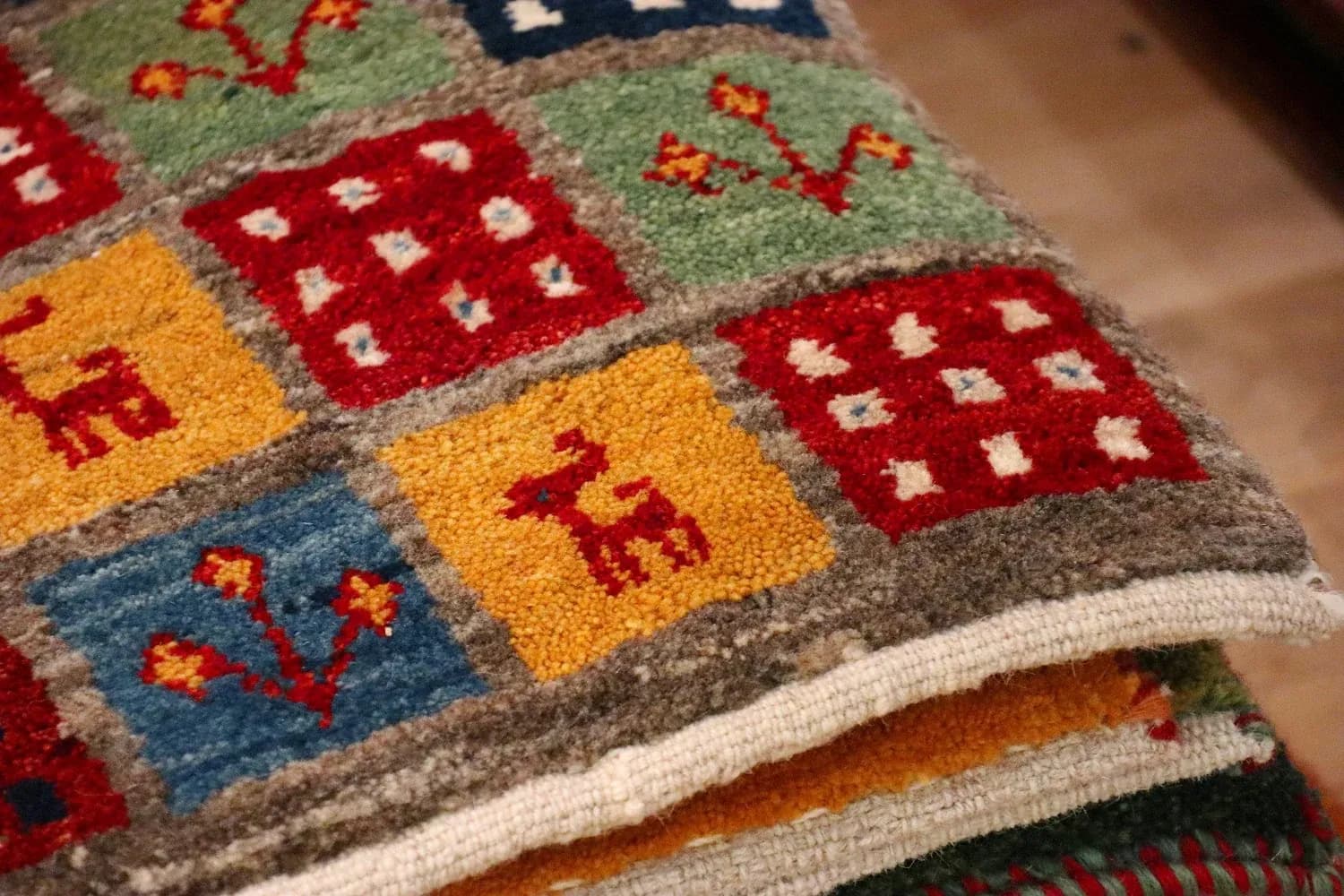
A tree of lifeA design in which one large, elaborate tree rises through most of the field, surrounded by botanical ornament, with birds, animals and flowers spread among its branches. The tree can also occupy a single panel of a garden-panel rug or appear as a border pattern. In Persian tradition it stands for the connection between earth and the environment, is also read as a link between heaven and earth, and symbolizes strength, wisdom and the continuity of life. It is woven in Tabriz, Kashan, Isfahan, Kerman and Malayer rugs and in Baluchi rugs. rug gives most of its field to one great tree, with birds, animals and flowers among its branches. It is said to stand for the bond between the earth and all that lives on it, and to bridge heaven and earth: a sign of strength, wisdom and long life. The same tree also turns up in one square of a garden panel designA layout in which the field is divided into a grid of framed, mostly square panels, each holding its own imagined garden of flowers, plants, trees and birds, usually on a single background color of its own. Scenes vary, from cypress trees and villas to lakes, deer in a forest or a tree of life, and in some rugs the panels carry the four seasons. Weavers treat each panel as a window onto paradise and a sign of hope for a bright future. Best known from Bakhtiari rugs, it is also woven in Tabriz, Sarouk, Kashmar, Kerman and Qum. The Persian name Kheshti comes from khesht (“brick”), after the square frames., or along a border.
Garden panel design: a grid of gardens
The garden panel designA layout in which the field is divided into a grid of framed, mostly square panels, each holding its own imagined garden of flowers, plants, trees and birds, usually on a single background color of its own. Scenes vary, from cypress trees and villas to lakes, deer in a forest or a tree of life, and in some rugs the panels carry the four seasons. Weavers treat each panel as a window onto paradise and a sign of hope for a bright future. Best known from Bakhtiari rugs, it is also woven in Tabriz, Sarouk, Kashmar, Kerman and Qum. The Persian name Kheshti comes from khesht (“brick”), after the square frames. divides the field into a grid of framed squares, hence its Persian name, kheshti, from khesht, a brick. Each holds an imagined garden of flowers, cypresses and birds on its own ground colour, and weavers are said to treat every panel as a glimpse of paradise. BakhtiariColorful rugs of the Bakhtiari, a Zagros Mountains tribe that was nomadic until much of it settled southwest of Isfahan in the 19th century and whose weaving now spreads across more than 200 villages; smaller pieces tend to be tribal work and larger ones come from the region's villages. The foundation is usually cotton under a wool pile from the tribe's own sheep, though some small tribal pieces are wool throughout, and every row is beaten down so hard that the pile ends up dense and long-lasting. The signature layouts are the garden panel design (Khesti, also spelled Kheshti), a grid of framed squares that each show a garden scene meant as a view of paradise, and the medallion-and-corner design with a semi-geometric center medallion. Deep red and dark navy are the usual field colors. rugs are its best-known home. Floral fields can carry the same idea without the frames: their vines are said to bring the gardens of paradise indoors in a dry land.
Vase design: flowering vases
In the vase designA layout of vases holding flowers, spread across the rug, often with one large vase at the center surrounded by smaller ones around the medallion, the arrangement then repeated over the whole field. In Persian tradition the flowering vase stands for growth and opportunity, and it is also read as a symbol of abundance and paradise. The design is typical of Kashmar rugs and is also found in Bakhtiari, Tabriz, Sarouk, Qum and Kashan rugs; in Kashmar and Kashan rugs vases can also appear in the border., vases of flowers stand across the field. Often one large vase holds the centre, the place a medallionA large motif at the center of a rug's field, around which the rest of the design is organized; the large central medallion is said to have been introduced in the Safavid era (16th-17th centuries). Floral medallions, typical of city rugs such as Tabriz, Kashan and Sarouk, are often read as a lotus blossom, and the motif has also been read as mirroring the interior dome of a mosque; geometric ones, often hexagonal or diamond-shaped, mark village and tribal rugs such as Heriz and Zanjan. A medallion may stand alone, come with four corner pieces, be flanked by smaller medallions above and below, or repeat down a runner. Rugs with no central motif are called allover. In a well-made rug the medallion sits at the center and the corners mirror one another, as closely as handwork allows. would take, with smaller ones around it, and the group may repeat like an all-over design. The flowering vase is taken to stand for growth and opportunity, and for abundance; like the garden panels, it is also linked with paradise. KashmarRugs from Kashmar, a city in northeastern Iran near Mashhad, whose weavers bring finished pieces to the Mashhad market. Less famous than Tabriz, Mashhad or Kashan, they are often undervalued relative to their quality: good wool, often high knot density and vegetable dyes at a modest price. The colors are soft earth tones: brownish cream, light and dark blue, orange, brown and a distinctive pink. Typical designs are a medallion with corner pieces and border, sometimes with vases in place of flowers, and garden designs in panels that each show a scene, such as a lake with trees, a tree of life or deer in a forest. The pile is thin to medium. Not to be confused with Kashmir. rugs are known for it.
Shah Abbasi: the court design
Shah AbbasiA classic Persian floral style named after the Safavid ruler Shah Abbas, which began as a royal court pattern about 400 years ago. Its main features are stylized, feather-like palmette leaves and lotus flowers, the lotus being an ancient symbol of long life, arranged in strict symmetry with scrolling ornament around a central medallion, often a rosette. Early examples favored deep reds and blues, while later rugs in this style often turn to muted neutral tones. The design appears in Kashan, Nain and Tabriz rugs. is named after Shah Abbas, the Safavid ruler from 1588 to 1629, and began as a design of his court. Feathery palmetteA stylized fan- or palm-leaf-shaped flower motif whose petals or leaves spread from a single base. It is repeated in the fields and borders of city rugs such as Kashan and Tabriz, usually alongside arabesque scrolls, rosettes, and floral sprays. In Sultanabad rugs the palmettes are drawn oversized and set among angular vine scrolls in an allover pattern. leaves and lotus blossoms, by tradition an emblem of long life, are balanced around a medallionA large motif at the center of a rug's field, around which the rest of the design is organized; the large central medallion is said to have been introduced in the Safavid era (16th-17th centuries). Floral medallions, typical of city rugs such as Tabriz, Kashan and Sarouk, are often read as a lotus blossom, and the motif has also been read as mirroring the interior dome of a mosque; geometric ones, often hexagonal or diamond-shaped, mark village and tribal rugs such as Heriz and Zanjan. A medallion may stand alone, come with four corner pieces, be flanked by smaller medallions above and below, or repeat down a runner. Rugs with no central motif are called allover. In a well-made rug the medallion sits at the center and the corners mirror one another, as closely as handwork allows. at the centre, often a rosetteA round, flower-like ornament in which petals radiate evenly from a center, like a blossom seen from above. From about the 16th century, as floral design entered Persian rugs, weavers began placing a rosette at the center of the field, which produced the central medallion of floral city rugs, as in the circular rosette medallion with scrolling lines on a round Shah Abbasi Tabriz. On Abadeh rugs a small rosette worked in navy, red or cream marks the center of the medallion, one way to tell the type apart. Rosettes also repeat along borders, as in Tabriz and Bakhtiari rugs, and among the vines and palmettes of Sultanabad rugs., so that each half mirrors the other. Many floral rugs borrow from it, and its lotus, the flower tradition also sees in a floral medallionA floral rug built around one central medallion, either a single large flower or a cluster of small blooms joined into one shape, often echoed by smaller medallions above, below and beside it. The medallion is traditionally said to stand for the sacred lotus. Because it takes up field space, the flowers and branches are smaller and thinner than in allover floral rugs. The design is typical of Tabriz, Kerman, Sarouk and Kashan, and its strong center makes it a natural focal point of a room., is said to date from the earlier Ilkhanid periodThe era of Mongol and Ilkhanid rule over Persia, which some rug histories date from the 1300s into the 1500s. It is credited with blending Chinese and Islamic art in Persian carpet design: pictorial, open-space compositions and motifs such as the phoenix, lotus, cloud band and dragon are traced to this contact, and Persian rug weaving as it is known today may have begun here. Little evidence remains, since much of the period's work was destroyed, but rare glimpses of its rugs show floral motifs and birds starting to appear..
Mihrab: the prayer arch
A prayer rugSmall rugs made for Islamic prayer, each featuring a mihrab (also spelled mehrab), an arched doorway that symbolizes the niche of a mosque and reminds the person praying that they stand in a sacred space; the arch also marks the direction of Mecca. The design is unidirectional, meant to be viewed from one end, and the arch may be a bare outline or an elaborate architectural frame with columns. Prayer rugs are often no larger than about 3' x 5' (0.9 x 1.5 m), are said to date back to the very early stages of rug making in Muslim lands, and are woven by Turkmen, Baluchi, Qum, Isfahan and Malayer weavers, among others. Any small rug can serve for prayer, but a true prayer rug carries the arch as its focal point. is built around the mihrabAn arch- or doorway-shaped niche woven at one end of a prayer rug's field, echoing the niche of a mosque that marks the direction of Mecca. It is the focal point of the rug and reminds the person praying that they stand in a sacred space. The drawing ranges from a bare outline of a doorway to an architectural rendering with columns and fine detail., an arched doorway at one end of the field echoing the niche in a mosque wall that faces Mecca. The arch, a bare outline or full architecture with columns, is meant to remind whoever kneels there that they stand on sacred ground. Such rugs are small, often no larger than about 0.9 × 1.5 m (3 × 5 ft), and are drawn to face one way. Any small rug will do for prayer, but only one with the arch is a prayer rug in the trade’s sense.
Open field design: a plain ground
The open field designA layout in which most of the field is left open, usually one plain ground color with only a few flowers in curving lines and sometimes a medallion. It comes in three forms: a single central medallion, two or more repeating medallions, or an allover scatter of motifs with generous space between them. The composition is said to echo the cover of a Quran and is found mainly in city-style Persian rugs such as Tabriz, Kashan, Sarouk, Hamadan, and Kerman, and also in Bijar rugs. With so little pattern to hide behind, inconsistencies in the wool or dyeing show plainly. leaves most of the field one plain colour, with a few flowers on curving stems, and is said to take after the cover of a Quran. It comes with a single medallionA large motif at the center of a rug's field, around which the rest of the design is organized; the large central medallion is said to have been introduced in the Safavid era (16th-17th centuries). Floral medallions, typical of city rugs such as Tabriz, Kashan and Sarouk, are often read as a lotus blossom, and the motif has also been read as mirroring the interior dome of a mosque; geometric ones, often hexagonal or diamond-shaped, mark village and tribal rugs such as Heriz and Zanjan. A medallion may stand alone, come with four corner pieces, be flanked by smaller medallions above and below, or repeat down a runner. Rugs with no central motif are called allover. In a well-made rug the medallion sits at the center and the corners mirror one another, as closely as handwork allows., with repeating medallions or as an all-over scatter of motifs set wide apart. Mostly a city design, it hides nothing: any unevenness in the woolA natural animal fiber used for the pile, and in some rugs also the foundation, of high-quality rugs. It is durable, resilient, stain resistant and flame resistant, feels soft and cushioned underfoot, insulates against cold, and takes up dye readily and holds it for many years. It also traps dust particles, which helps reduce allergic reactions. Quality depends above all on where the sheep graze: high-elevation pastures and good feed give thicker, oilier wool, with Manchester, New Zealand and Ghazni wools the best-known prized examples. Early-spring shearing and hand spinning (finer, softer thread than machine spinning) improve it further, while thin, dry wool from dead sheep goes into cheaper rugs. or the dye shows at once, and so does abrashSubtle shifts in color within a handmade rug, often visible as horizontal bands across the field. They arise because successive dye batches never match exactly, because differences in the wool's fat and oil content make colors change unevenly with age, and, in cream areas woven from undyed wool, because the fiber changes tone as it ages. Abrash often grows more distinct with age, so in an older rug it counts as a sign of natural dyes and hand production rather than a fault, while a newer rug is still checked for even color. Machine-made and some new hand-knotted rugs imitate it on purpose., a natural trait in an older rug.
Pictorial rug: a woven picture
A pictorial rugA rug woven as a picture, with landscape scenery, scenes from history or mythology, biblical or other stories, and human figures in place of a repeating ornament, comparable in composition to traditional art. Master weavers in city workshops make them, chiefly in Tabriz, which is known for a wide variety of pictorial designs, and also in Kashan, Isfahan, and Sarouk. Faces and floral areas are often woven at a higher knot density than the rest of the rug, so the knot count is best averaged over two or three areas. is woven as a picture: a landscape, a moment from history or a story such as Layla and MajnunA pictorial rug theme drawn from the classic Persian love story of two young people whose families forbid them to marry. The man, known as Majnun (“madman”), loses his reason from longing and roams the desert composing poems and songs; the woman, Layla, is married off to a wealthy nobleman to safeguard her family's honor and dies of grief, and he weeps himself to death on her grave. The best-known Persian telling is the verse romance of Nizami (1188), and the story appears on pictorial rugs, for example from Tabriz., laid out as a painter plans a canvas. Such rugs are among the hardest tests of a master weaver and come from city workshops, above all in Tabriz. The hunting designA pictorial layout in which the field is filled with animals in the chase or in flight, such as leopard, stag, fox, rabbit and birds. Some examples hold well over a hundred different animals, and a few carry a second scene in the border instead of the usual flowers, for instance herons, cranes or deer resting under blossom trees. The design is woven in Isfahan, Qum, Kerman and Tabriz rugs. The Persian term shikargah (also shekargah) means “hunting ground”., its field full of animals in the chase, is a close relation.
Who draws the pattern
Until the Safavid era the weaver was usually also the designer. As designs grew more intricate, specialist designers, many of them miniature painters, began setting each pattern out as a weaving cartoonA drawn design plan, also called a blueprint, that a workshop weaver follows knot by knot. In the Safavid period, as patterns grew more complex, separate designers, often miniature painters, are said to have drawn them on such plans, so that weavers only carried out others' designs, and weaving schools grew up around this way of working. City rugs from workshops in places such as Tabriz and Isfahan are so precise because they are woven from such plans. Village weavers rely on plans much less, and tribal weavers work from memory and from designs handed down within the family, so their rugs tend to be less symmetrical. for the weavers to follow. City workshops still work this way, hence their near-perfect symmetry: each knot goes where the cartoon puts it.
Village and tribal weavers, the BakhtiariColorful rugs of the Bakhtiari, a Zagros Mountains tribe that was nomadic until much of it settled southwest of Isfahan in the 19th century and whose weaving now spreads across more than 200 villages; smaller pieces tend to be tribal work and larger ones come from the region's villages. The foundation is usually cotton under a wool pile from the tribe's own sheep, though some small tribal pieces are wool throughout, and every row is beaten down so hard that the pile ends up dense and long-lasting. The signature layouts are the garden panel design (Khesti, also spelled Kheshti), a grid of framed squares that each show a garden scene meant as a view of paradise, and the medallion-and-corner design with a semi-geometric center medallion. Deep red and dark navy are the usual field colors. and QashqaiTribal rugs woven by the Qashqai, a nomadic tribe of southwestern Iran that unites Turkic, Arab, Kurdish and Lur groups and has lived in the region since at least the 16th century. Designs come from memory rather than written plans, pairing geometric and medallion layouts, occasionally in a simpler, sparsely detailed form, with animals, plants and household objects, in jewel-tone reds, saffron gold and indigo, often on deep red or dark navy grounds. The thick, hard-weaving wool of the tribe's own flocks is durable yet soft, forming a medium-height, dense pile on a cotton or wool foundation that suits busy areas; compact looms keep sizes small, typically 4 x 6 ft (1.2 x 1.8 m) or 5 x 7 ft (1.5 x 2.1 m) plus runners. among them, mostly weave from memory, with designs handed down in the family and drawn from their surroundings. It shows in a motif that changes size or a border that does not quite turn the corner: marks of the hand, not faults.
A short history of Persian rug patterns
The first rugs were woven against cold and damp, and pattern followed. By the 5th century BC it was well established: the Pazyryk rugThe oldest known pile carpet in the world, woven around the 5th century BC and discovered in 1949 in the frozen tomb of a Scythian noble in Siberia's Altai Mountains. Grave robbers left the burial mound open, so cold and moisture froze the chamber and sealed the carpet in ice for some 2,500 years. Its symmetrical knots, about 36 per square centimeter (roughly 230 per square inch), show that carpet weaving was already a mature art in antiquity. It is often described as the oldest Persian rug and as early evidence of tribal weaving, a craft that began as protection against cold and damp. It is displayed in the Hermitage Museum in St. Petersburg., the oldest knotted rug known, frames its field with borders of deer and horsemen. Much later, the Ilkhanid periodThe era of Mongol and Ilkhanid rule over Persia, which some rug histories date from the 1300s into the 1500s. It is credited with blending Chinese and Islamic art in Persian carpet design: pictorial, open-space compositions and motifs such as the phoenix, lotus, cloud band and dragon are traced to this contact, and Persian rug weaving as it is known today may have begun here. Little evidence remains, since much of the period's work was destroyed, but rare glimpses of its rugs show floral motifs and birds starting to appear. of Mongol rule is credited with bringing Chinese and Islamic art together in Persian design, and with them the lotus, the cloud bandA stylized, ribbon-like cloud motif that curls in soft, swirling lobes and is Chinese in derivation. It is among the motifs credited to the Mongol (Ilkhanid) period of Persian weaving, when designs from China were blended with Islamic art, together with the lotus, dragon and phoenix. Few rugs from that period survive., the phoenix and the dragon.
The Safavid dynastyThe Persian ruling house that reigned from 1501, beginning with Shah Ismail, into the 1730s, whose court patronage of painting, calligraphy and weaving made this the golden age of Persian rugs. Many museum and top-auction masterpieces come from the era, with Tabriz, Herat, Kashan and Kerman the largest centers. As patterns grew more complex, designers, often miniature painters, became separate from the weavers who worked from their drawings; the large central medallion, curvilinear and geometric layouts and richer flowers and vines became hallmarks, and patterns were standardized for export to Asian and European markets. The Afghan invasion of Isfahan in 1722 interrupted weaving in the main manufacturing centers for several years, though tribes and villages carried on., from 1501 into the 1730s, was the golden age: royal patronage brought the large central medallionA large motif at the center of a rug's field, around which the rest of the design is organized; the large central medallion is said to have been introduced in the Safavid era (16th-17th centuries). Floral medallions, typical of city rugs such as Tabriz, Kashan and Sarouk, are often read as a lotus blossom, and the motif has also been read as mirroring the interior dome of a mosque; geometric ones, often hexagonal or diamond-shaped, mark village and tribal rugs such as Heriz and Zanjan. A medallion may stand alone, come with four corner pieces, be flanked by smaller medallions above and below, or repeat down a runner. Rugs with no central motif are called allover. In a well-made rug the medallion sits at the center and the corners mirror one another, as closely as handwork allows., curving floral drawing and richer vines, and patterns were standardised for export. In the 19th century, under the Qajar dynastyThe era of the Qajar dynasty, which ruled Persia in the 19th century and produced the largest rug output in Persian history. Weaving revived after the turbulence of the 1700s that had halted the main manufacturing centers, and exports to Europe and America thrived, with England and Germany the biggest buyers. Newer centers such as Sultanabad and Kashan rose alongside Tabriz and Kerman, and European and American companies set up their own manufacturing hubs in Persia. Rugs from these large factories follow standardized, easily recognized designs, unlike village and tribal rugs, whose weavers still design their own patterns., output peaked and workshop designs grew uniform enough to show a rug’s origin at a glance.
Can the pattern date a rug?
A pattern places a rug more readily than it dates it. A few designs do belong to a period: Ziegler MahalA type of Persian carpet first made in the late 19th century for the European market by the firm Ziegler & Co., with enlarged, modified traditional Persian designs in softer, muted colors suited to Western tastes. A Ziegler Mahal design marks a particular period of production, yet old Ziegler patterns are still reproduced today, so design alone cannot date a rug. The name is also one of several trade names, alongside Oushak, Peshawar, Chobi and Farahan, used for workshop rugs made in Pakistan since roughly the 1970s in traditional Persian and Turkish designs, with a wool pile on a cotton foundation; which name applies varies with design and knot density. began in the late 19th century as a design for the European market, and around HerizBold village rugs from the Heriz area of northwestern Iran, near Tabriz, and the best-known of all Persian village rugs. A coarse, tough wool pile on a cotton foundation, usually double-wefted for extra thickness, and a low-to-medium knot density (commonly quoted at about 120 to 170 KPSI, roughly 1,900 to 2,600 per 10 by 10 cm) make them very durable; the wool's strength is traditionally credited to copper-bearing mountain water. The classic design is a large angular medallion with four corner pieces, sometimes an allover layout, in a rust red traditionally credited to copper minerals in the local river, with dark navy and cream. Bakshaish and Serapi, the latter now over a century old, are their older forms. the local style moved on, from BakshaishRugs of the older, more tribal-looking phase of Heriz-area weaving, made in the 1870s and earlier with open, loosely arranged compositions. Specialists place them before the more structured but still open Serapi of the late 19th to earliest 20th century and the busier Heriz patterns woven after the 1910s, and how closely a design matches this phase helps them estimate a Heriz-area rug's age. The name comes from Bakhshayesh, a town in the Heriz district of northwestern Iran. and SerapiAn antique Persian rug from the Heriz weaving area of northwestern Iran, the middle stage of Heriz design: more structured than the tribal, more open Bakshaish of the 1870s and earlier, yet less busy than the Heriz woven from the 1910s onward. Woven from the late 19th to the earliest 20th century, Serapis keep an open, spacious layout with bold geometric drawing in an earthy palette. All are now over a century old and fairly rare, and collectors prize them for their decorative appeal and durability. to the fuller designs woven since the 1910s. But an antique reproductionA newly woven rug that copies the designs of much older rugs and is often finished to look aged, with a clipped low pile, stone washing, sun exposure and softly shaded natural dyes, although it has no real age. Peshawar (Chobi) rugs, and Oushak-style and Kazak-style rugs woven in Pakistan, are typical examples. Because old patterns keep being recreated, design alone cannot date a rug, and wear is an unreliable guide too. Experts look instead at the color: natural dyes fade gently down the pile fiber from tip to base, while treated color tends to look bleached with a sharp band. A supposedly very old rug with no repairs at all may be a recent copy. can copy an old pattern closely, so a design may hint at an era without settling a date. Experts judge it alongside what the back shows and how each colour has aged from tip to base, and our rug valuation weighs age and origin with materials, dyes and knotting.
Keep exploring
See these patterns on real rugs, look up any motif by name, follow a Persian rug from fleece to finished piece, or have a rug of your own valued.