Cleaning Handmade Rugs
Caring for a hand-knotted rug is mostly a matter of routine: gentle vacuuming every week or two, quick first aid when something spills, a light clean at home now and then, and a professional wash every few years. Wool, the usual pile, is sturdy and naturally resists stains, so none of it is difficult. It only has to be done the right way.
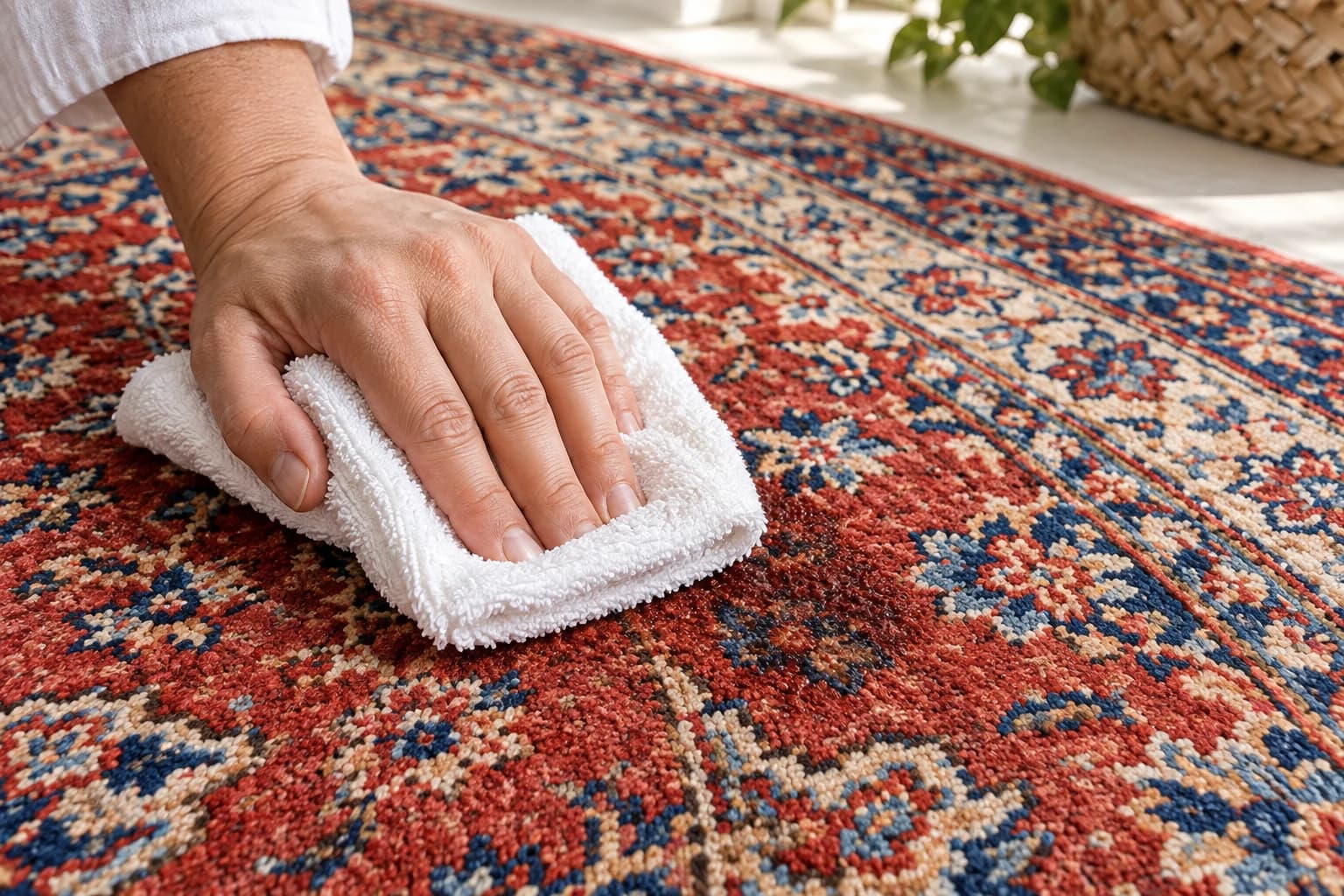
The routine for a hand-knotted rug, in the order you will need it:
Use a light canister vacuum with a suction-only head: nothing heavy-duty or industrial, and no beater bar or rotating brush (if yours has one, switch it off). Run it across the rug from side to side rather than along its length, so the suction neither tugs the pile the way it lies nor drives against it. Keep the fringes out of the nozzle: you can work close to them, but never let them be sucked in, because the pulling damages them over time. Every month or two, turn back half the rug at a time, vacuum the back as well to loosen the grit that works down through the pile, and clean up whatever has collected on the floor underneath.
Frequency: every 1–2 weeks (weekly if you have pets); once a month in a room that is seldom used
Deal with a spill the moment it happens: the faster you react, the less likely it is to stay. This first aid weakens a stain a great deal, but it will not always remove it completely. Whatever remains is a job for a professional wash.
You will need: a bowl, a spoon, foaming dish soap without bleach, two clean white cotton towels and a small brush.
- Scrape the liquid up with the spoon, working against the pile, into the bowl: as much of it as you can lift.
- Cover the whole stained area with dish-soap foam.
- Work the foam into the pile with a white cotton towel, soaking up foam and stain together.
- Dab the spot with the second, dry towel until the pile feels dry. Dab; never rub.
- Feel which way the pile lies, then brush it back down in that direction.
- Slip a bowl under the rug, beneath the spot, so air reaches the back and it dries faster.
Between professional washes you can freshen the surface yourself. This is a light clean, not a wash: it lifts some of the dirt and lets you wait longer before the next professional wash, without ever soaking the rug.
- Vacuum the front side to side, sparing the fringes, then the back (step 1).
- Dilute some bleach-free foaming dish soap in a bowl of water, so the mixture is mild.
- Dip a clean white cotton towel in it and wipe the pile gently in the direction it lies. Going against the pile drives the water deep into it, and you only want to clean the surface. Dip the towel again whenever it runs dry.
- Work in sections, one at a time: a rug of 4 × 6 ft (120 × 180 cm) takes about four. Change to a clean towel as soon as yours looks dirty, so you don’t spread the dirt around.
On a hand-knotted rug the fringe is not a trim: it is made of the ends of the warp threads that hold the whole rug together, so if it unravels, the rug starts to come apart. Keep it out of the vacuum, since a rotating brush grabs and tears the threads, and sweep it gently with a broom instead. Now and then, comb it with a soft, wide-tooth comb so it doesn’t tangle or mat.
Washing dirty fringes:
- Slide a wooden stick or a flat board under the fringe.
- Dip a soft brush in the same mild soap mixture and brush the fringe lightly, from the rug out towards the tips, until it is soaked through.
- Work along the whole end, then leave the fringe lying on the stick until it is completely dry.
- Do the other end with a second stick, or move the first one across once the first end is dry.
Cleaned this way, the pile is only ever damp and dries within 30 to 60 minutes. Feel it before anyone walks on the rug: it should be completely dry to the touch. After a spill, the bowl under the rug lets air reach the back. If the whole rug gets wet, from a leak or a flood, lay it flat somewhere well ventilated straight away.
Important: don’t put a rug back into use, or into storage, until it is completely dry. Moisture left in the pile weakens the fibers over time and attracts moths.
A full wash is the one step to leave to a professional: a specialist rug washer, not an ordinary dry cleaner. Book one when the rug needs it, which for most rugs means every few years; after a stain that first aid could not lift; and before the rug goes into storage for a year or more. Our in-house team washes handmade and antique rugs with fiber-safe products, controlled drying and hand finishing.
How often: about every 5 years in ordinary use; every 3–4 years in a hallway or entrance; as rarely as every 10 years in a quiet room where the rug stays clean
Our care routine for hand-knotted rugs follows the advice published by Catalina Rug, a Californian dealer in hand-knotted Persian rugs.
Did this help? You may also want to know:
Need Professional Rug Cleaning?
While this guide provides comprehensive DIY cleaning instructions, some situations are best left to specialists. For valuable, antique, or severely damaged rugs, our own professional carpet and rug cleaning service in the Marbella area is on hand to ensure your precious items receive the expert care they deserve.