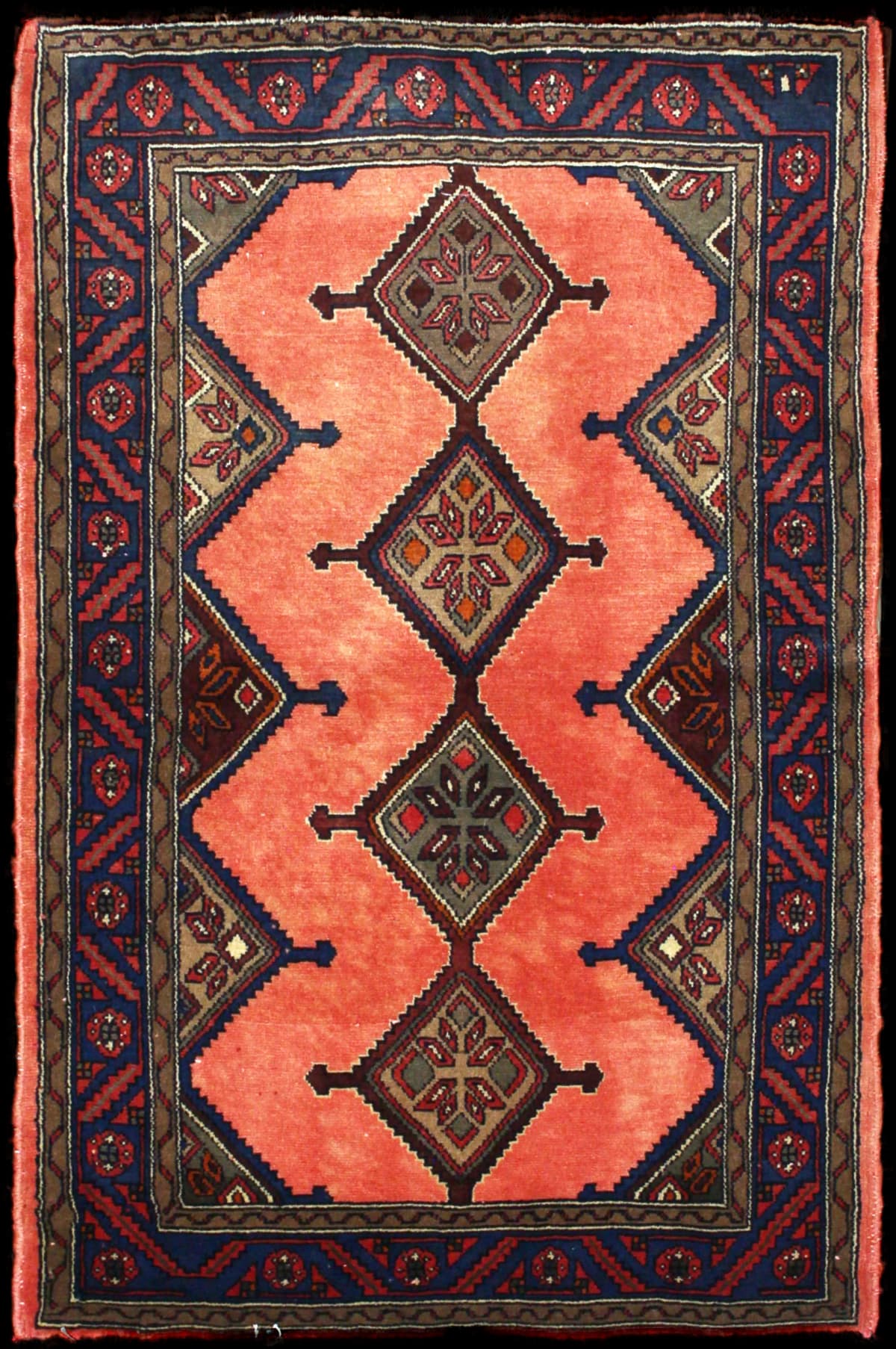
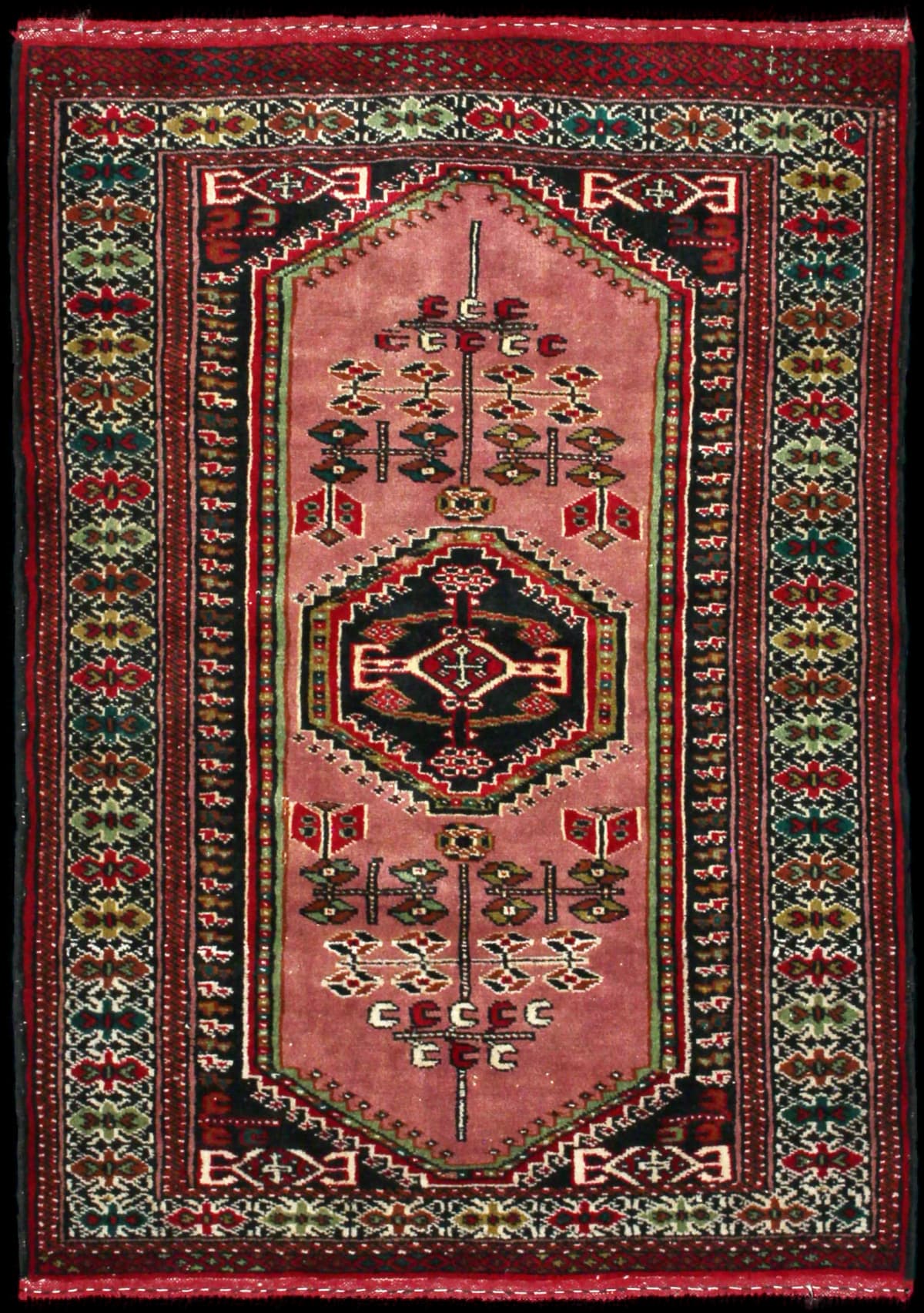
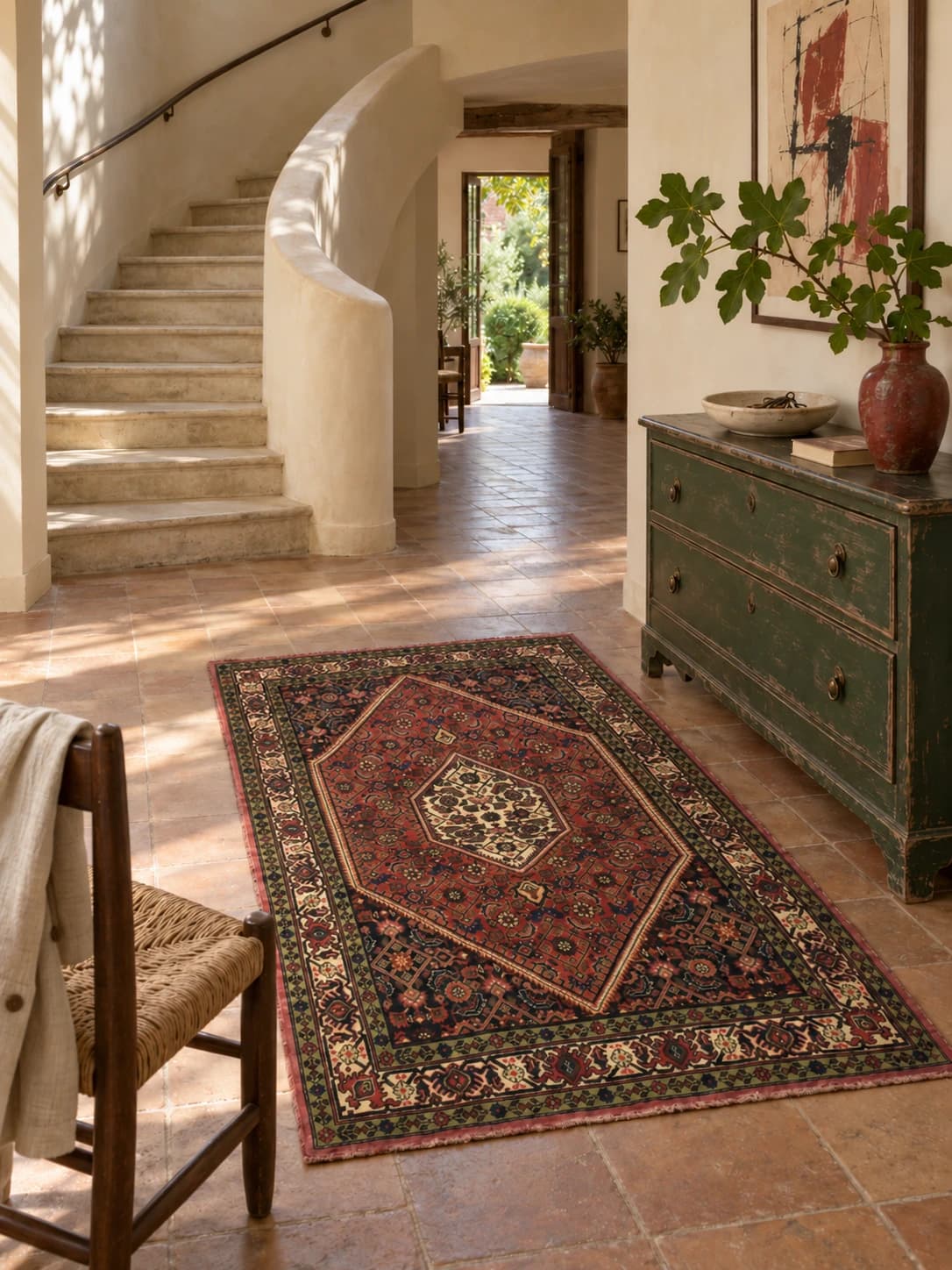
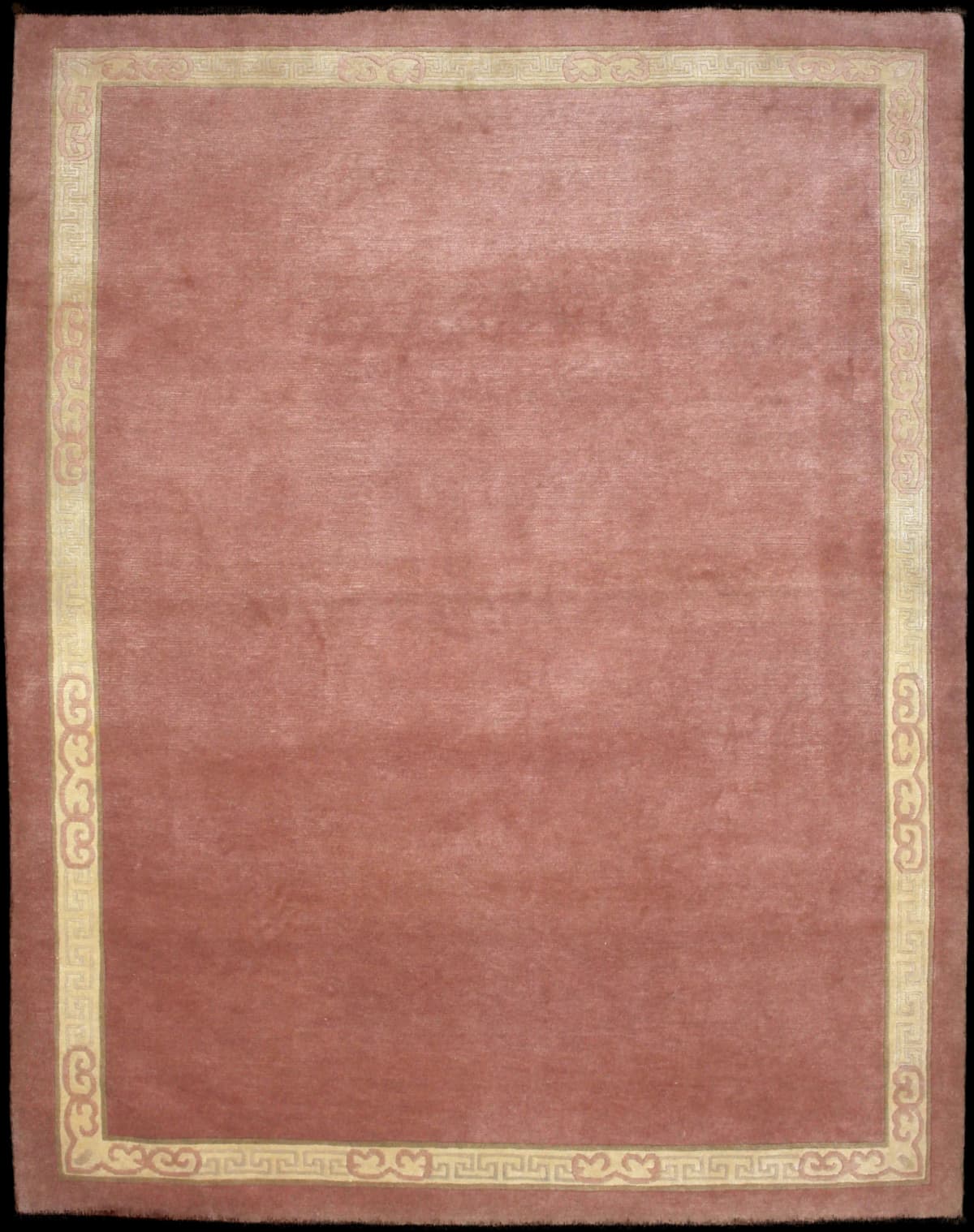
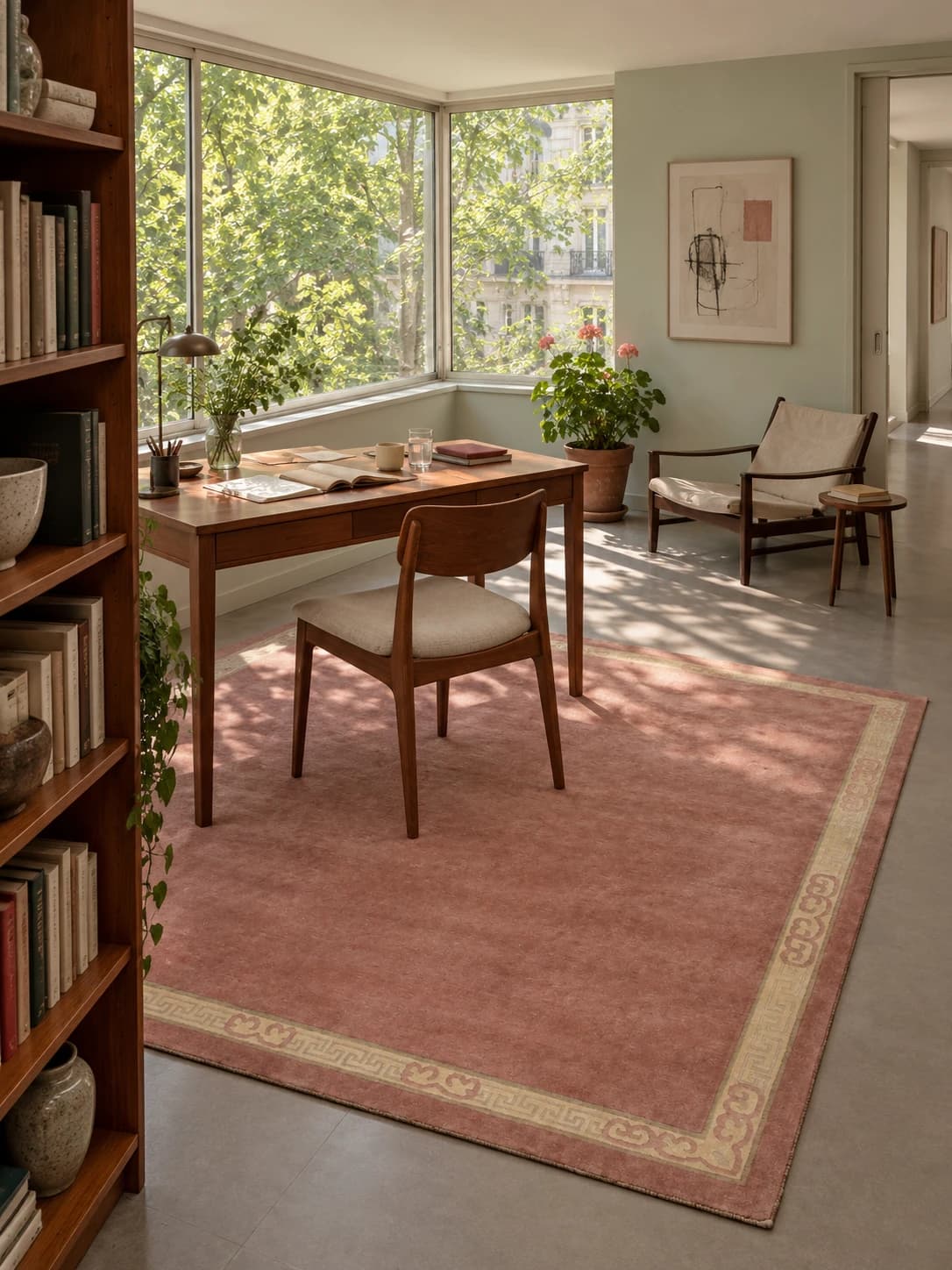
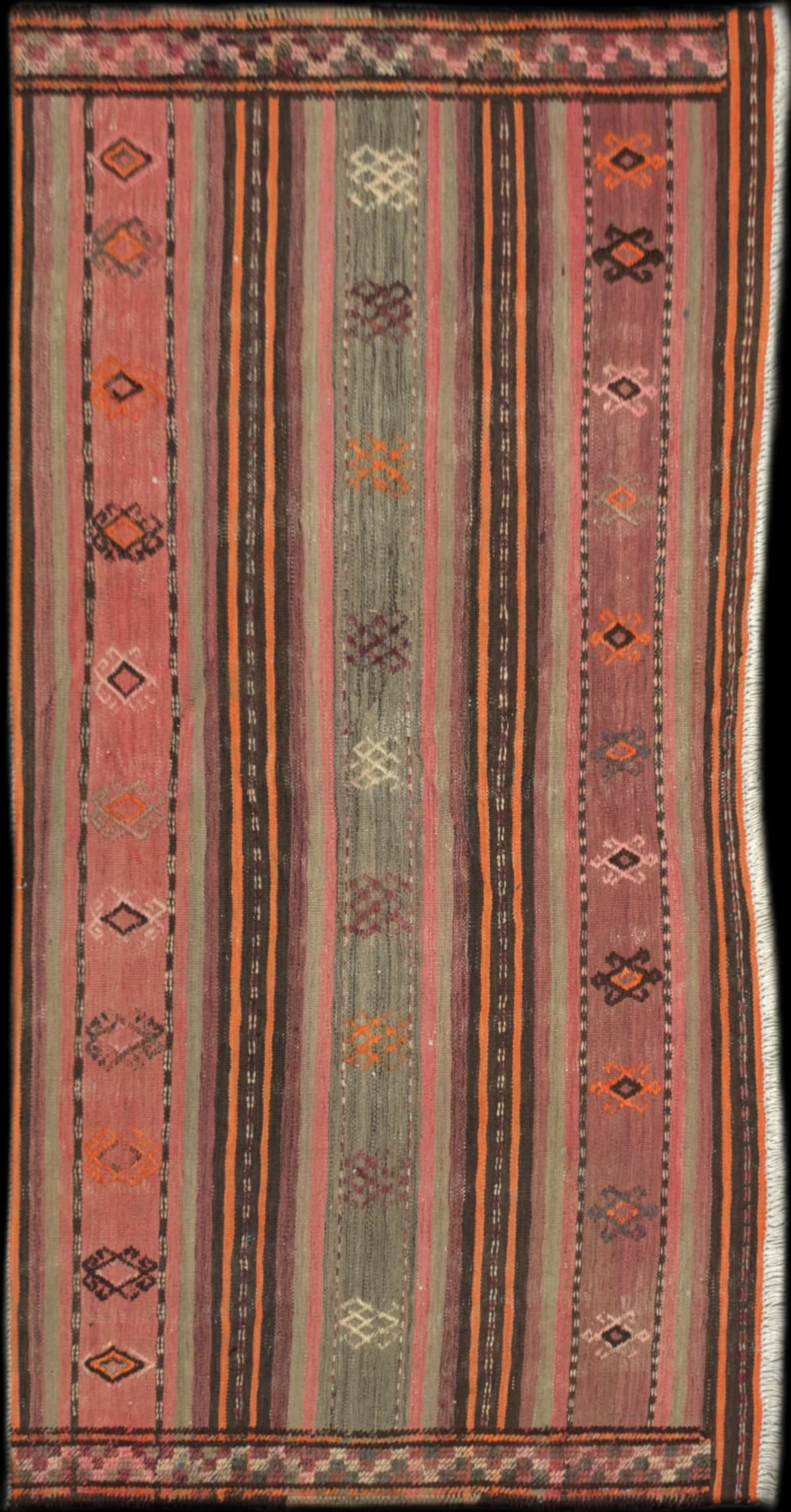
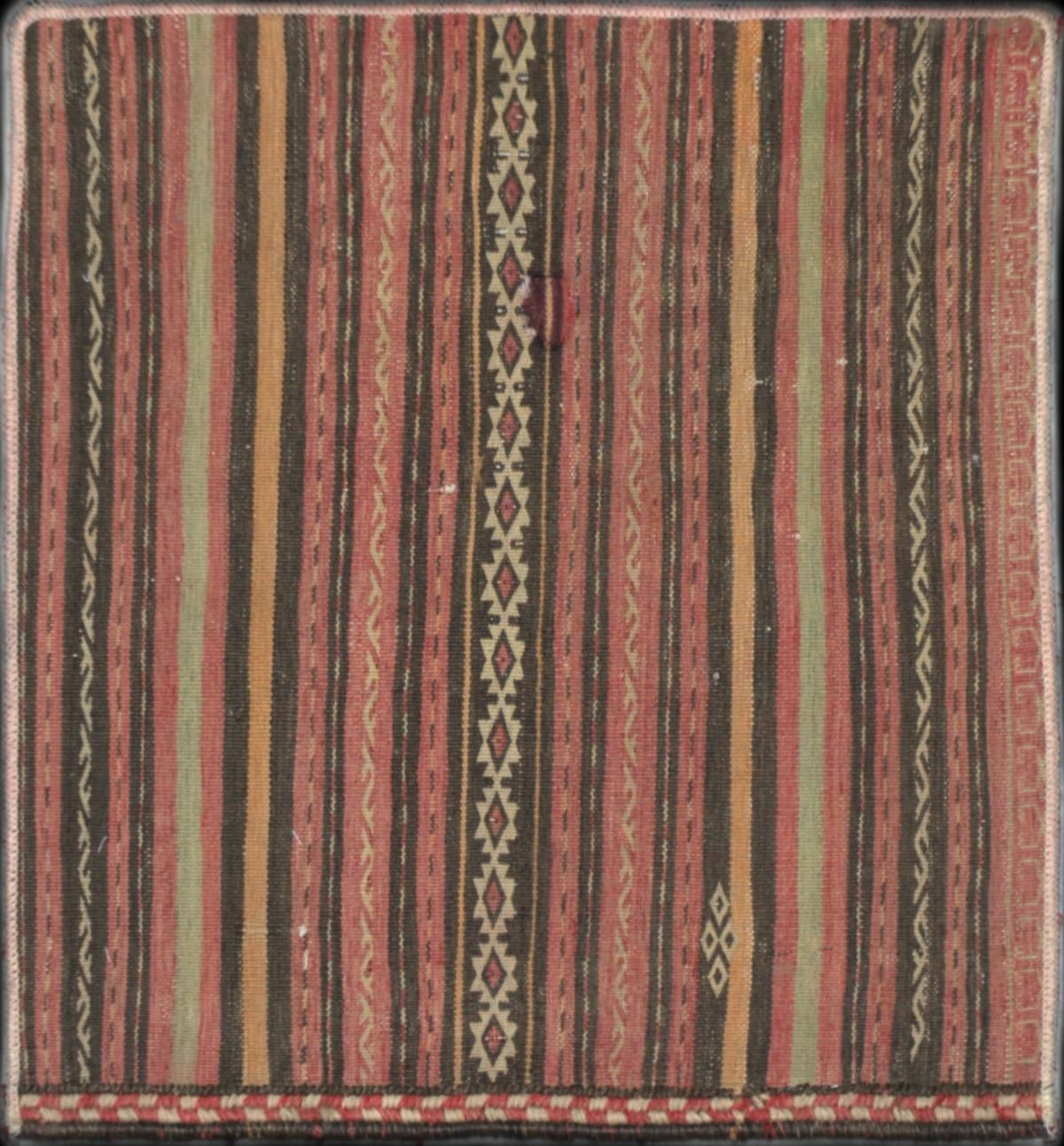
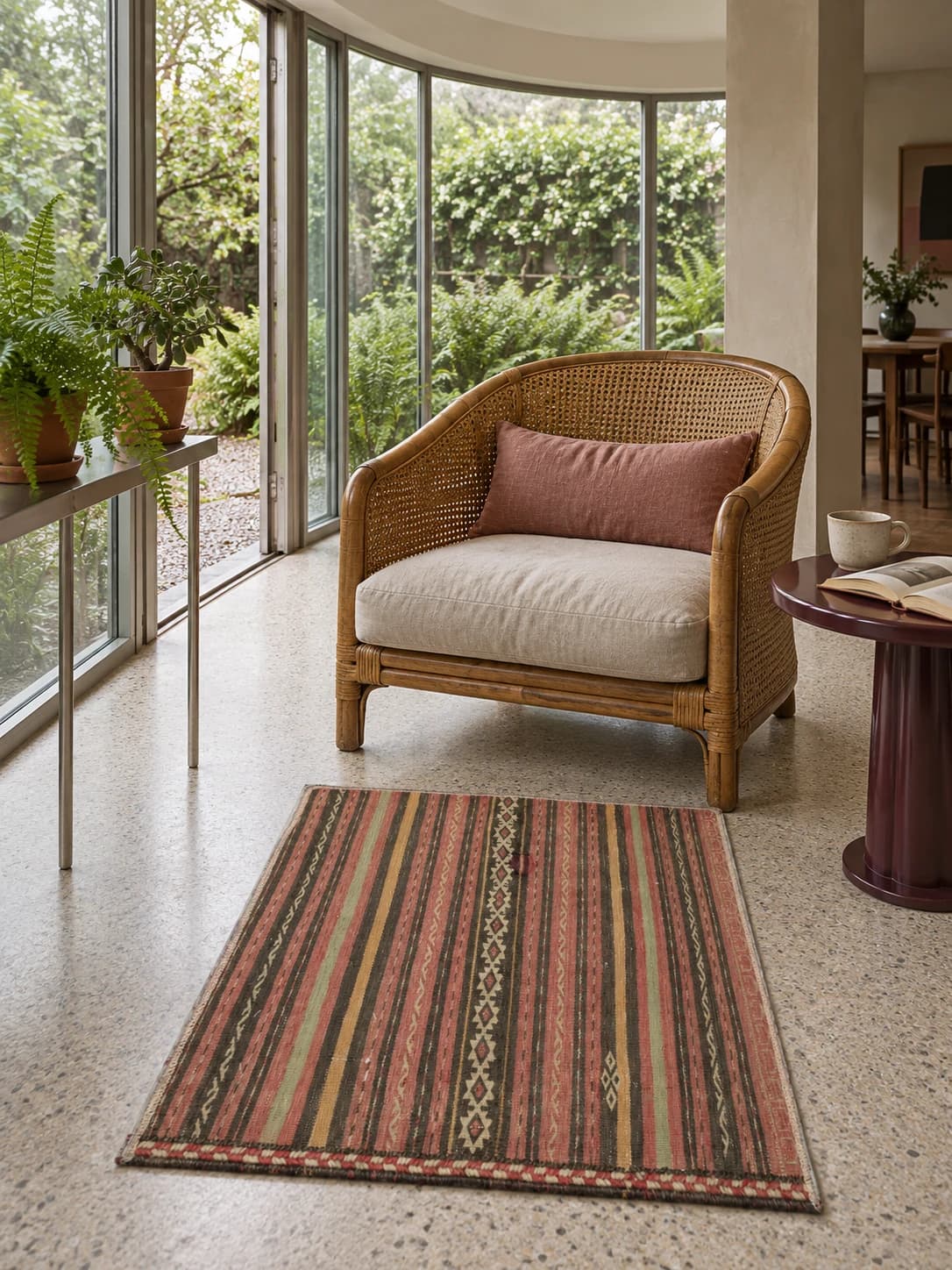
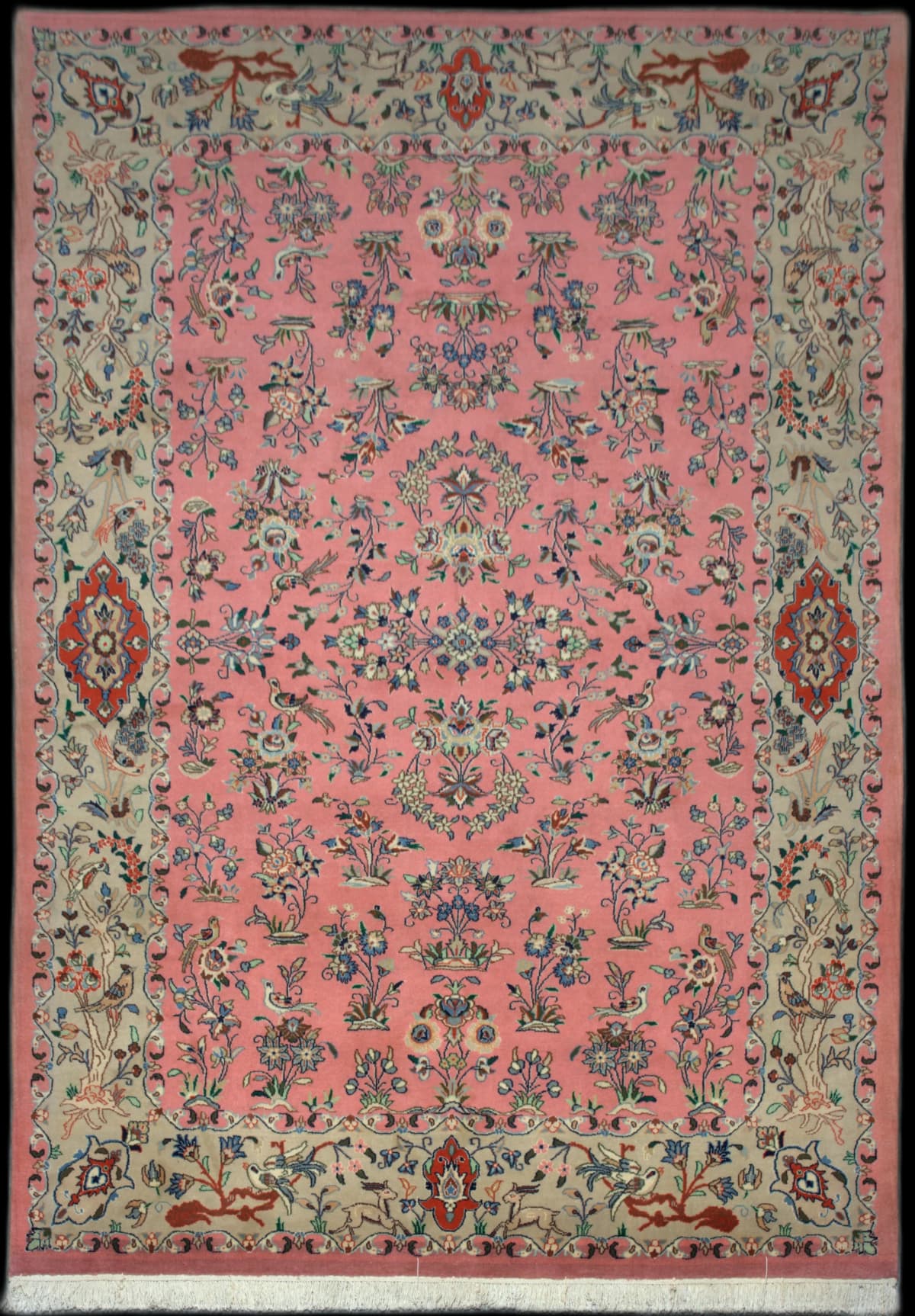
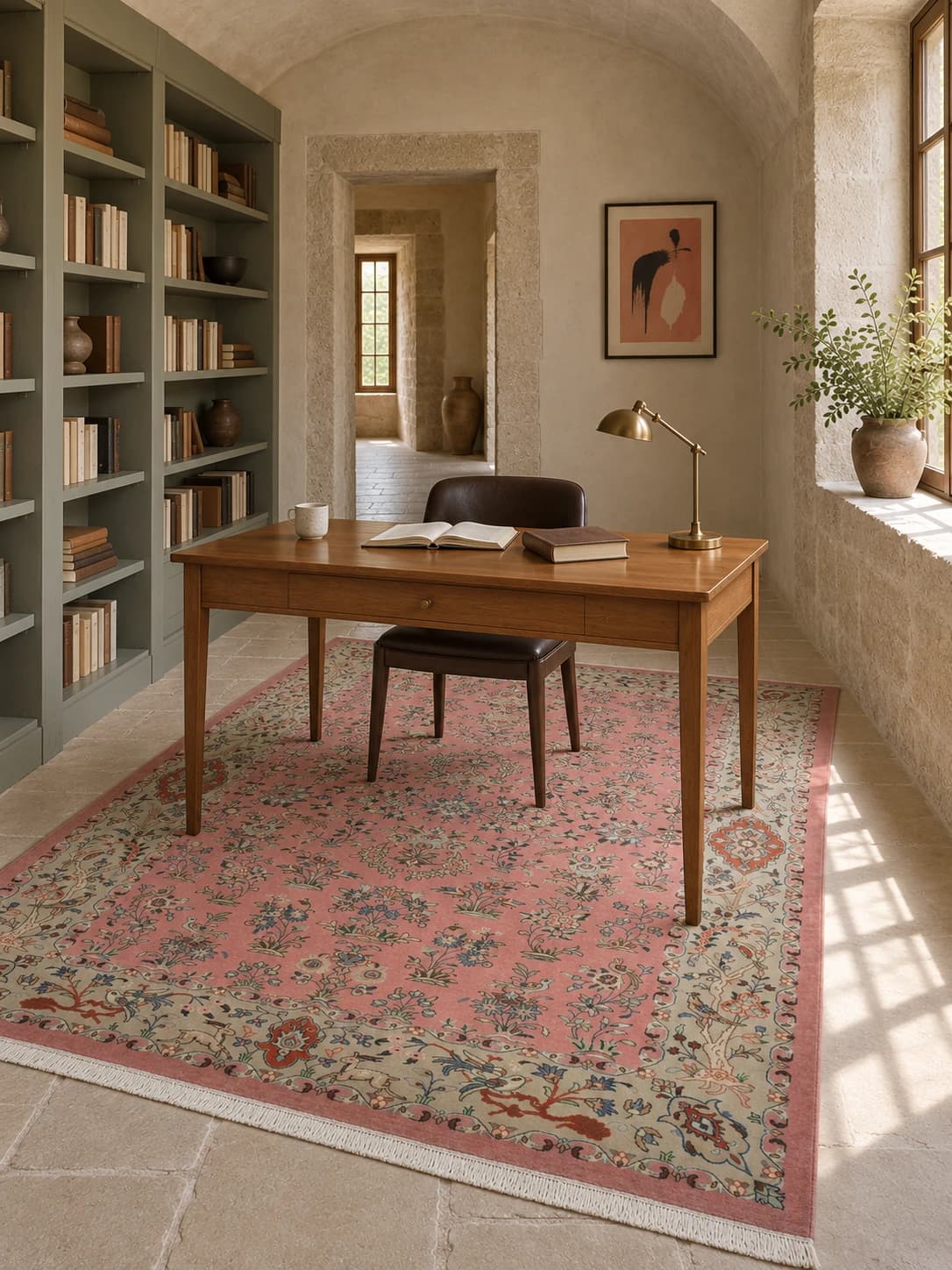
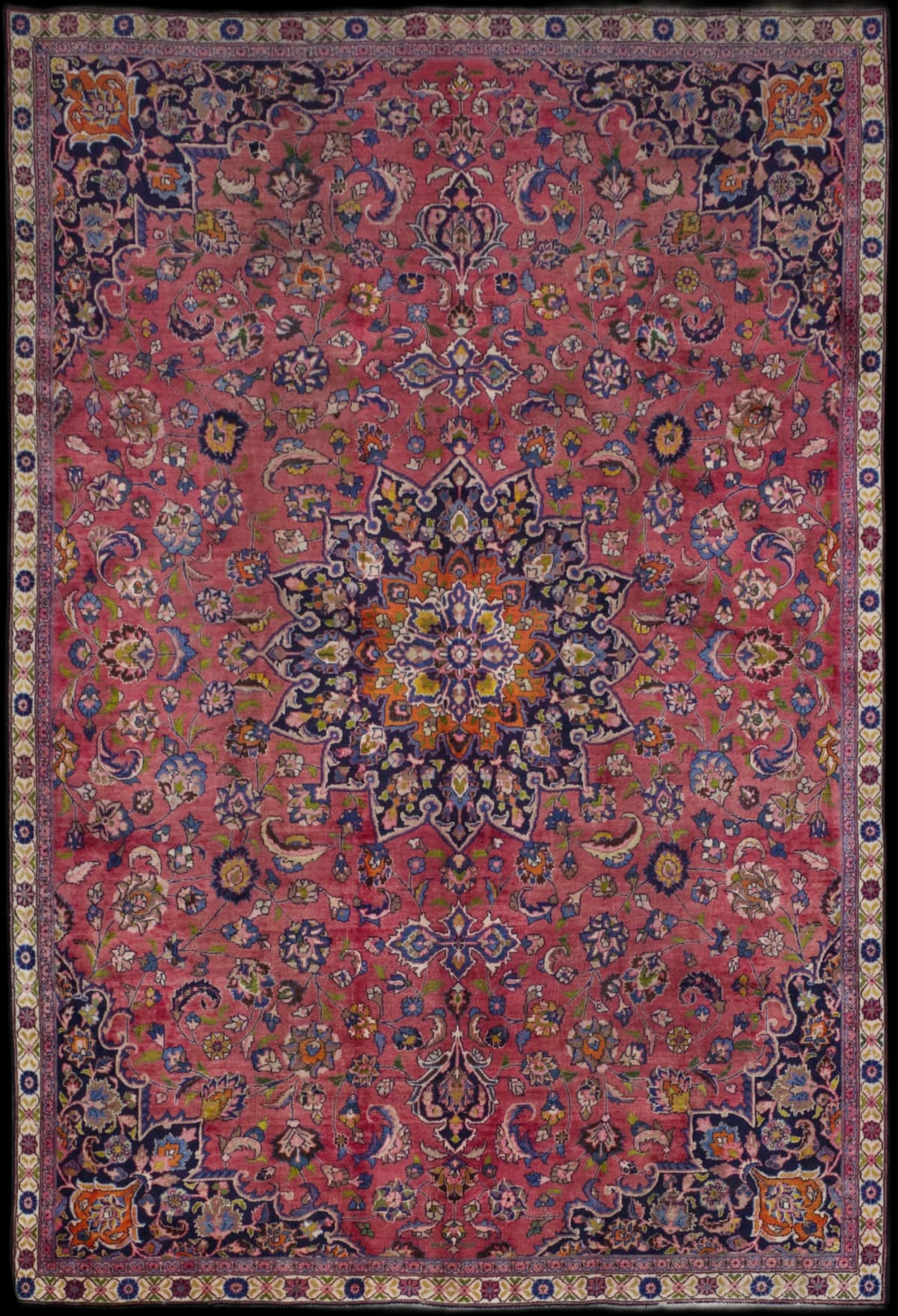
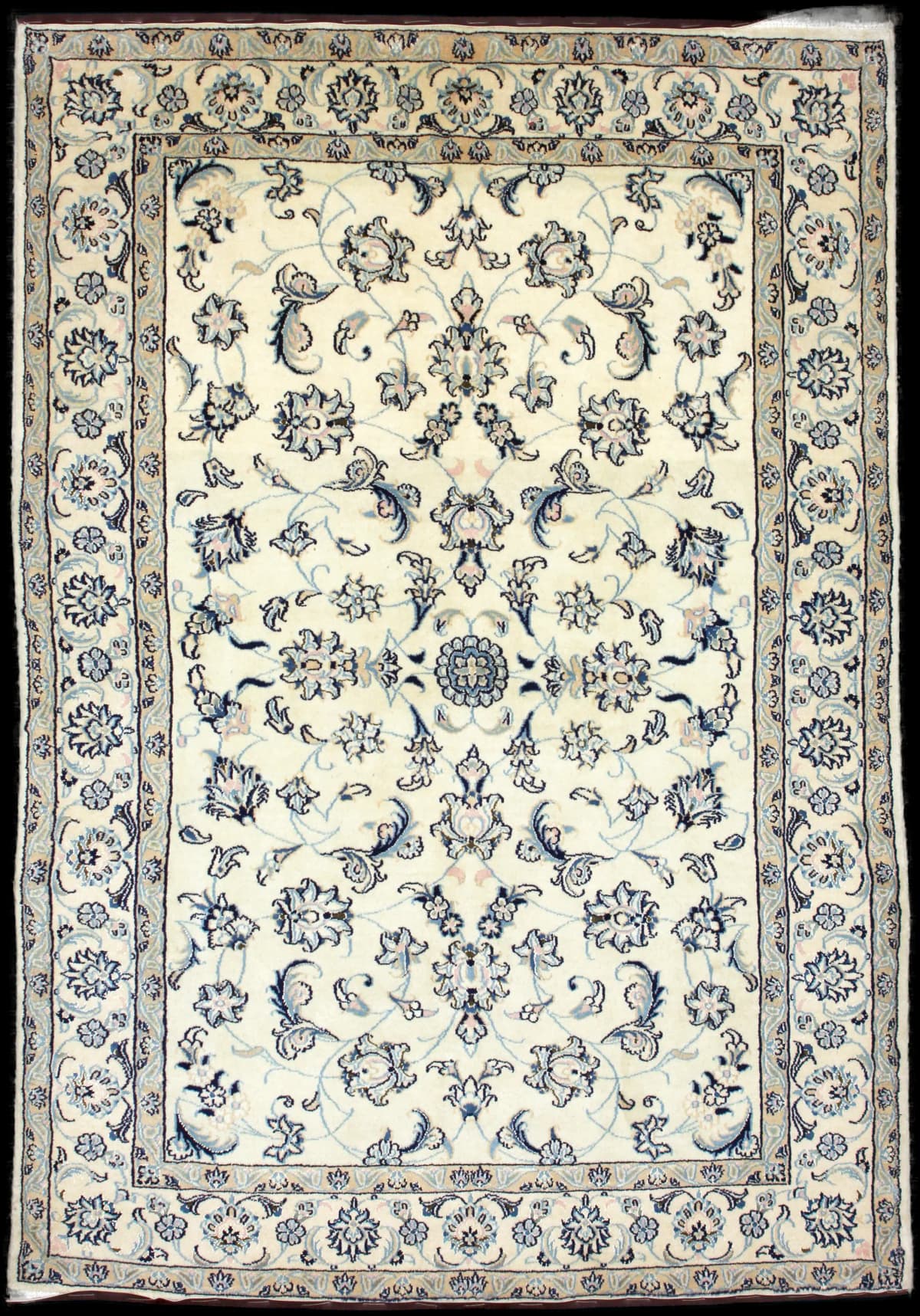
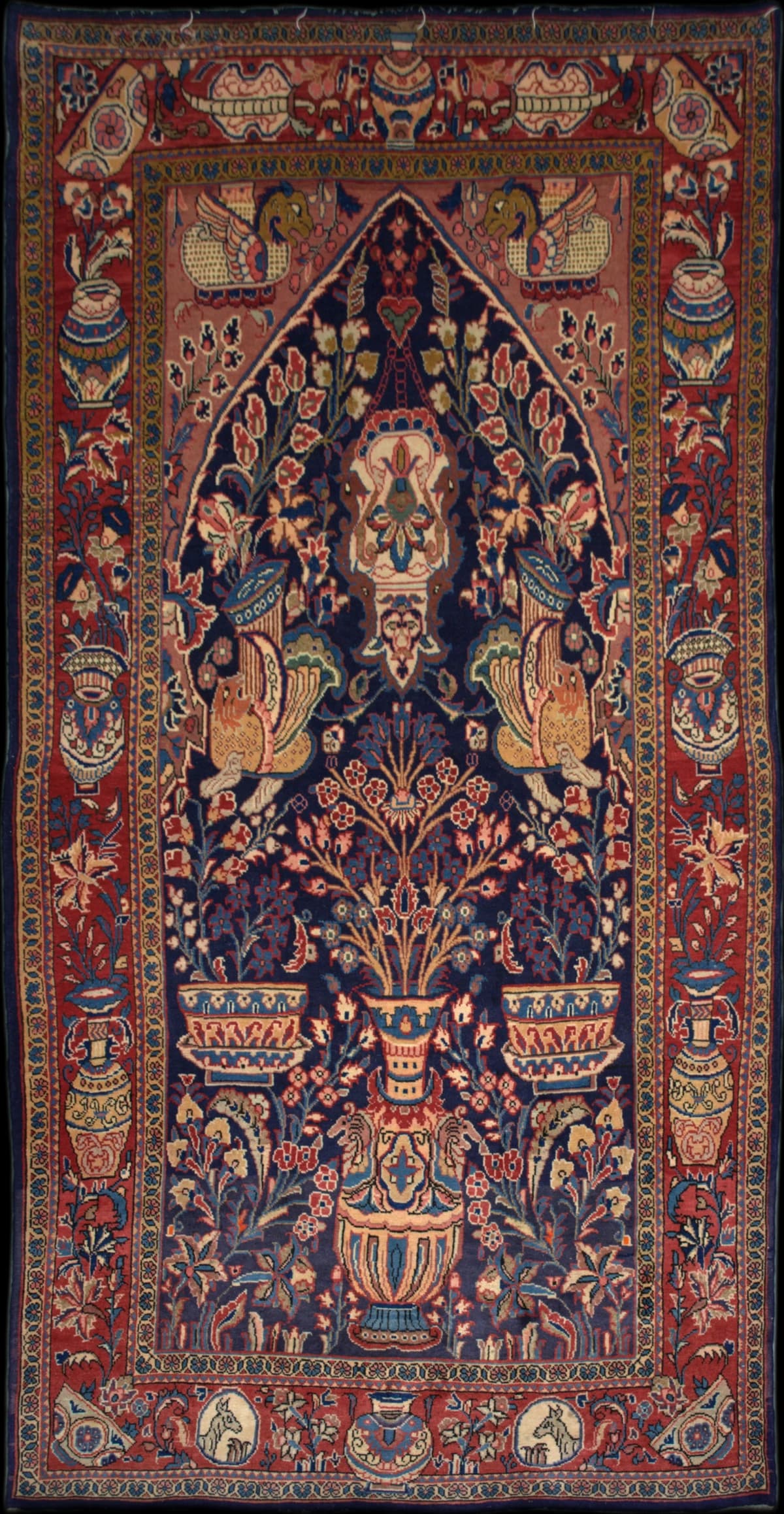
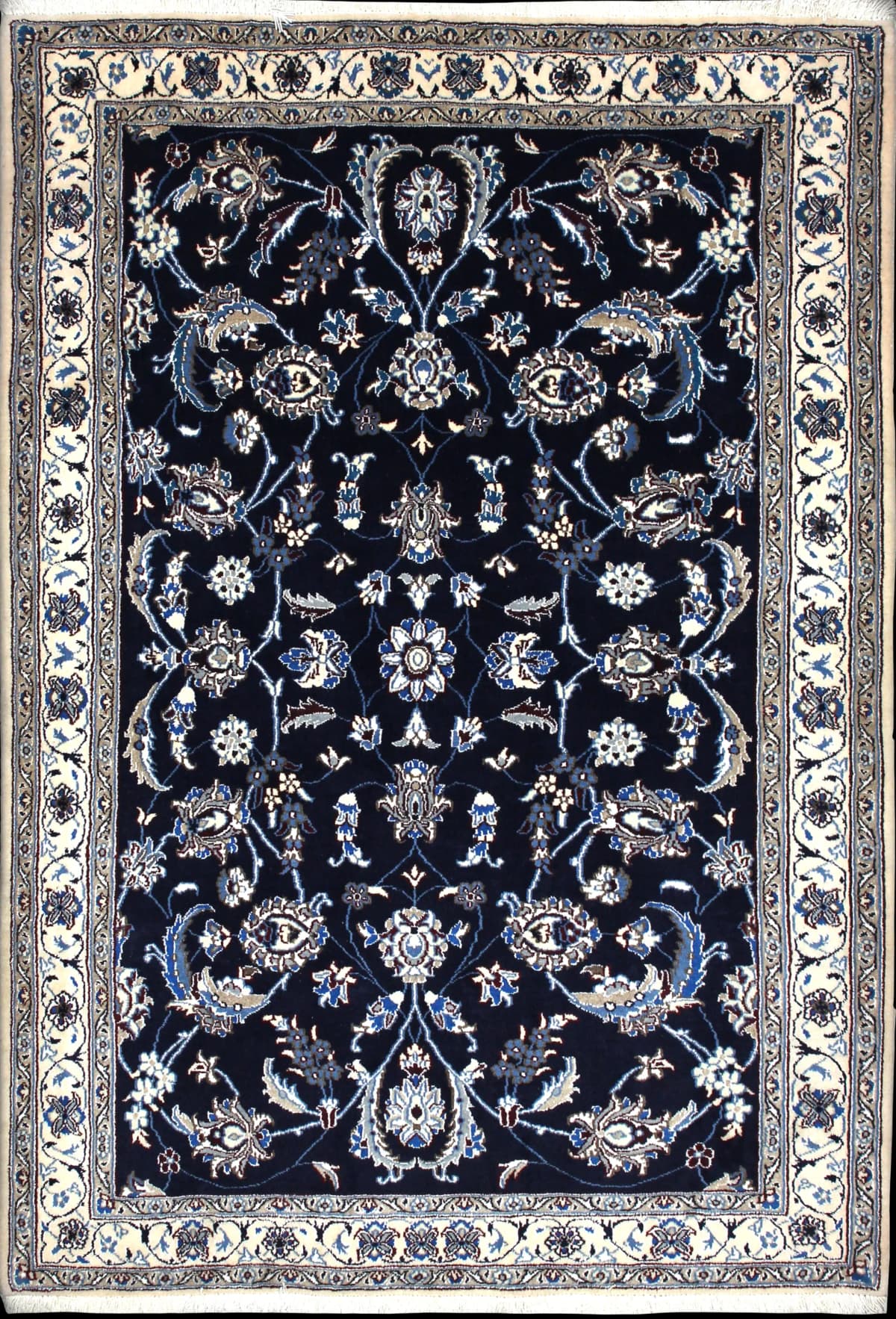
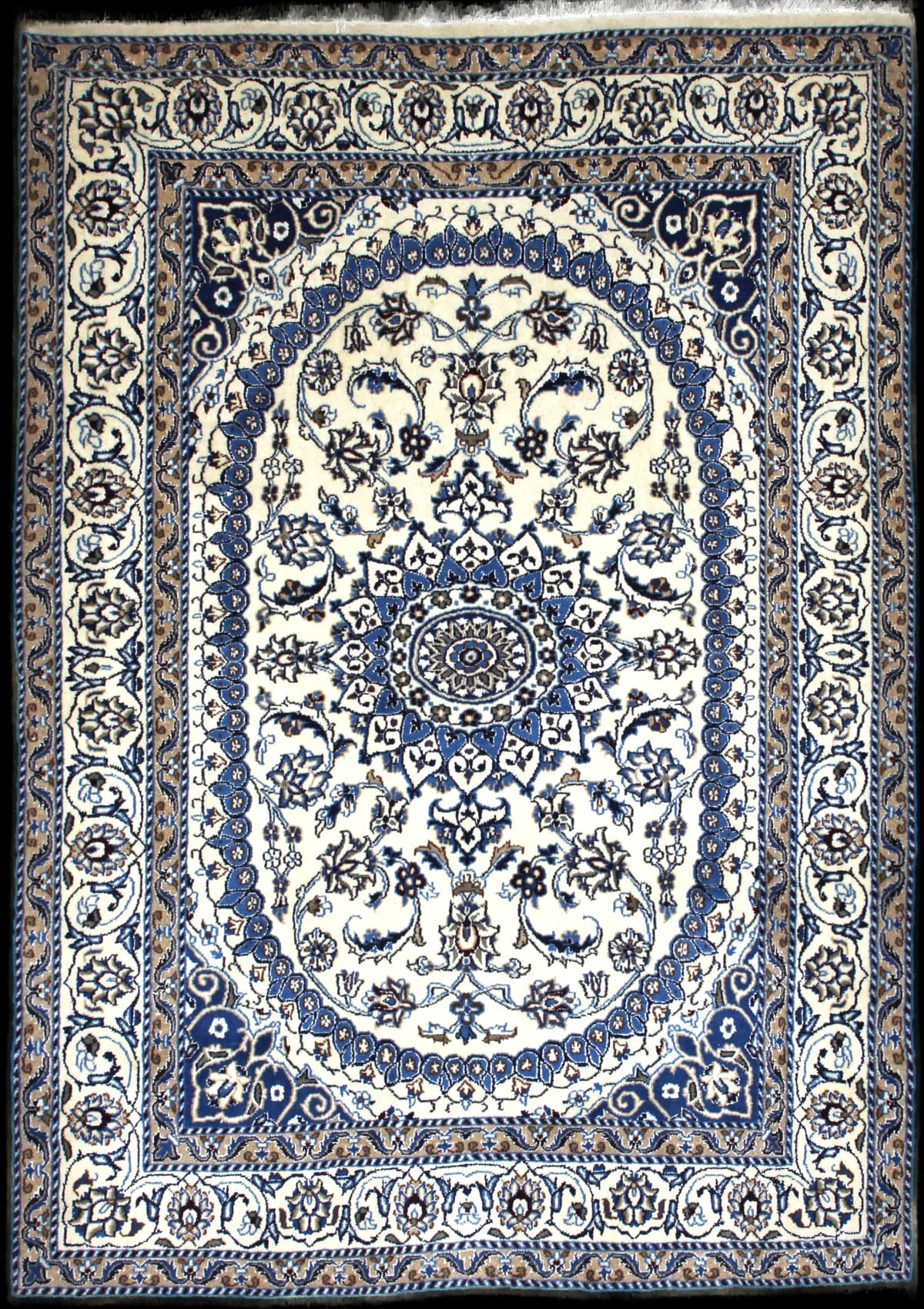
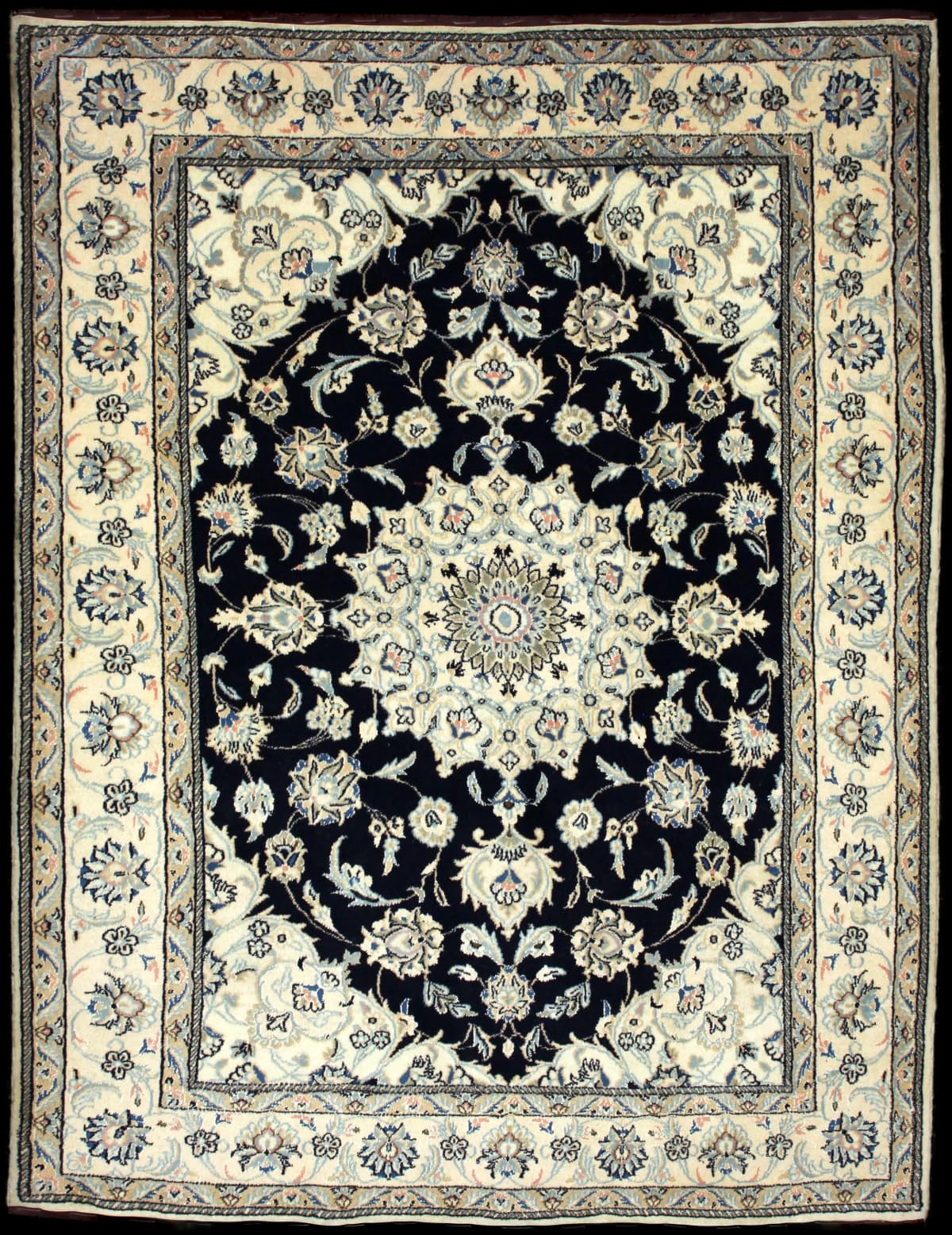
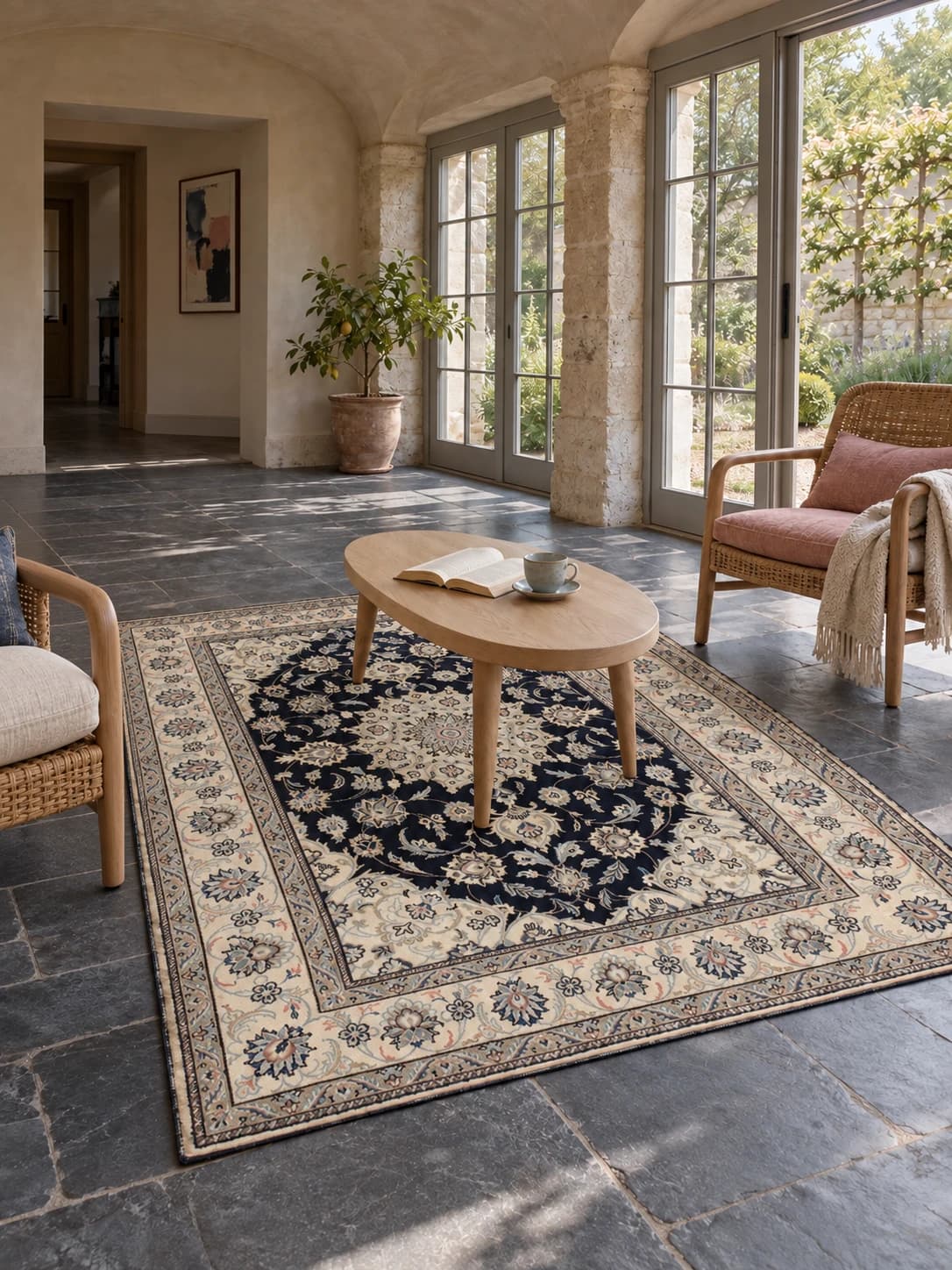
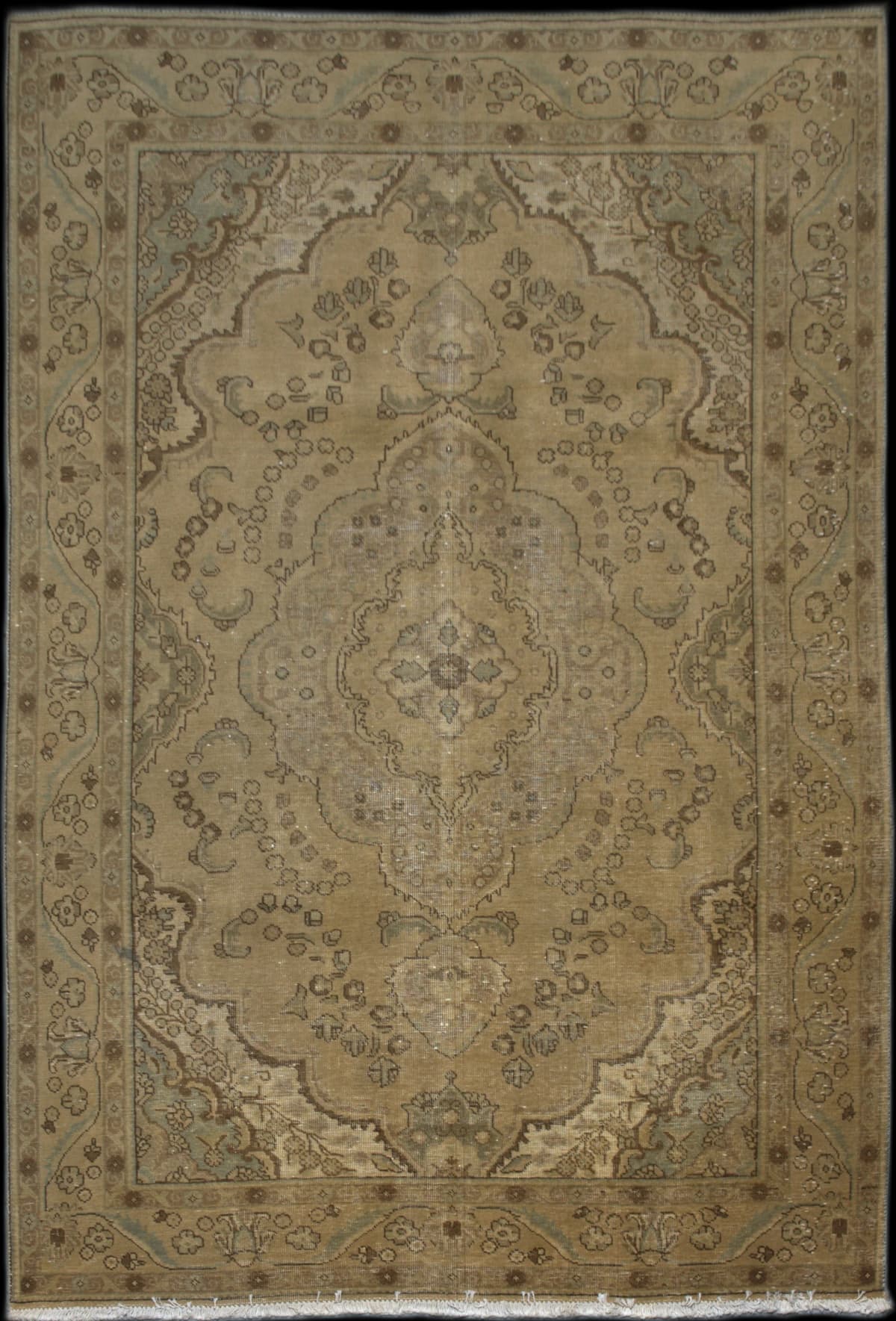
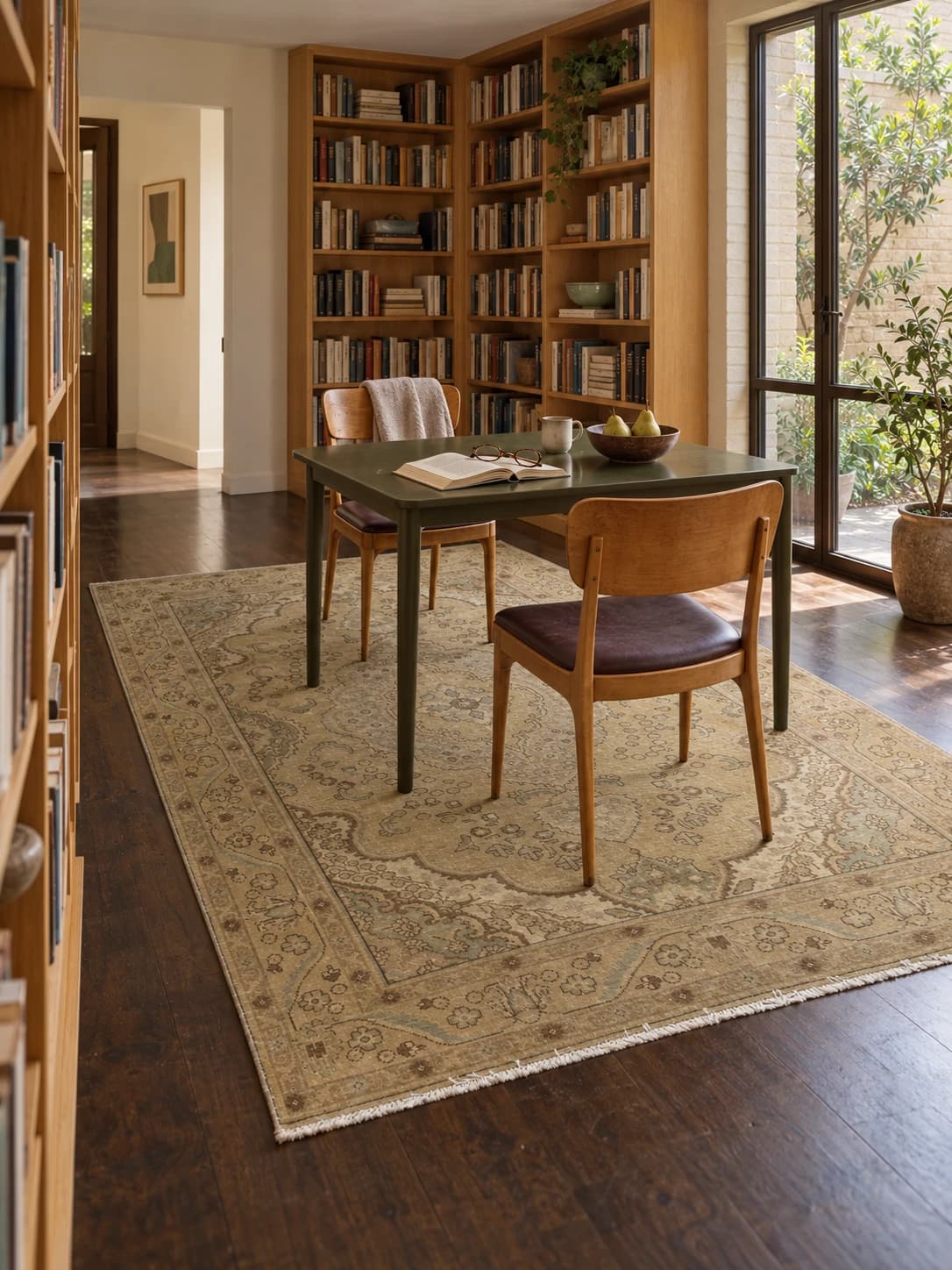
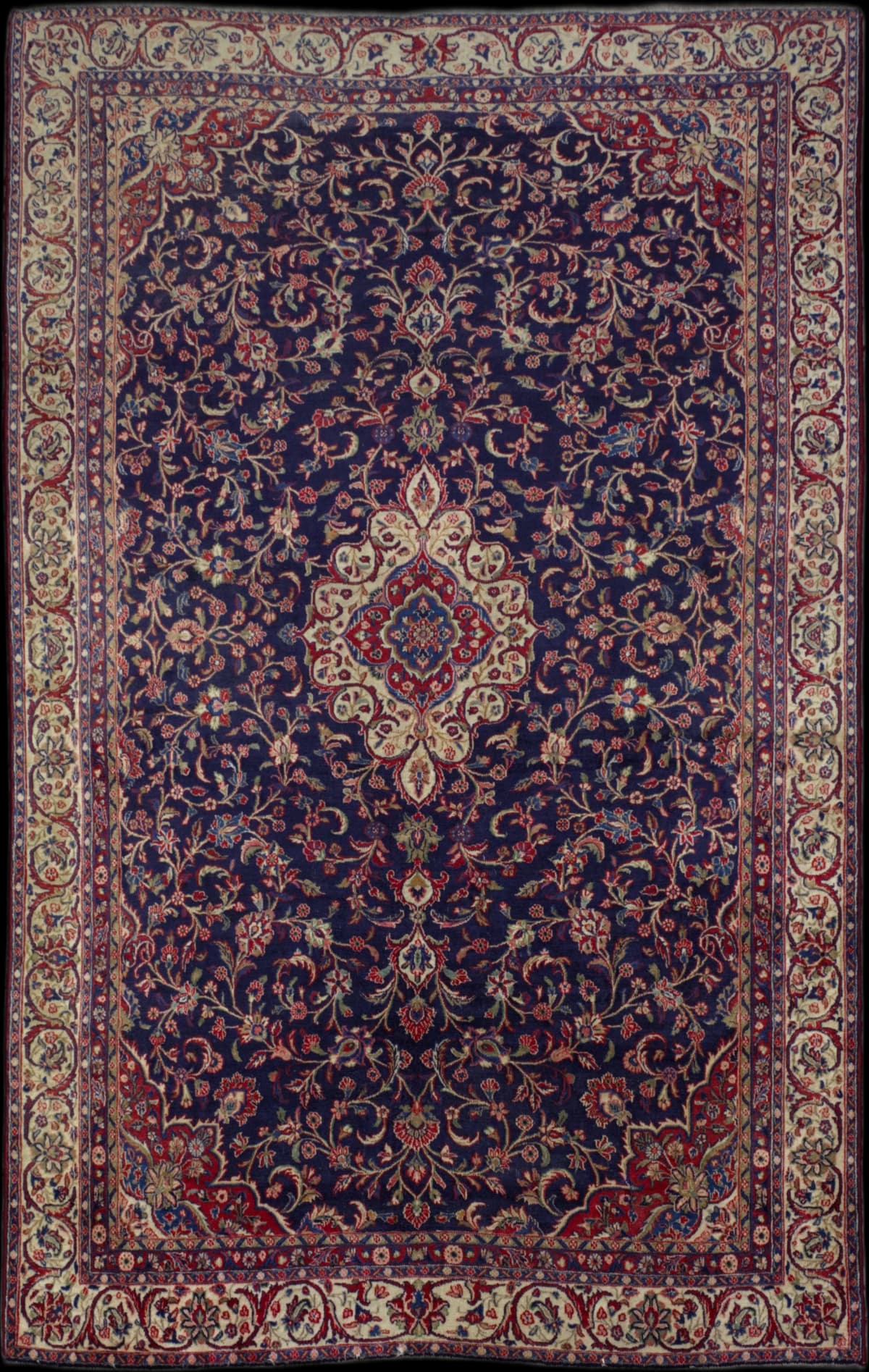
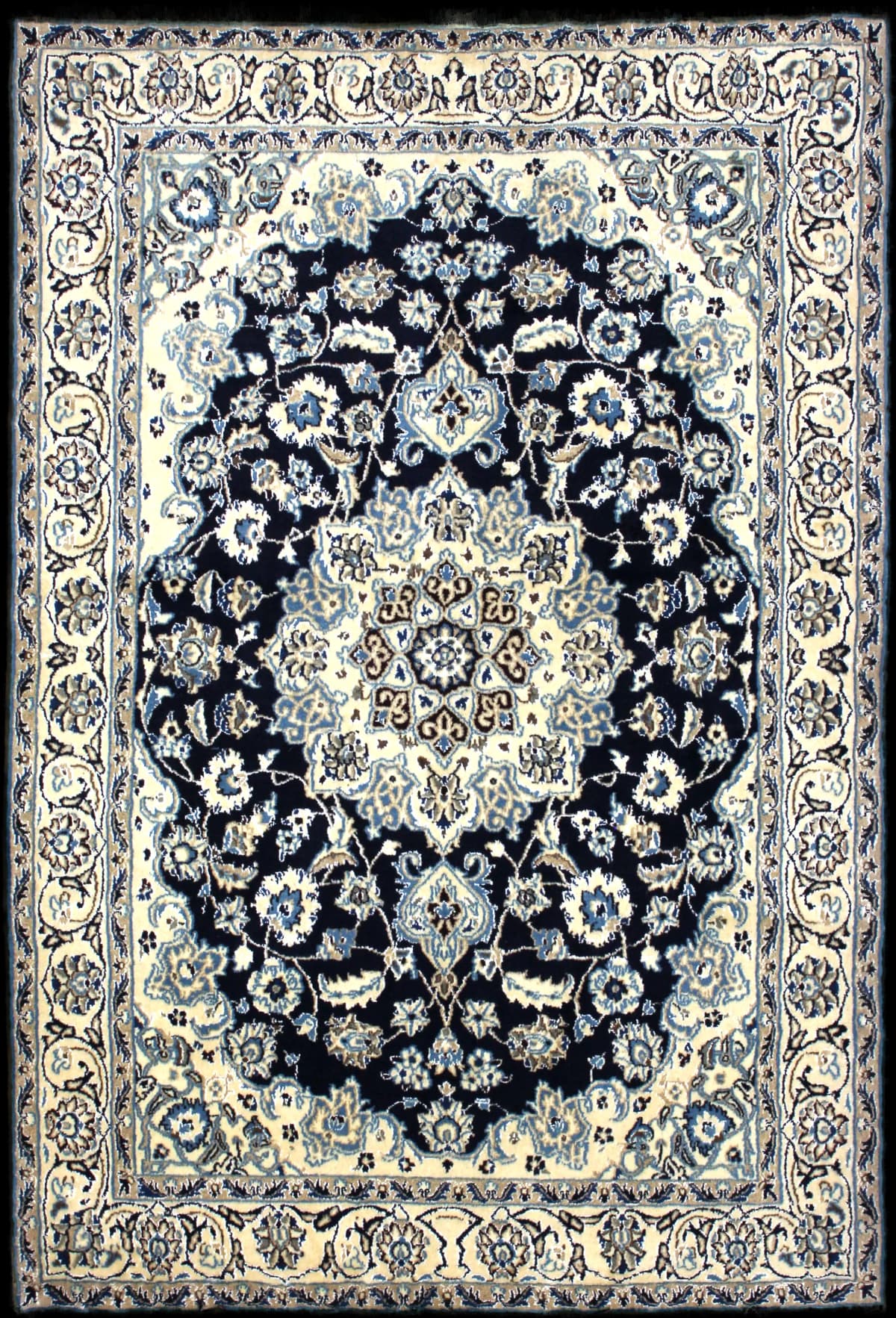
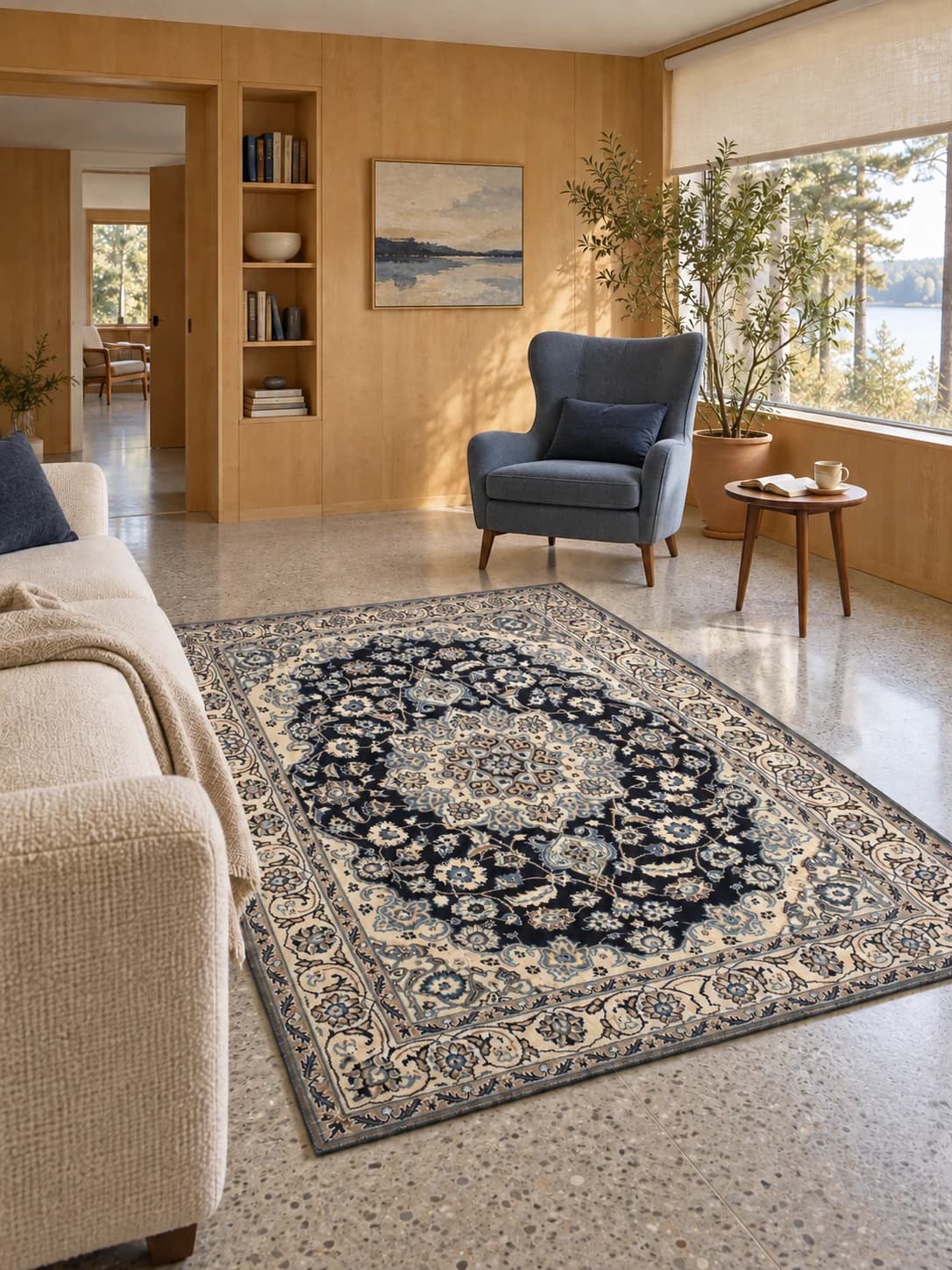
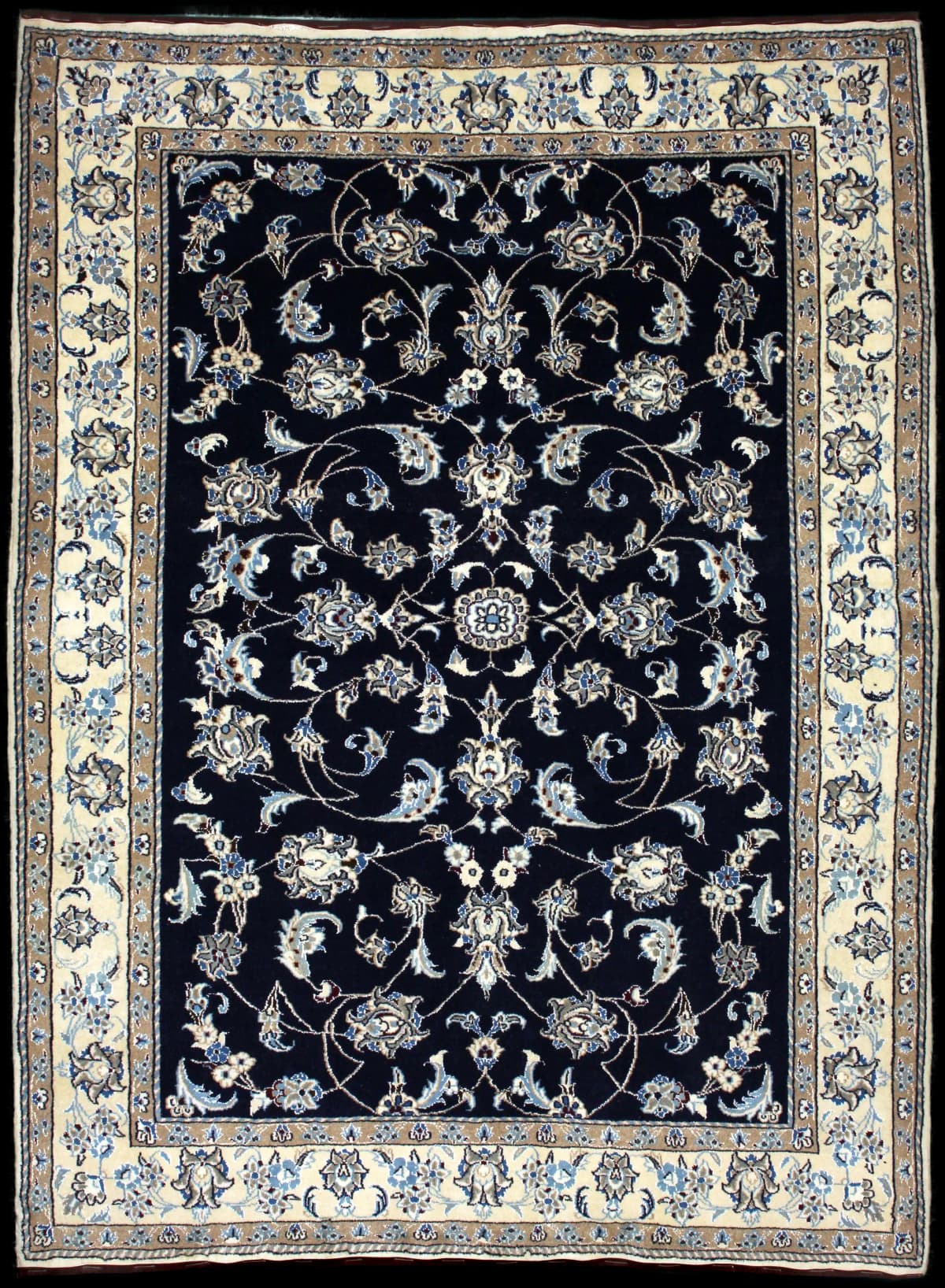
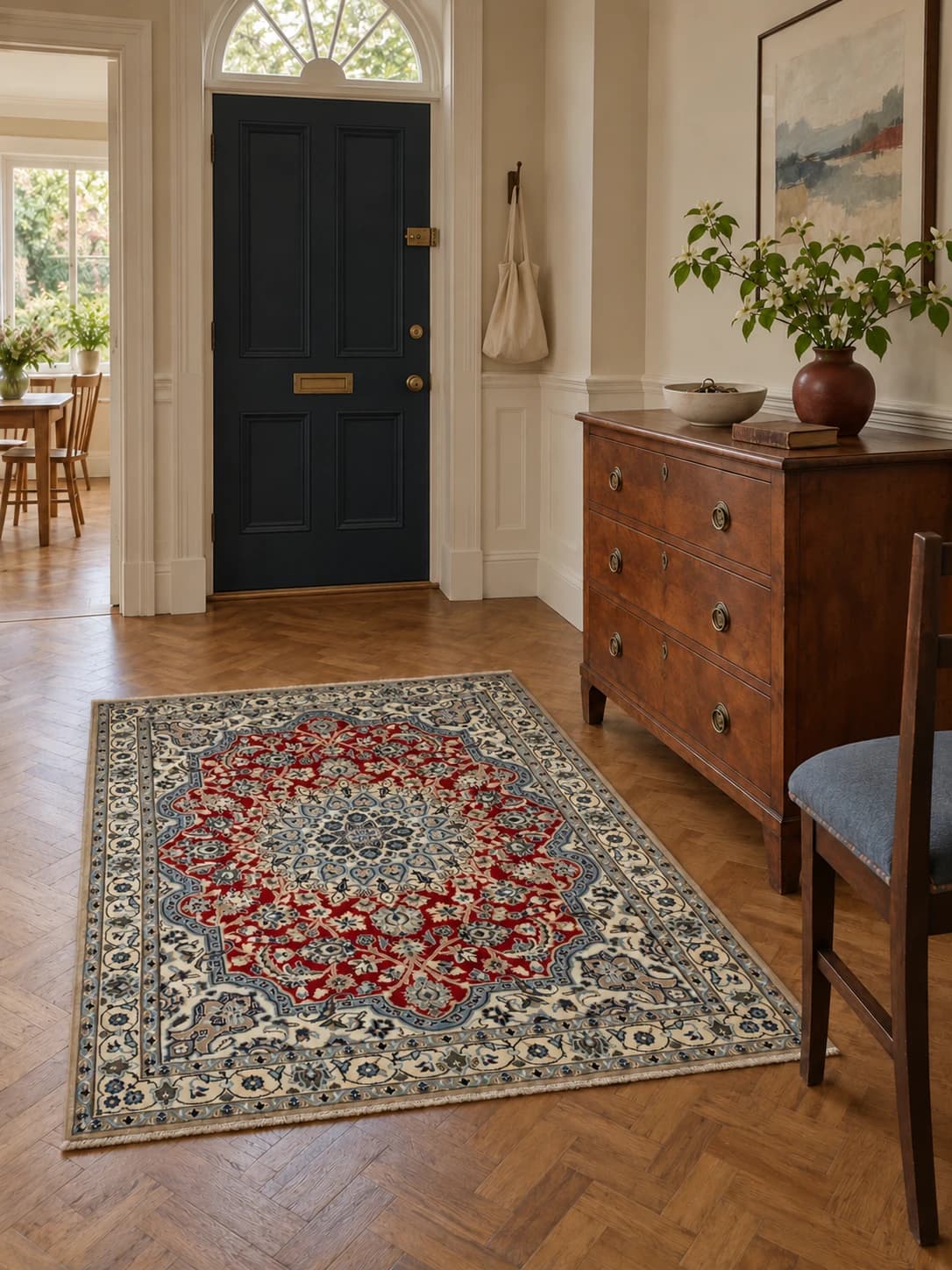
From the region ofساروقSarouk
What makes this piece special
Hover over or tap a feature to read moreTwo knots per tuft — a denser, more durable pile that holds its pattern for decades.
Up close
Origin: Sarouk
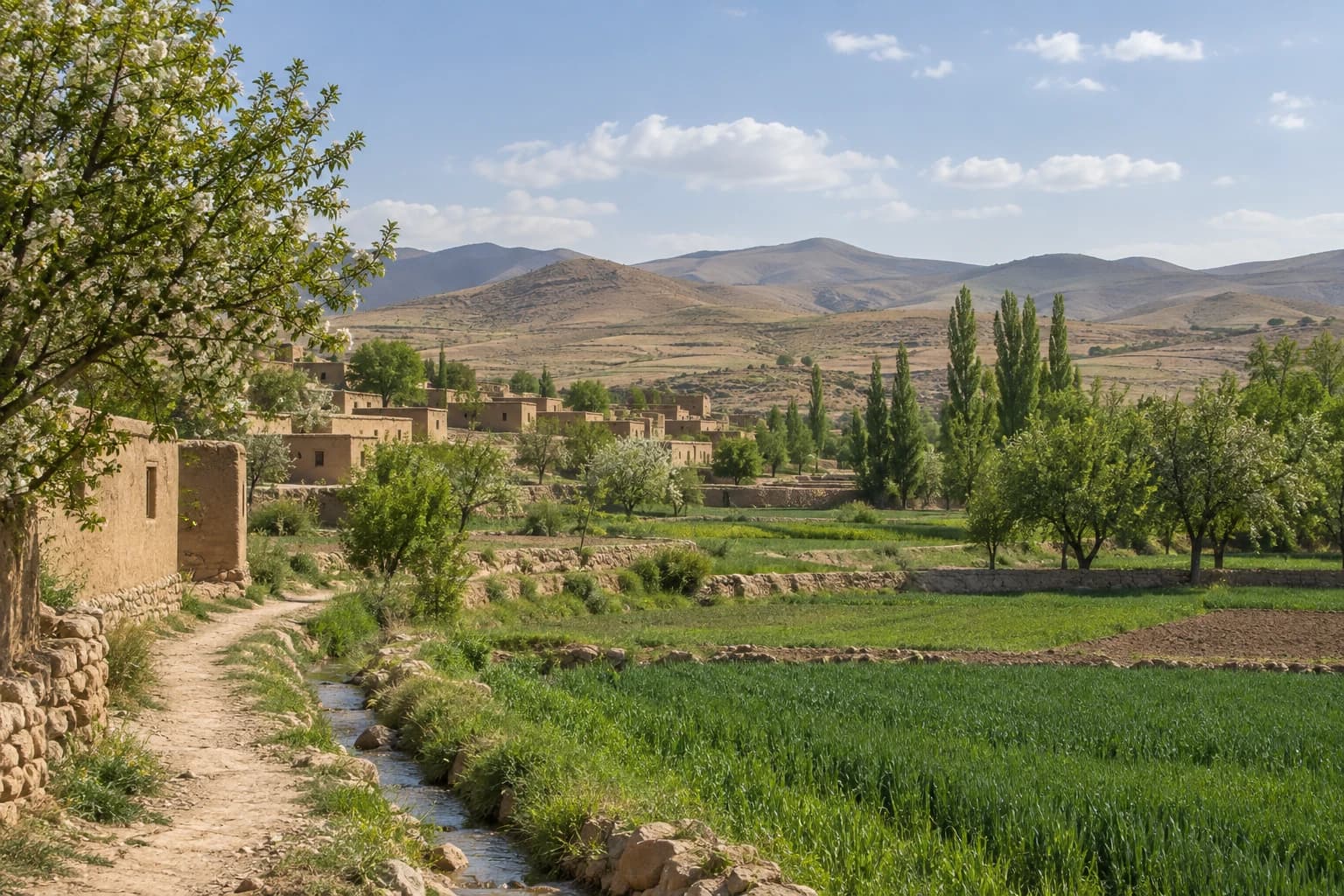
SaroukSee in the carpet dictionary is a village in the Farahan district of Markazi Province in central Iran, about 50 km north of the provincial capital, ArakSee in the carpet dictionary. Arak itself was called SultanabadSee in the carpet dictionary until the 1930s, and the old name still sits on rugs sold today. Sarouk, Farahan, Sultanabad and Mahal are all names from one stretch of the Arak plain rather than four unrelated places. In the trade the village name reaches well beyond the village itself: it describes the workshop style of the whole district, woven on town looms by trained weavers rather than by nomads. You will also meet the spellings “Sarough”, “Saruk” and “Saruq”, which all name the same weave.
Weaving here became widely known during the 19th century, when the wider rug trade noticed that these workshops were turning out unusually intricate drawing, rich colour and a standard of finish that held steady from one piece to the next. That steadiness came out of how the work was organised: a drawn cartoon rather than a pattern carried in memory, several weavers at one loomSee in the carpet dictionary, and a master weaver keeping the line honest. The result is predictable in a way that village and tribal weaving rarely is, and more than any single motif it is what built the reputation of the name.
From the middle of the 19th century onwards the rugs went to Europe and then, in quantity, to the United States. Designs and colours were deliberately adjusted to what those markets wanted, and the adjustment was thorough enough to produce a named type of its own: the American SaroukSee in the carpet dictionary, woven mainly in the 1920s and 1930s and hugely popular there. The trade also calls that group Mohajeran Sarouk, after another village of the Arak district, though the Mohajeran name is often kept for the finest weaving of the period. A related village type, Lilihan, was woven in part by Armenian weavers and carries a pattern of its own that American buyers took to.
Names shifted over the same period. Nineteenth-century pieces from this district were commonly sold as Farahan, after the district, and the Sarouk name took over during the 20th century, so older rugs are still catalogued either way. Quality did not run smoothly throughout. A dip in standards around the middle of the 20th century is well remembered, and it was the master weavers in the workshops themselves who noticed and pulled the level back up fairly quickly. A state-owned body also ran inspected workshops in the weaving cities, this district above all, controlling both woolSee in the carpet dictionary and weave; a weaver who made even a small error had to cut the work out and weave the section again.
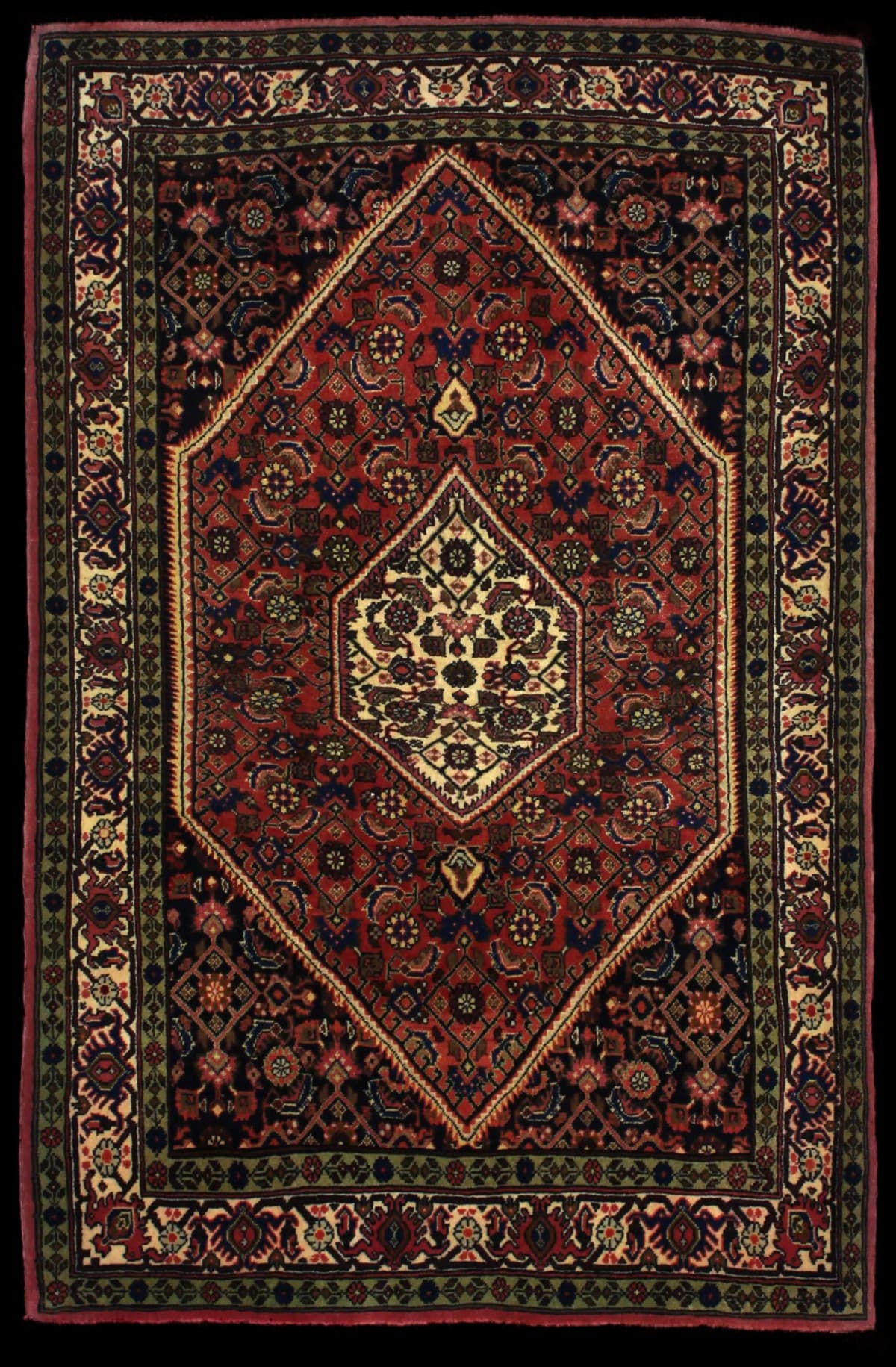
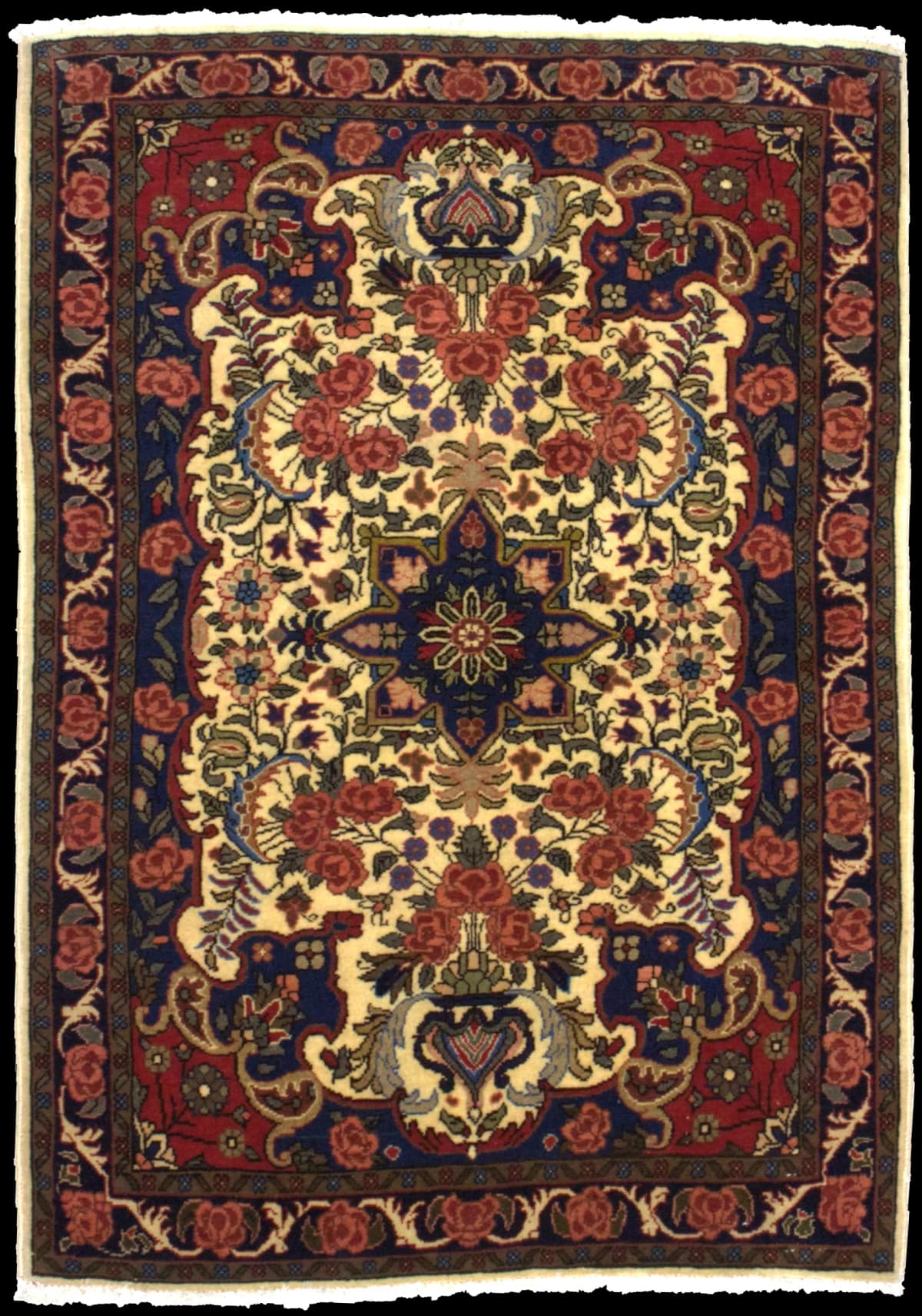
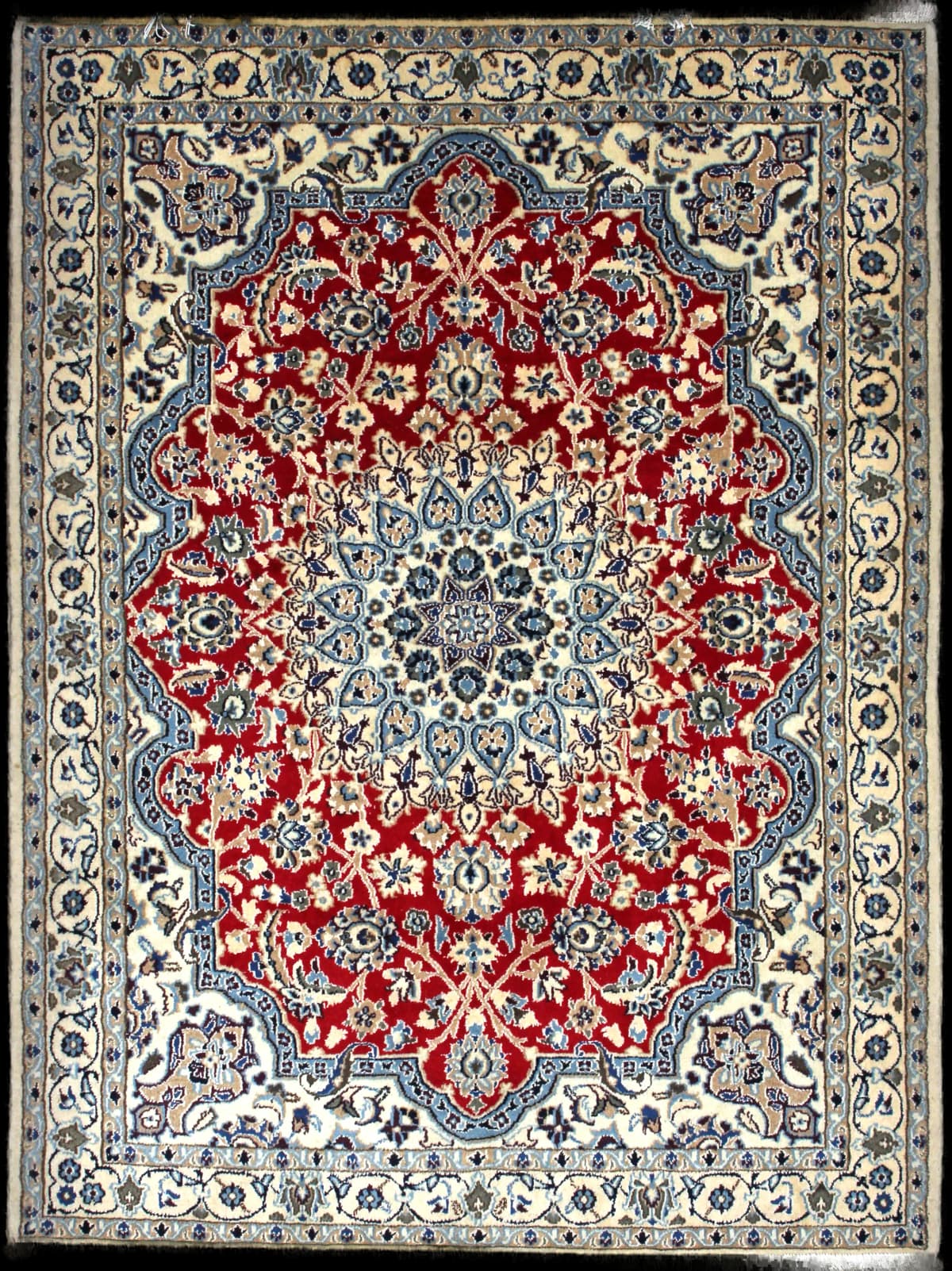
Drawing is floral rather than geometric, laid out either around a central medallionSee in the carpet dictionary or as an all-over field, with the all-over floral and the floral medallionSee in the carpet dictionary the two you meet most often. Within those layouts the classic Persian motifs all appear: herati, the fish-and-leaf lattice; botehSee in the carpet dictionary, the curled almond shape that became paisley in Europe; gulSee in the carpet dictionary hennai, the henna flower; and afshan, literally scattered flowers, an all-over of symmetrical leafy branches, rosettes and paired sprays with no medallion to anchor the eye. Open fields, garden panels and vase designs are woven here as well, and pictorial rugs, which only a short list of workshop centres attempts at all: Tabriz most of them, then Kashan, Isfahan and here.
One detail is worth knowing before you look at a rug closely. A Sarouk's main border is usually shadowed by a much thinner secondary borderSee in the carpet dictionary running around it, a narrow guard stripe framing the wide one, and once you have seen it you will pick it out across a room. The border is also almost always in a different colour from the field, so the composition reads as a picture inside a frame rather than as one continuous surface running from edge to edge.
Fields are usually beige, ivory or cream on the light side, navy or a mid blue on the dark side, or red. The red is the useful one. A Sarouk red leans towards rust and orange rather than burgundy, and that tilt is one of the quickest ways to tell it apart from the cooler, deeper reds of Kashan or Tabriz. Highlights run to yellows and to many shades of blue and green. The palette overall is broad, comparable with Tabriz for sheer range, and largely built on natural dyes, which is why antique examples tend to look better with age rather than tired.
Underneath, the structure is the one city workshops settled on: a cotton foundation, rigid and stable, which holds a rug flat and square and resists the pull that sends a looser weave out of shape. The pileSee in the carpet dictionary is wool, occasionally wool with silk used for highlights only. A silk foundationSee in the carpet dictionary is not part of this tradition, and any claim of one deserves a second look. Some older pieces use kurk, a particularly soft and fine grade of wool, and are shorn short, so short-pile antique Sarouks do exist alongside the thicker modern ones.
Knotting is Persian, or asymmetrical, which lets the weaver pack knots tightly and follow a curve without the drawing turning blocky. Some older Sarouks were tied with the Turkish knotSee in the carpet dictionary instead. DensitySee in the carpet dictionary runs from medium to high, reaching around 320 knots per square inchSee in the carpet dictionary at the top of the range, with plenty of sound pieces well below that; antiques in the low 200s already carry vines that swirl and flow rather than break into steps. Counts far above 320 belong to the very fine city weaves of QumSee in the carpet dictionary, Isfahan and Nain, not to this district.
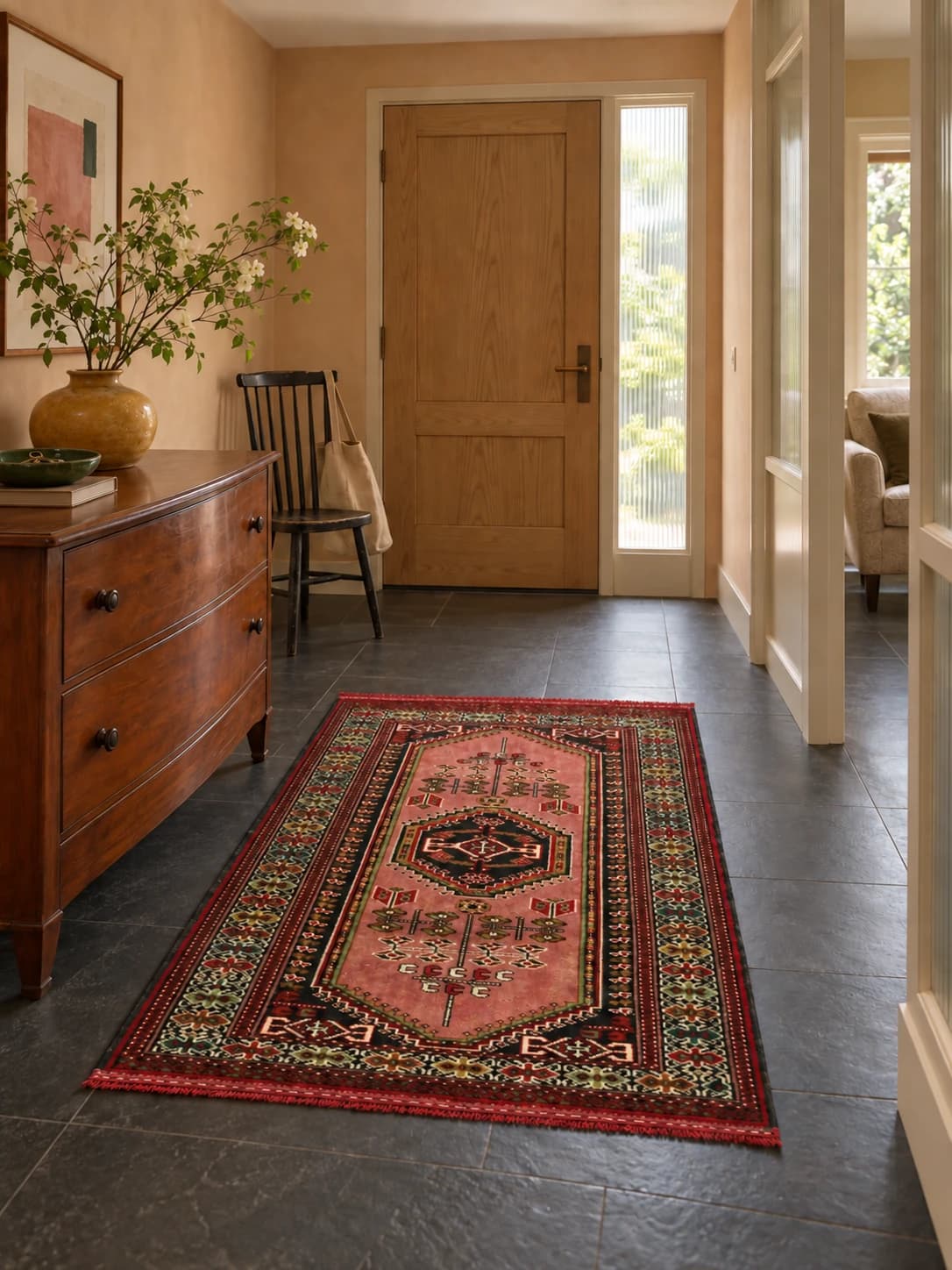
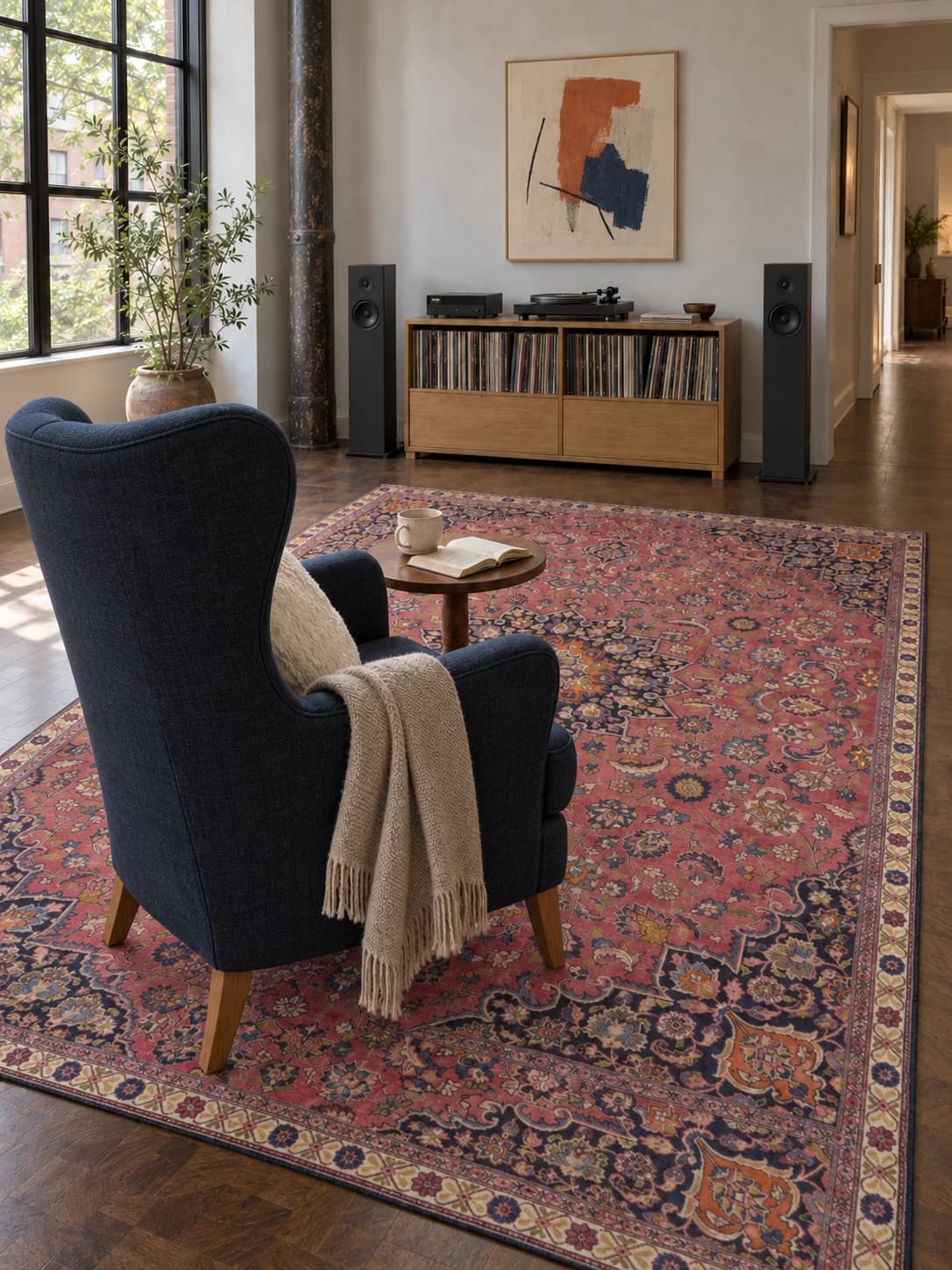
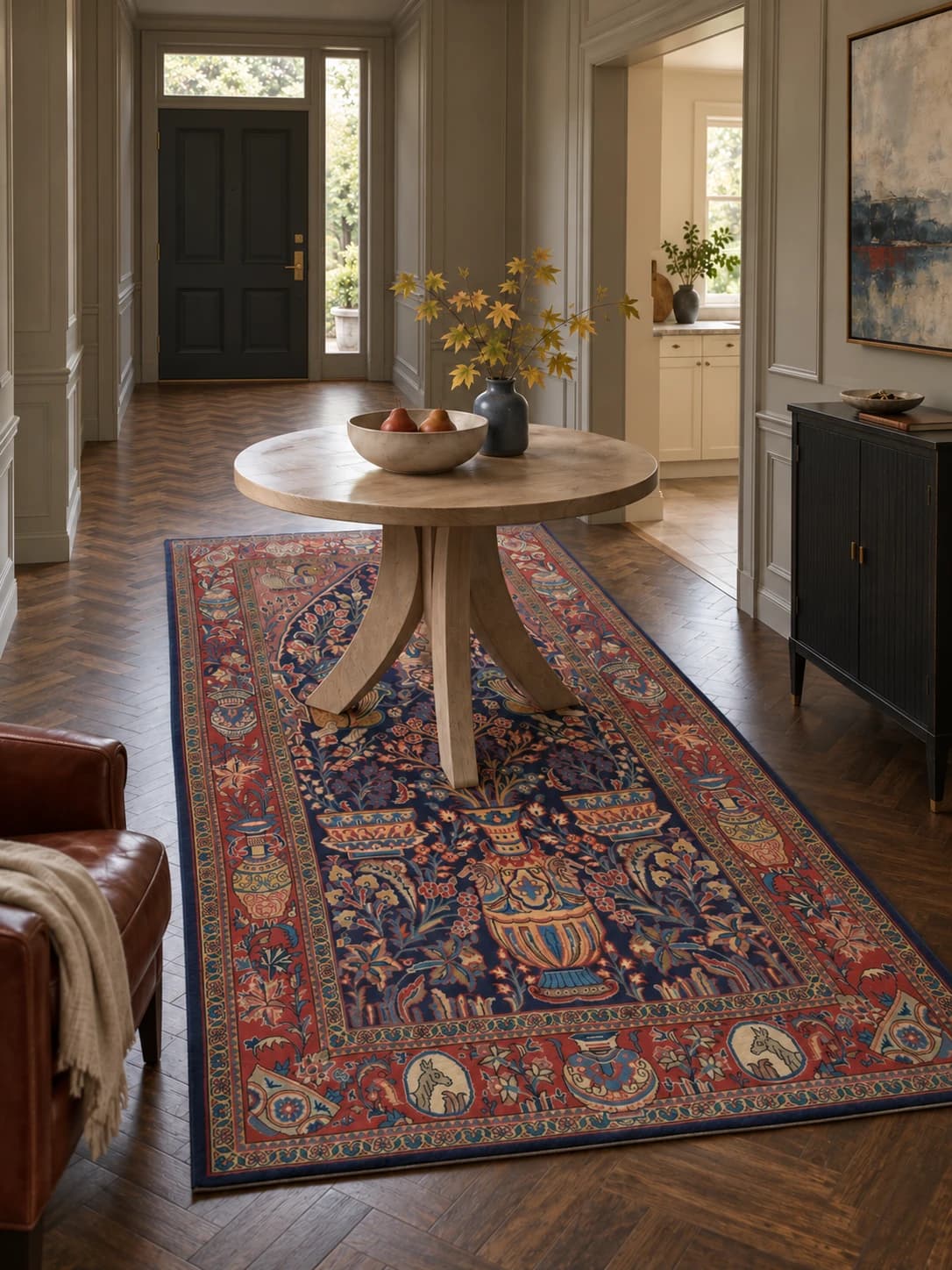
Pile is medium to thick, which places these rugs with HerizSee in the carpet dictionary, Mashad and BijarSee in the carpet dictionary rather than among the close-clipped city weaves. That matters in practice: a thicker pile takes footfall well, so a Sarouk suits a hallway, a living room or a dining room, where a darker field also forgives the occasional spill. Durability here is not a theoretical claim. Pieces of 40 and 50 years old turn up regularly in excellent condition, which is about as direct a test as a rug ever gets.
Few weaves cover the size range so completely. Small mats from about 60 by 90 cm, scatter sizes up to 120 by 180, the common room sizes of 150 by 210 and 180 by 270, large formats of 240 by 300 and 300 by 425, and oversize pieces beyond all belong to this district; the workshops have very large looms and deep resources, so commissioned and palace formats past roughly 3.6 by 5.5 metres are possible. Runners are a particular strength, from about 1.8 up to 6 metres, in narrow and wide widths, the wide ones turning up more often on older pieces.
A last point places the weave among its neighbours. Rugs from south-eastern Malayer follow Sarouk and Farahan drawing so closely that the two can be hard to separate, and the newer Mehraban style leans on Sarouk patterns, the American Sarouk design in particular. The traffic runs outward here: this drawing is copied by its neighbours more than it borrows from them. For a buyer it comes down to something plain enough. A Sarouk offers curvilinear floral drawing with a red you can recognise, on a foundation and a pile built to be walked on for decades.
The Persian rug
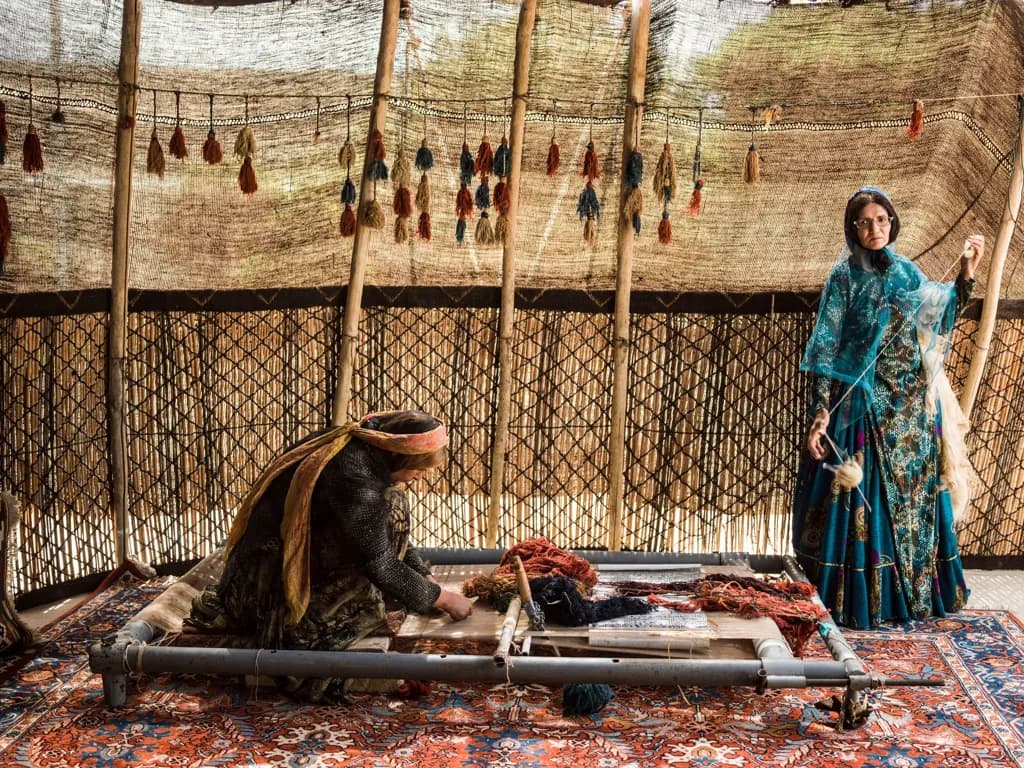
A Persian rug is an Iranian rug — a rug hand-knottedSee in the carpet dictionary in Iran — and the tradition behind it is the oldest documented anywhere. The earliest surviving carpet, the Pazyryk rugSee in the carpet dictionary, was found preserved in a frozen burial mound and dates to the fifth century BC — roughly 2,500 years ago — and it is already accomplished work, not a beginner's craft. What began as warm, hard-wearing floor coverings for tribal households grew, over those centuries, into the art form that every other rug-weaving country has borrowed from.
Two later chapters shaped what a Persian carpet looks like today. Under the Safavid dynastySee in the carpet dictionary, from 1501 to 1732, the court promoted weaving alongside painting and calligraphy, and the workshops of Tabriz, HeratSee in the carpet dictionary, Kashan and Kerman produced the masterpieces that now sit in museums. This is when the great central medallionSee in the carpet dictionary appeared, and when designs grew elaborate enough that a separate designer — often a miniature painter — drew the pattern onto a cartoon for the weaver to follow. The second chapter came in the nineteenth century, under the Qajar dynastySee in the carpet dictionary, when production reached its historical peak, exports to Europe and America boomed, and the workshop industry whose descendants still weave today took its modern shape.
The trade sorts Persian rugs into three families. City rugs — Tabriz, Kashan, Kerman, Nain, Isfahan — are woven in workshops from a drawn design, carry the highest knot densities and come in the widest range of colours, sizes and patterns. Village rugs such as HerizSee in the carpet dictionary, BakhtiariSee in the carpet dictionary and KarajaSee in the carpet dictionary sit in between, mostly geometric and largely woven from memory. Tribal rugs — Baluch, TurkomanSee in the carpet dictionary, QashqaiSee in the carpet dictionary, each named after the people who weave it — are made on small portable looms, so they run smaller, and their bold geometric drawing comes from the weaver's own head rather than from paper.
The design vocabulary draws on a deep stock of motifs: Shah AbbasiSee in the carpet dictionary palmettes, flowing arabesques, the small repeating Herati patternSee in the carpet dictionary, medallions, garden and tree-of-life compositions. These combine with regional habits into styles a practised eye can place at a glance, from the bold geometric medallions of Heriz to the fine curvilinear florals of Isfahan.
The classic palette is built on natural dyes: madderSee in the carpet dictionary reds, indigo blues, saffron yellows and the soft whites of undyed woolSee in the carpet dictionary, settled into combinations refined over centuries. Natural dyes age gracefully, mellowing into the patina that older rugs are prized for, and slight shifts of tone between dye batchesSee in the carpet dictionary — the effect called abrashSee in the carpet dictionary — are a mark of small-batch natural dyeing, not a flaw.
The pileSee in the carpet dictionary is almost always woolSee in the carpet dictionary, and in a Persian wool rug the wool itself decides much of the quality. The best fleece comes from high-altitude flocks, where it grows thicker and richer in natural oils; spring-sheared wool beats the autumn clip, and hand-spun yarnSee in the carpet dictionary gives a finer, softer thread than machine spinning. Fine pieces add silk highlights to a wool pile, and at the very top sits the Persian silk rug, woven in pure silk. Foundations are usually cotton in city weaving, wool in tribal and older pieces, silk at the very top of the range.
Every knot is tied by hand, one at a time, in one of two forms: the asymmetric Persian knotSee in the carpet dictionary, usual in central and eastern Iran, or the symmetric Turkish knotSee in the carpet dictionary, common in the north-west ever since Seljuk weavers introduced it in the eleventh and twelfth centuries. A large rug holds in the region of two million knots and can occupy a weaver for about a year.
Knot densitySee in the carpet dictionary is the figure newcomers fixate on, and the finest silk-foundation pieces do reach as much as 1,000 knots per square inch. But densitySee in the carpet dictionary only matters as far as the drawing demands it: a curvilinear Isfahan needs a fine weave to stay sharp, while a geometric Heriz is famously durable at a modest count. Material, symmetry, colour harmony and condition say more about quality than any single number.
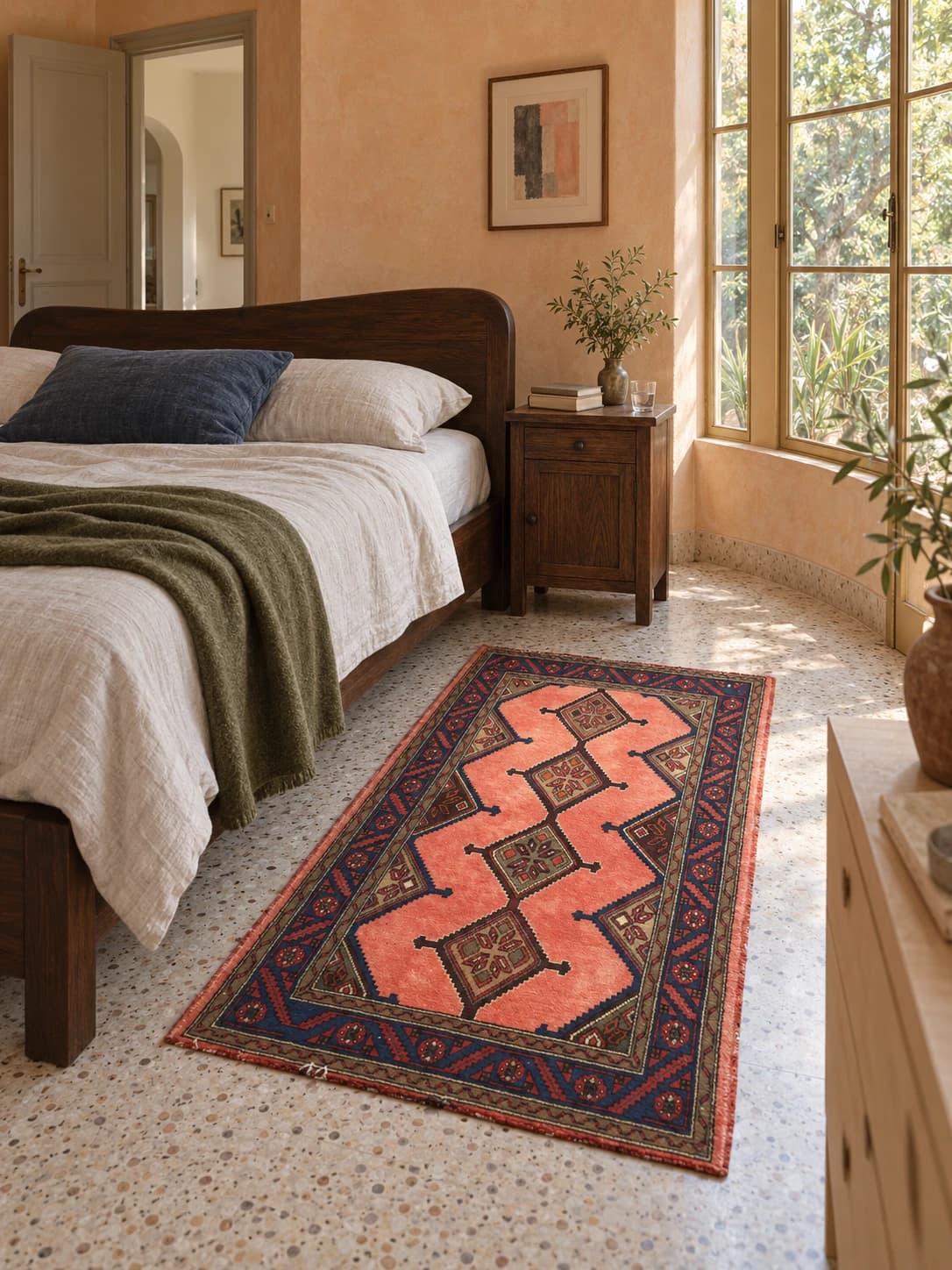
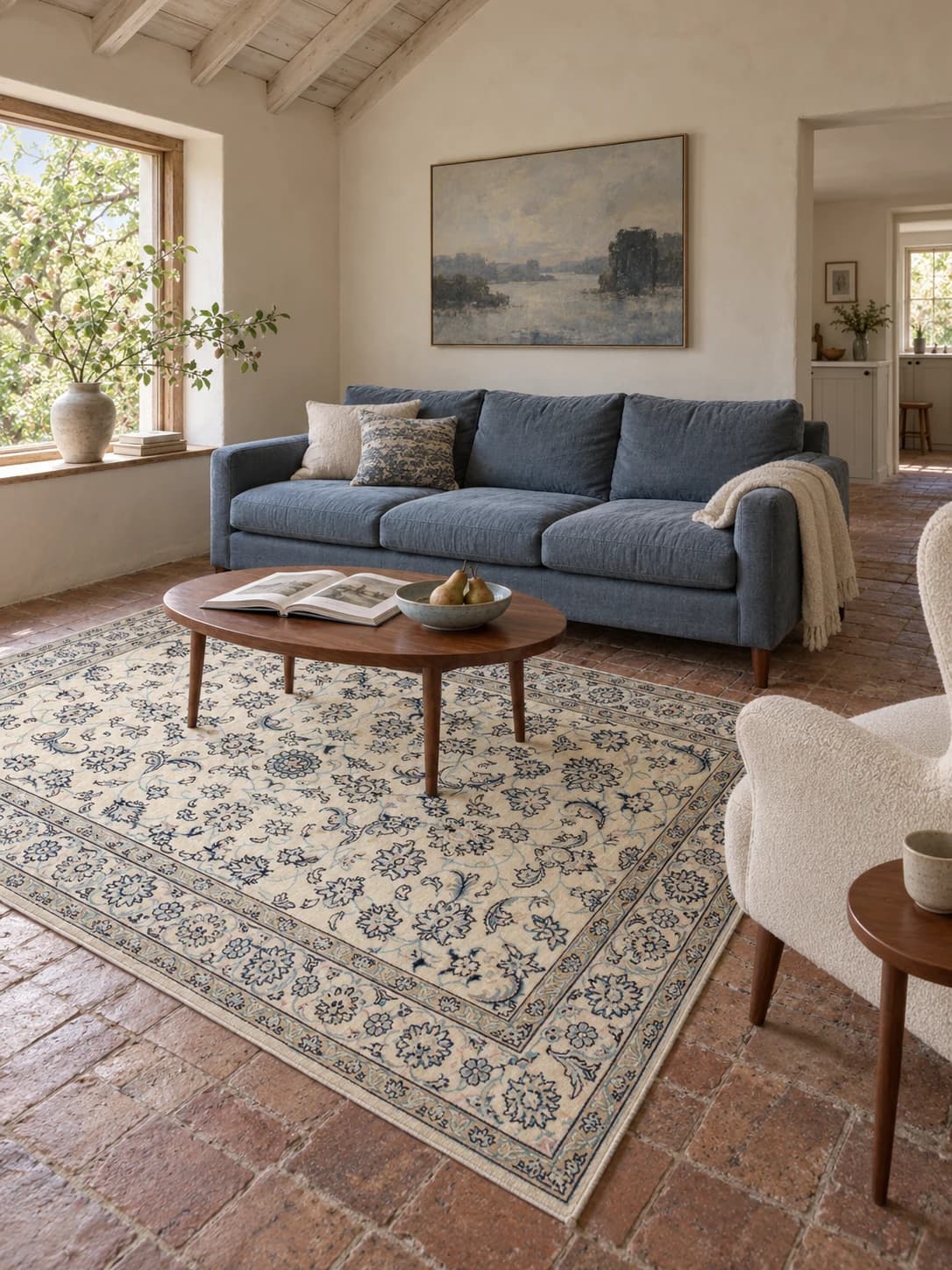
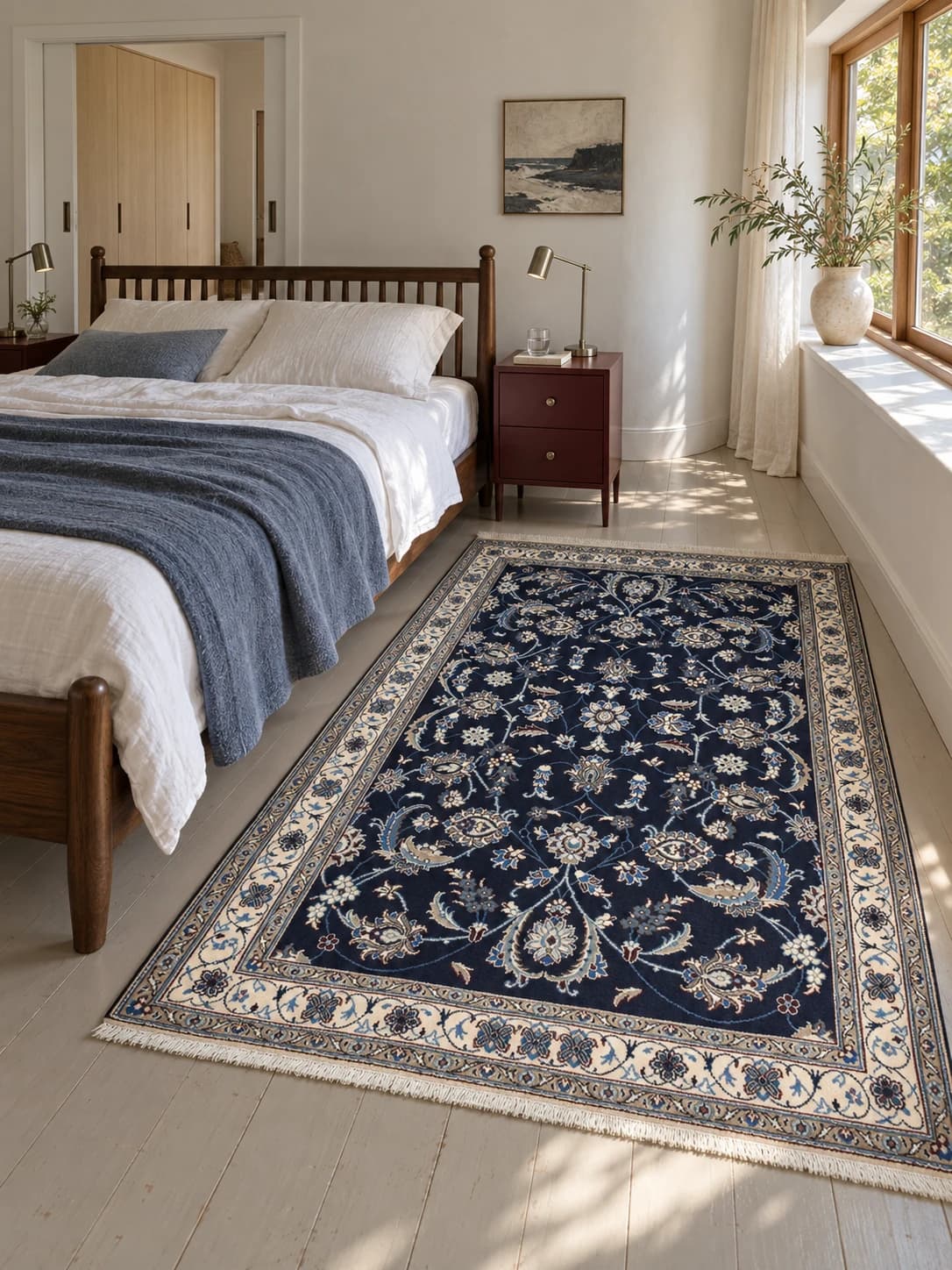
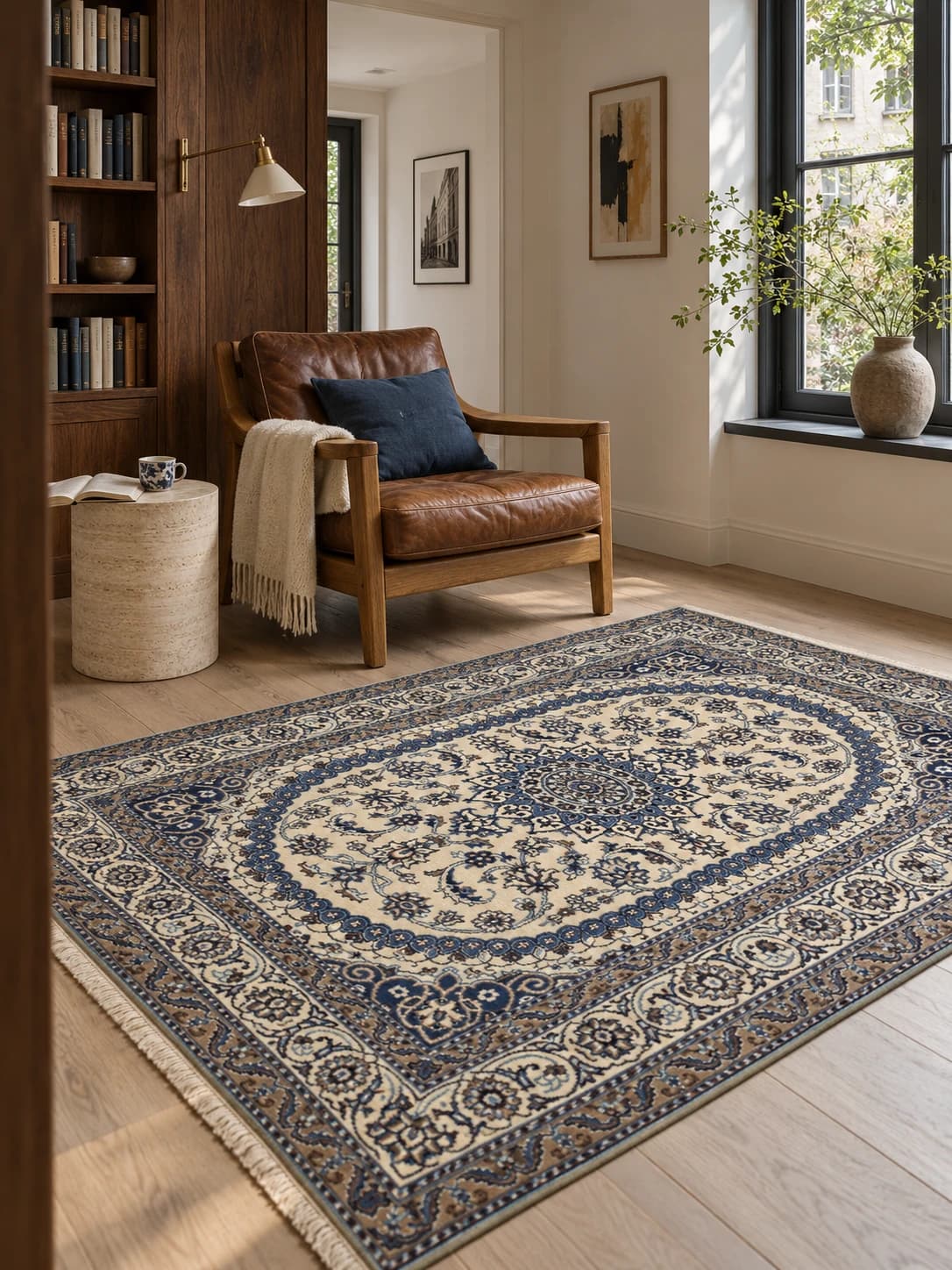
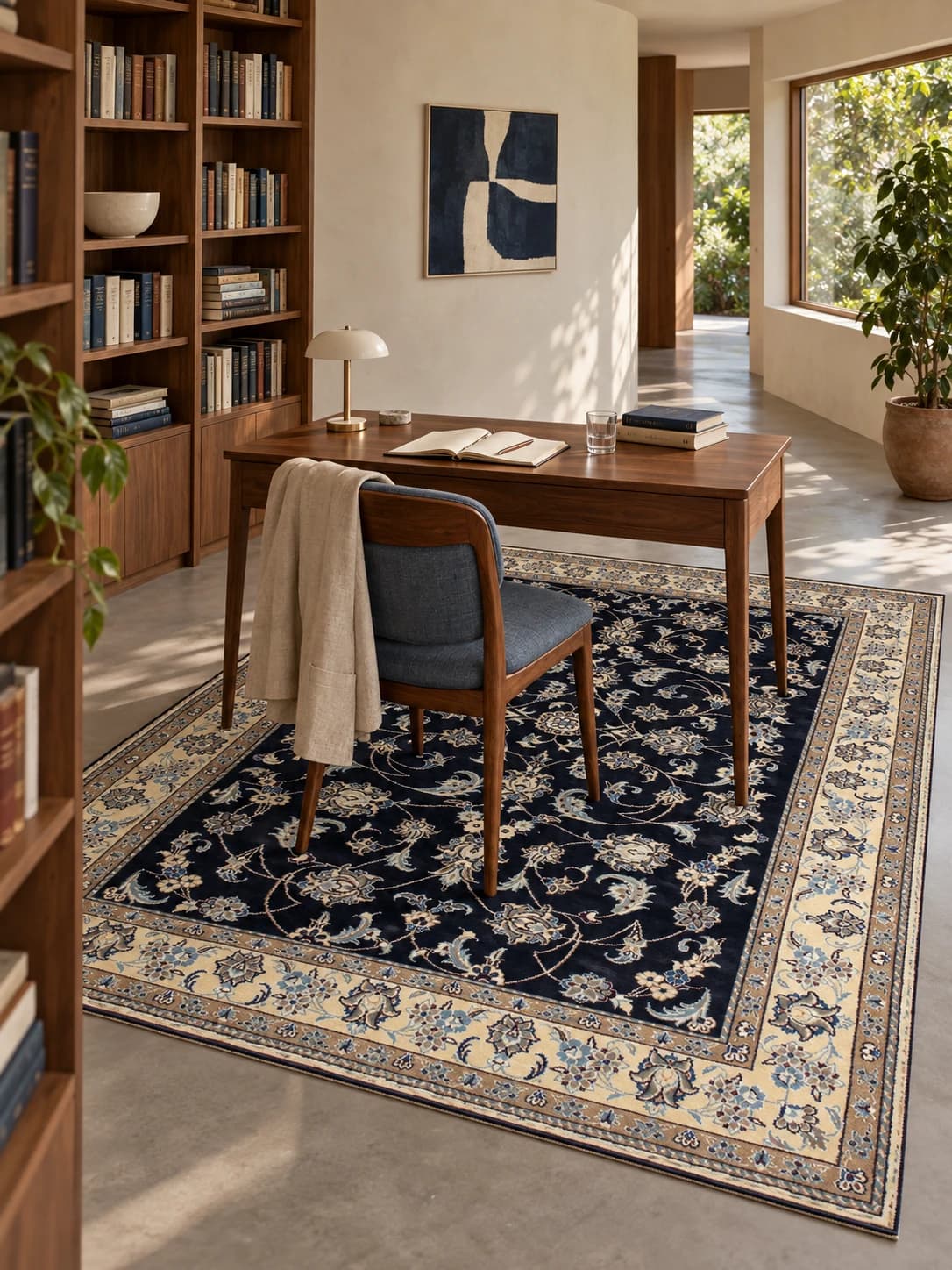
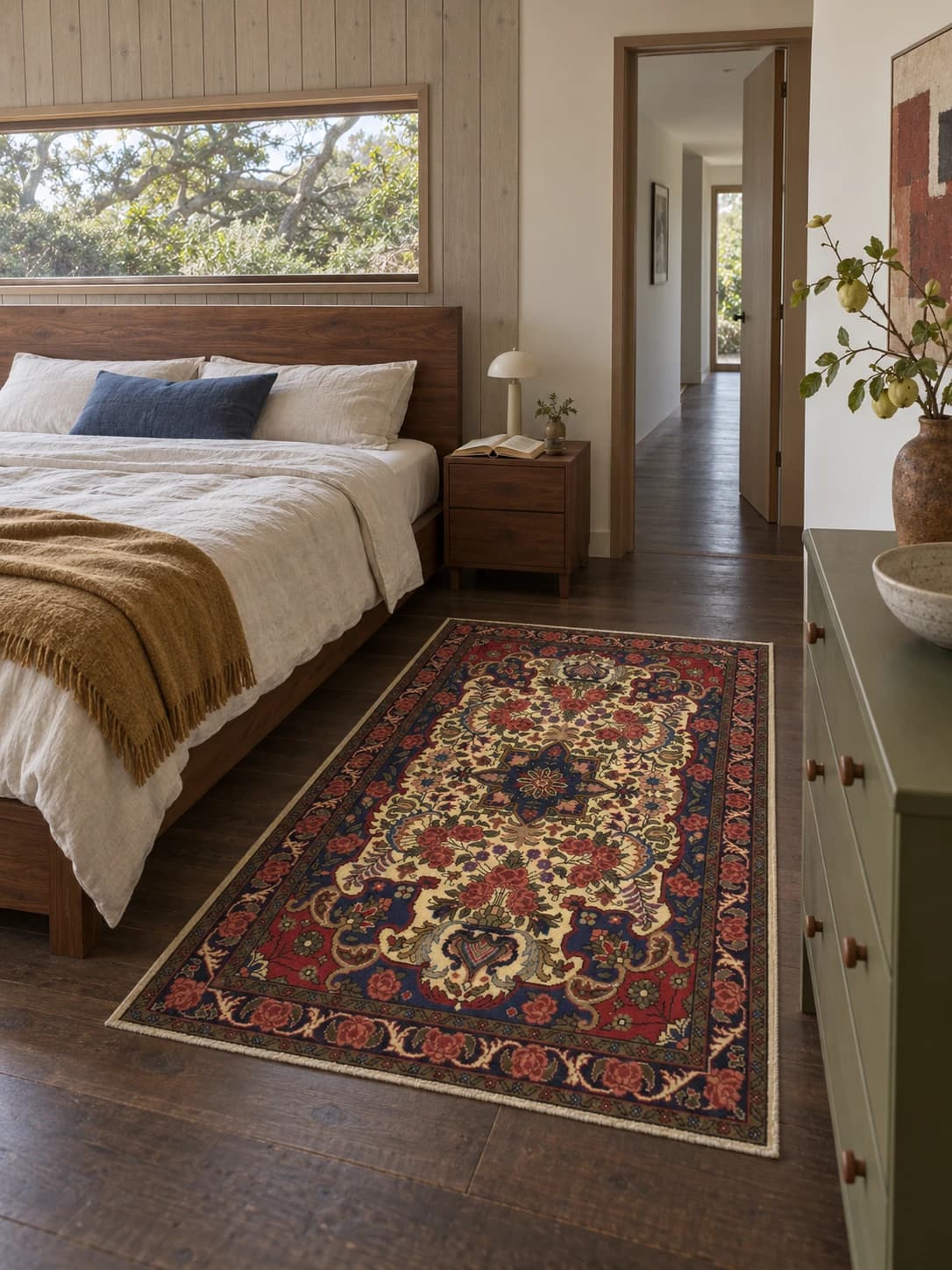
Persian carpets settle into modern rooms as naturally as classical ones, as a focal point in a living room, a foundation under a dining table or a quieter accent in a bedroom. Care is undemanding: gentle vacuuming without a rotating brush, an occasional turn for even wear, and a professional wash about every five years — sooner in a hallway or entrance, less often in a quiet room.
A hand-knotted Persian rug tends to outlast its owners. Pieces a century old regularly survive in fine condition, their colours settled and their pile supple, often looking better than when they left the loomSee in the carpet dictionary. A well-chosen, well-kept rug holds its worth and passes down as a family heirloom rather than being replaced — which is precisely what the knots, the wool and the dyes were always for.
Questions about this carpet?
Our family has traded carpets for two generations. Ask us anything — photos, video calls, advice on sizes.
Message us
Keep exploring
Guides from our family workshop: how to clean, place and care for hand-knotted rugs.