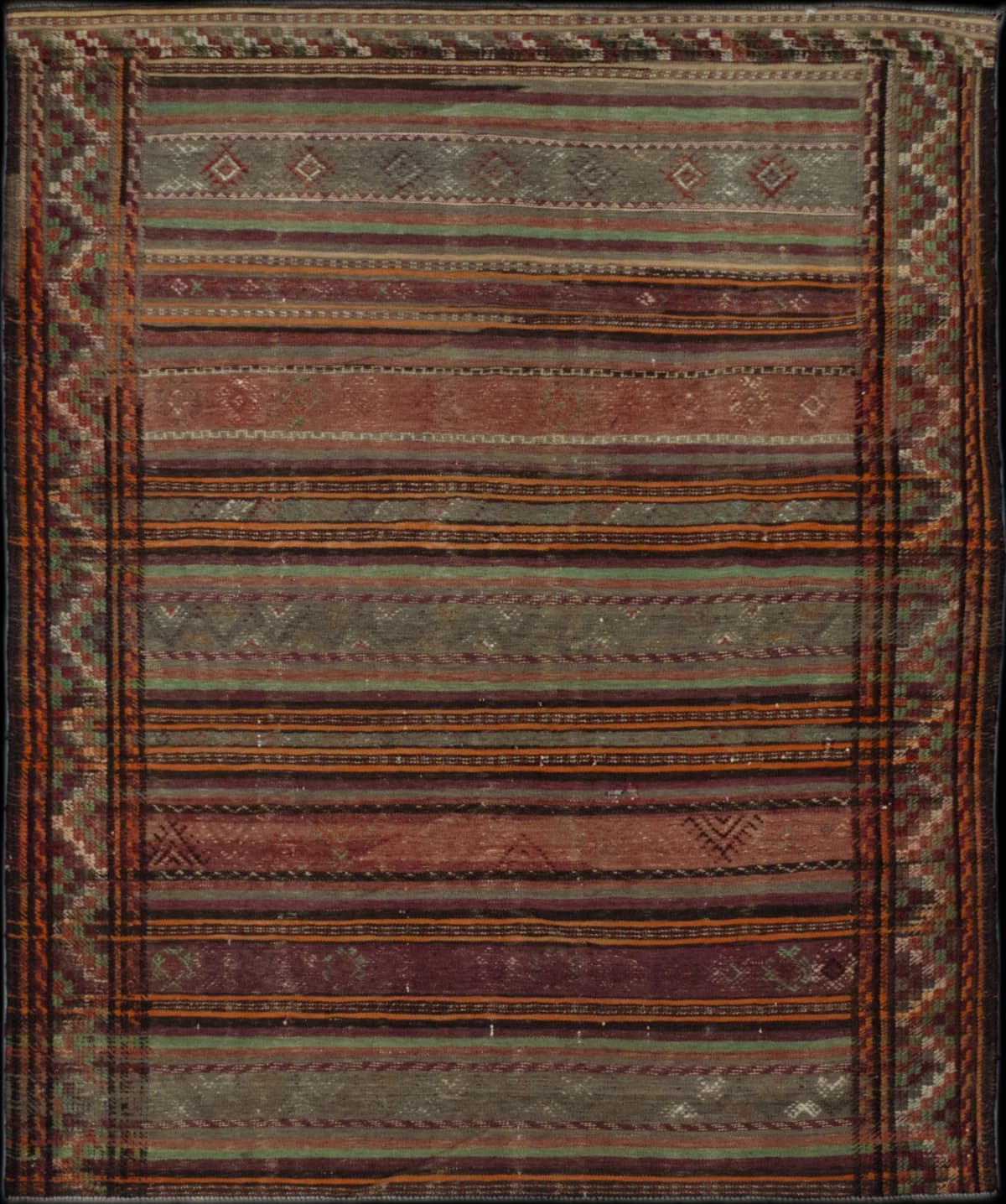
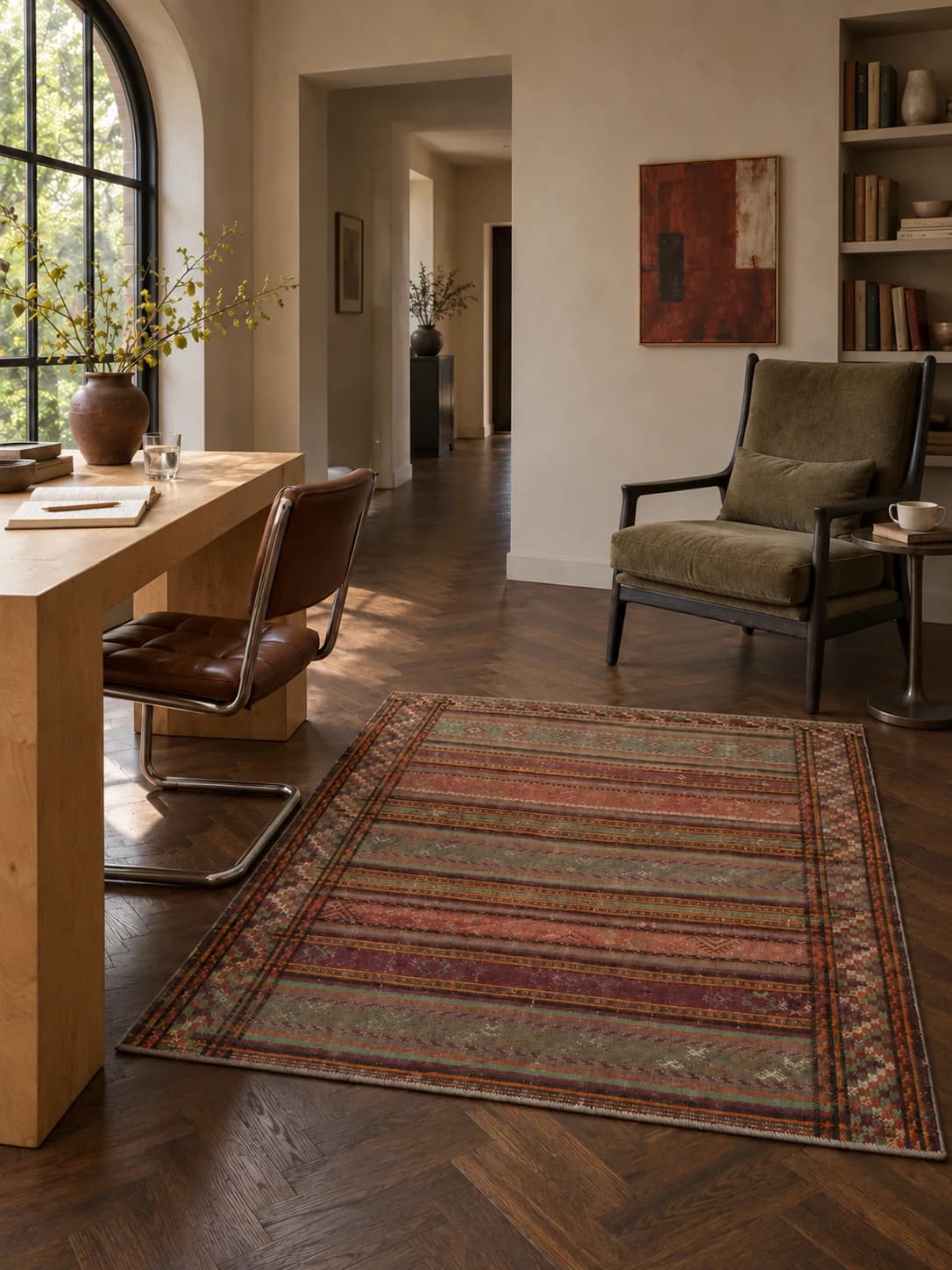
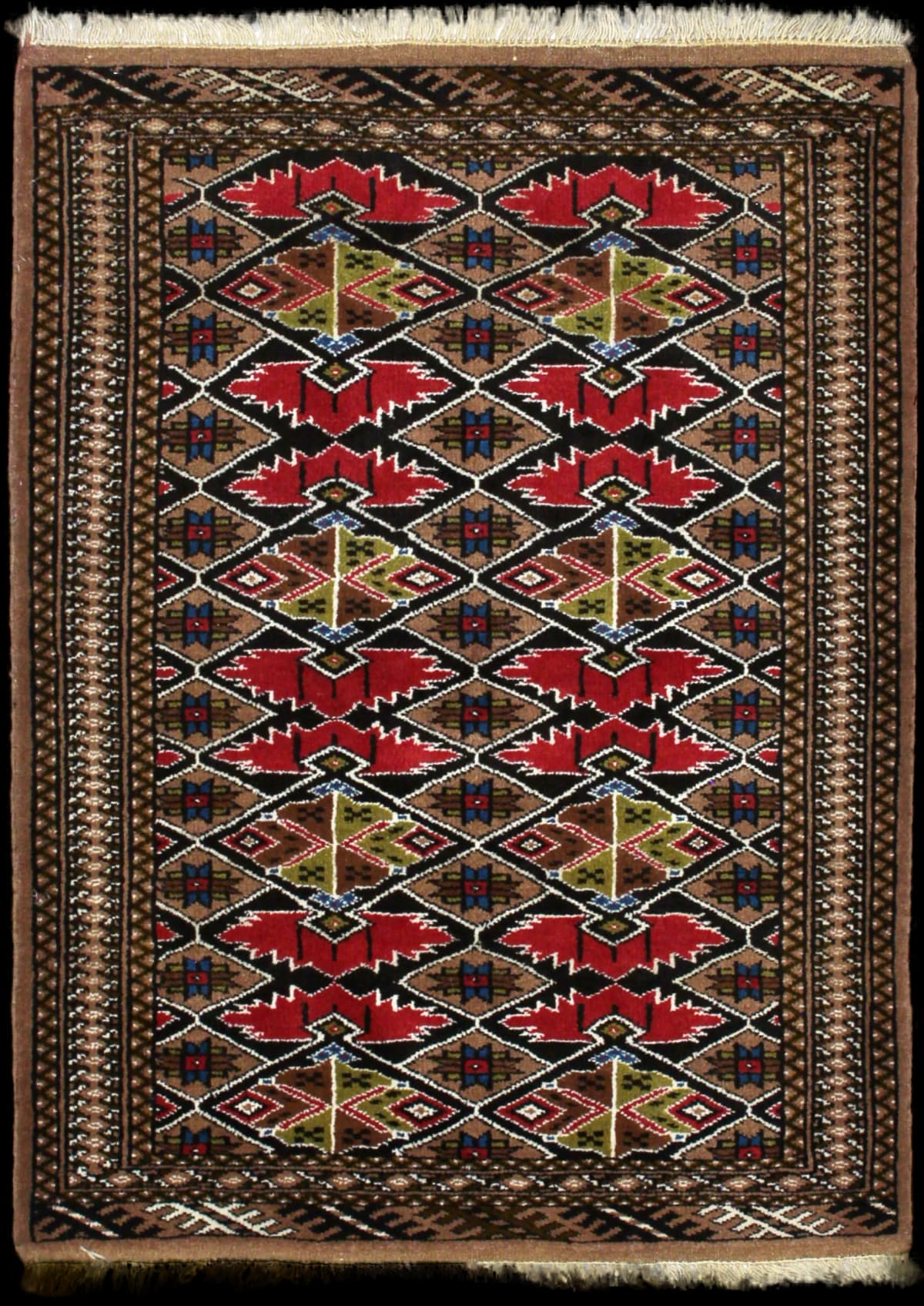
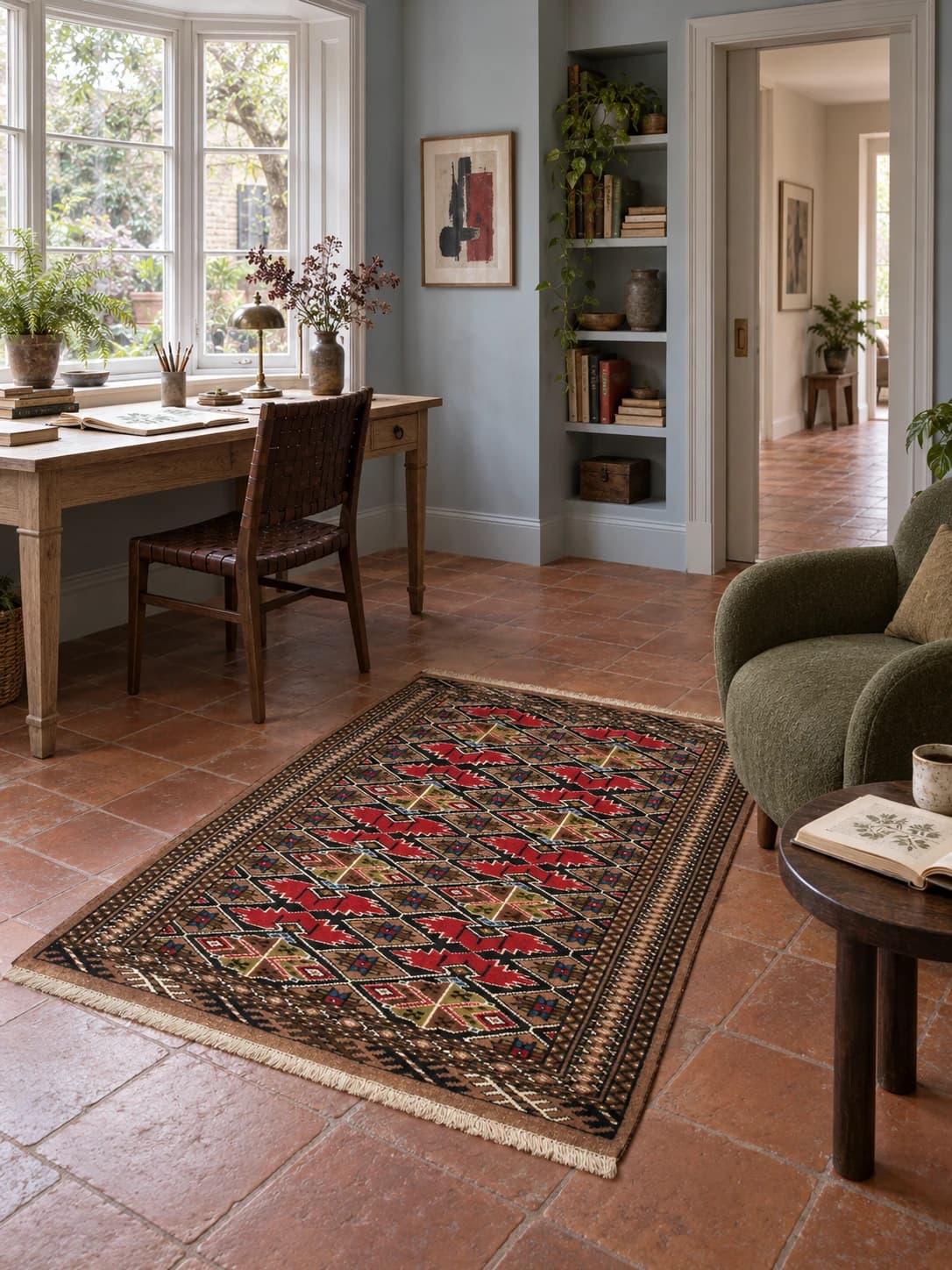
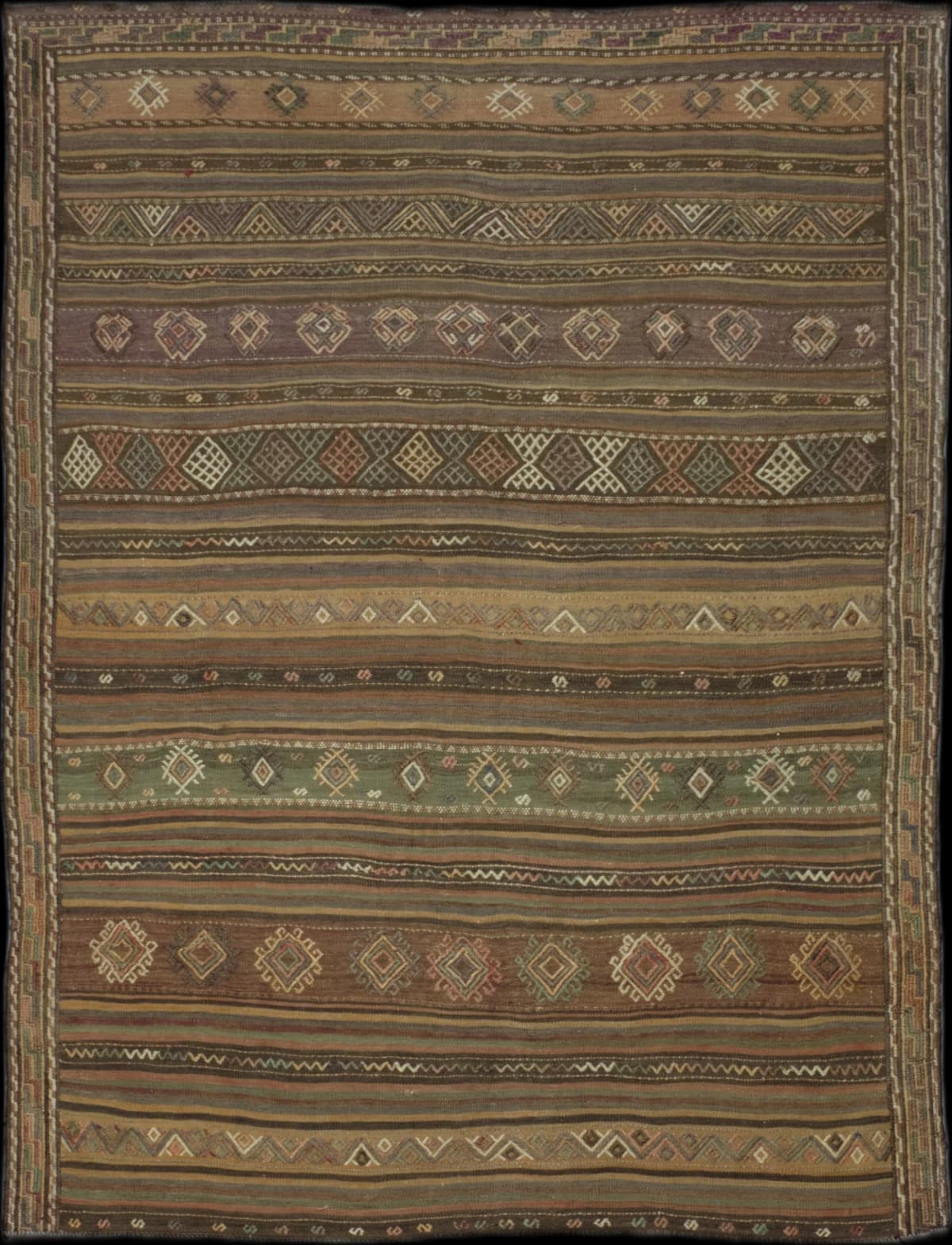
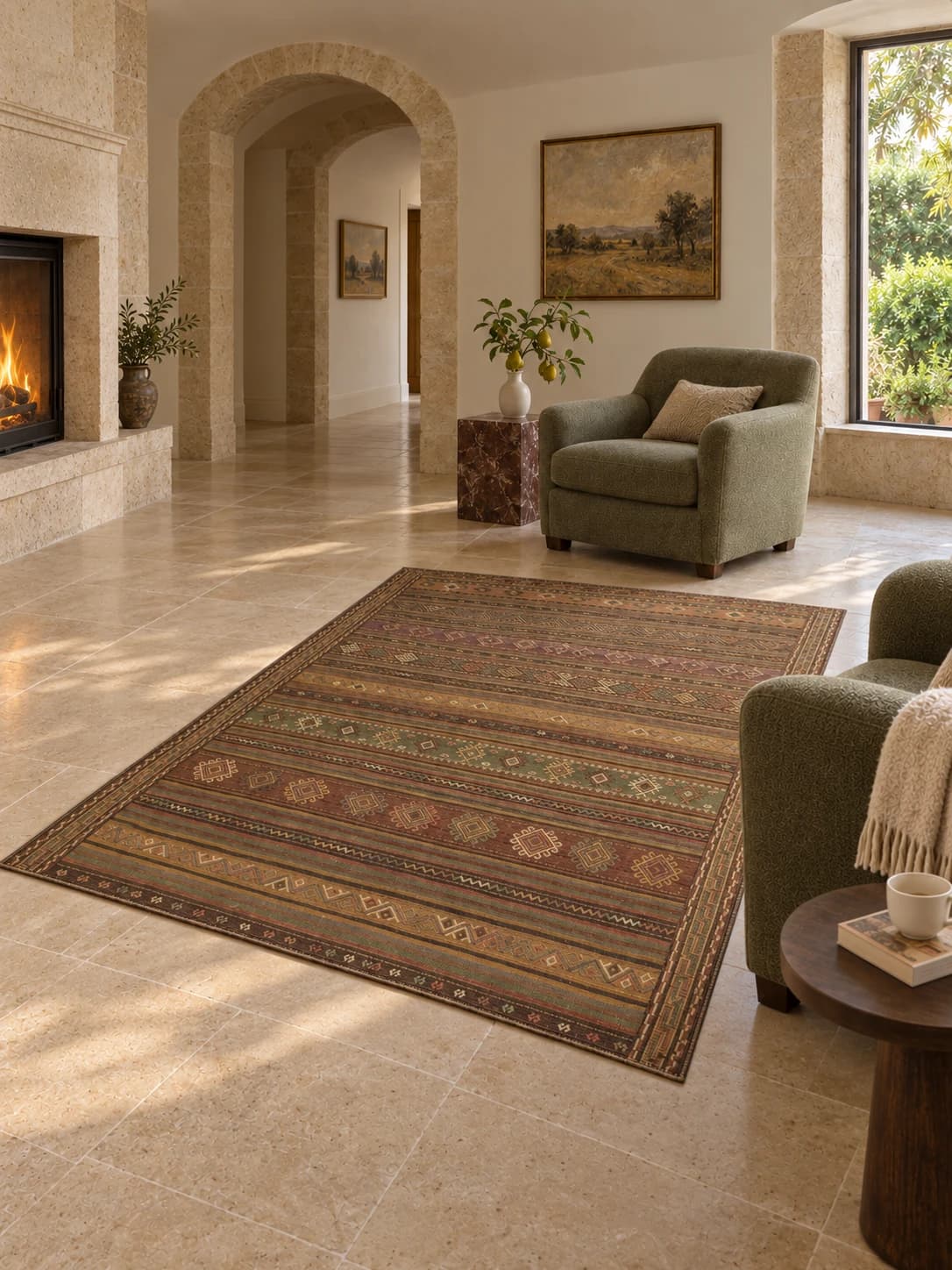
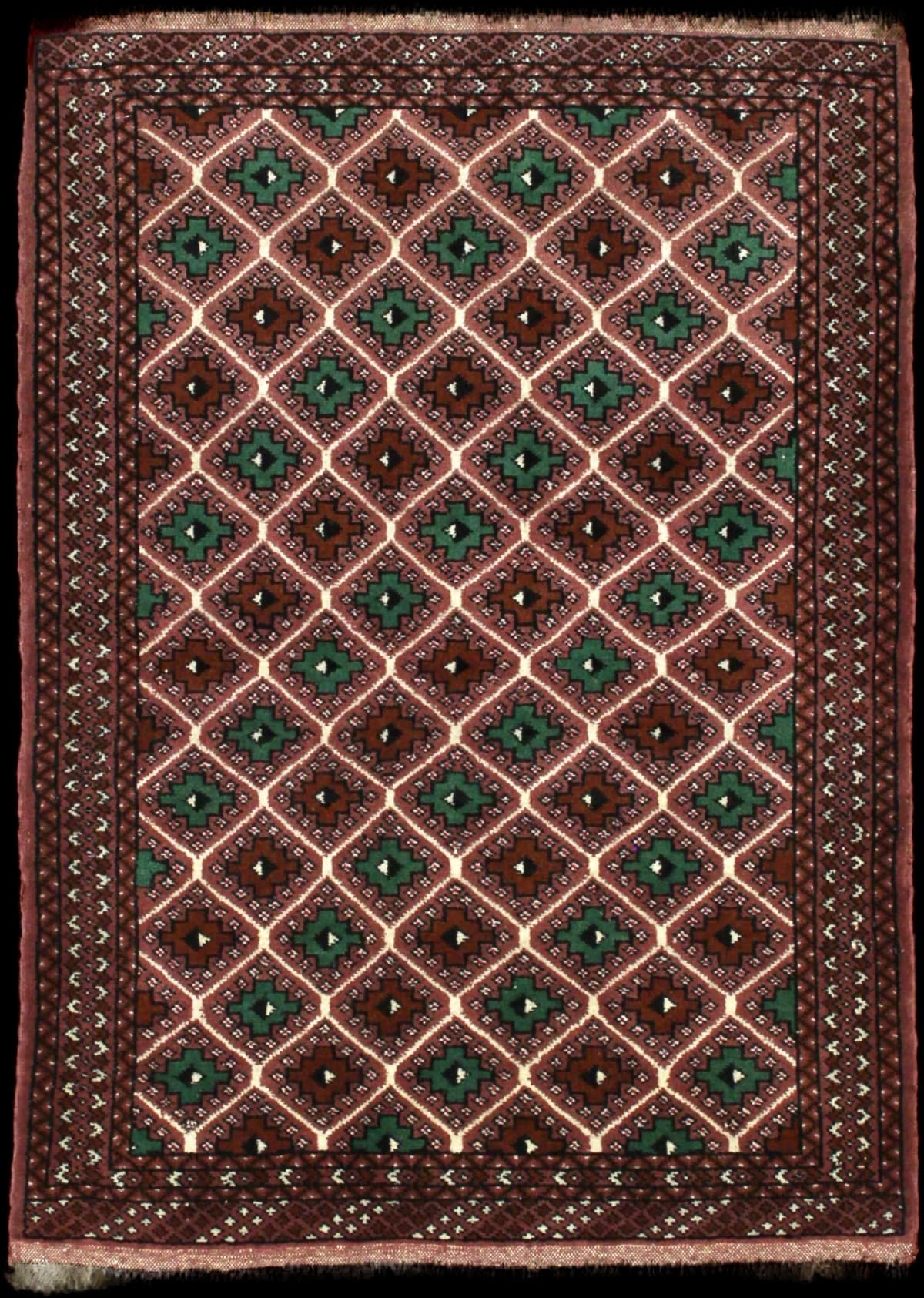
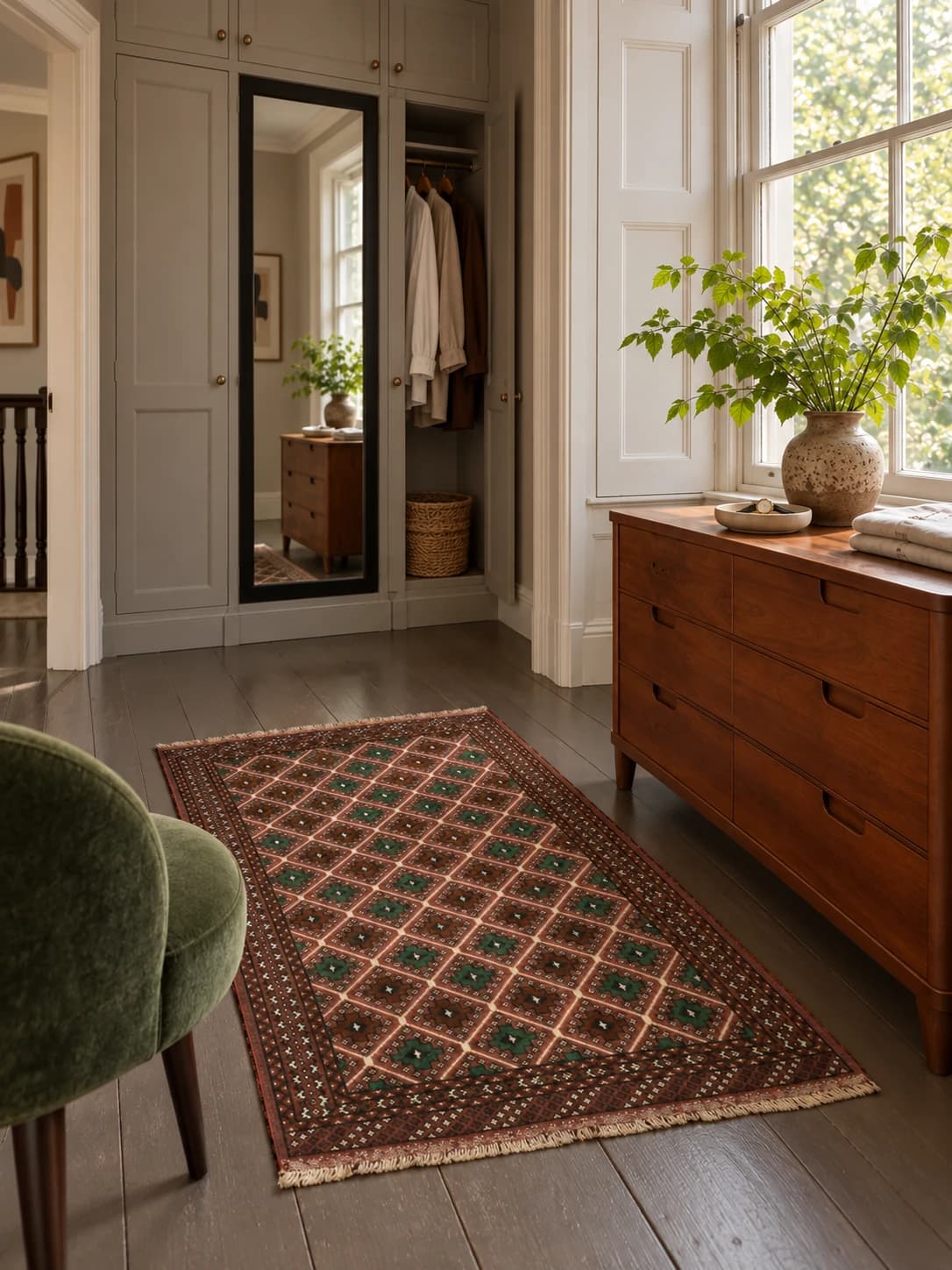
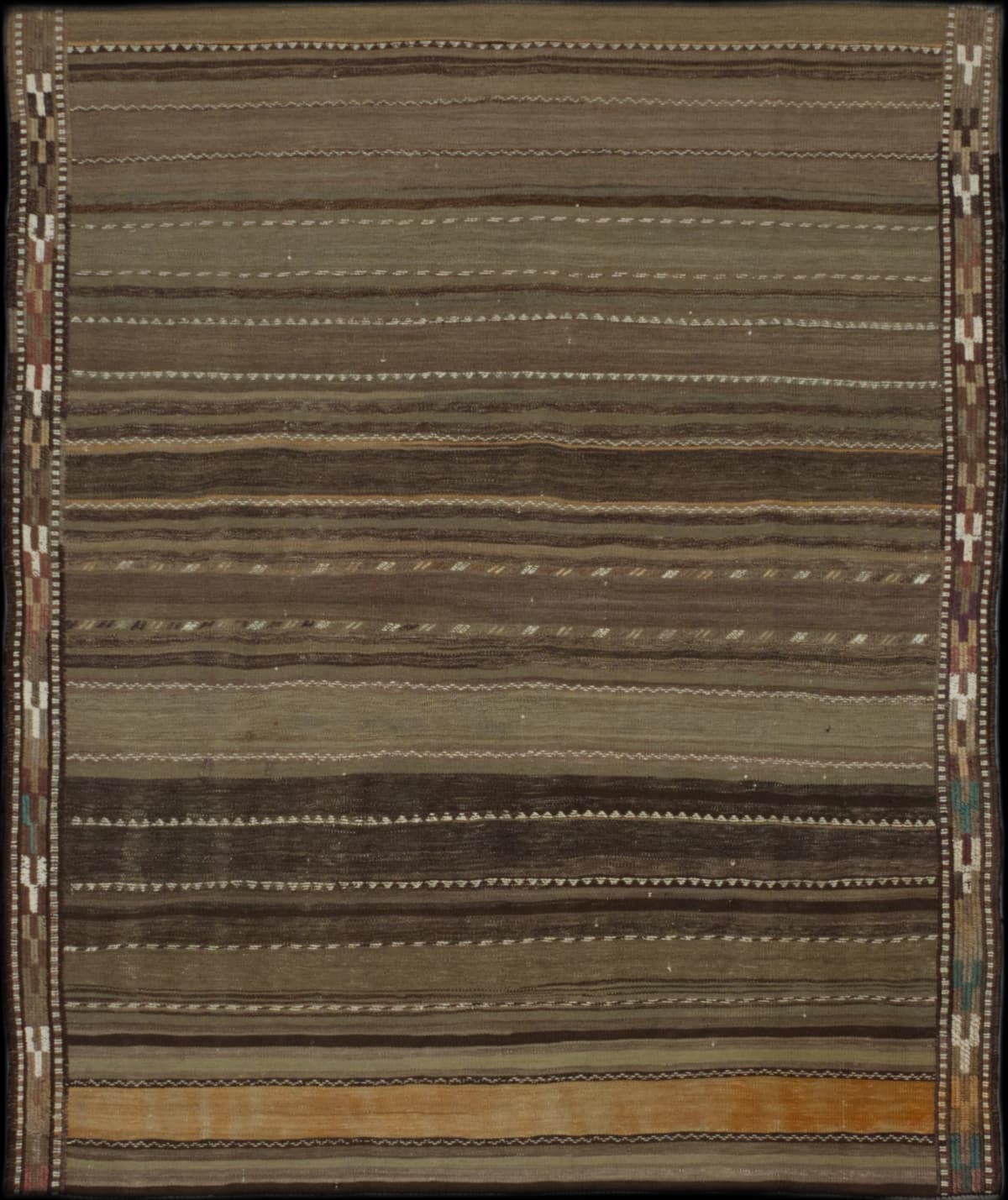
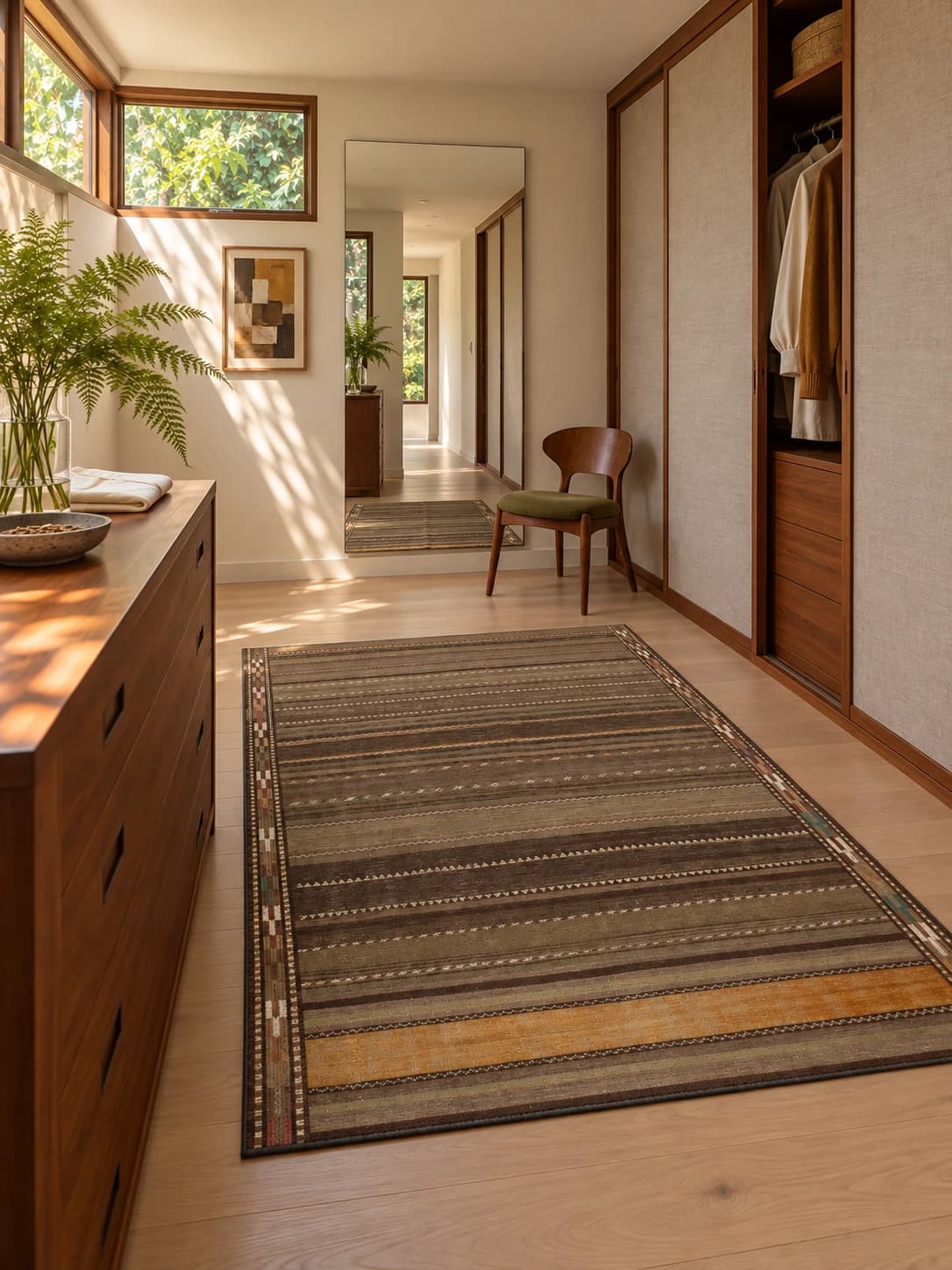
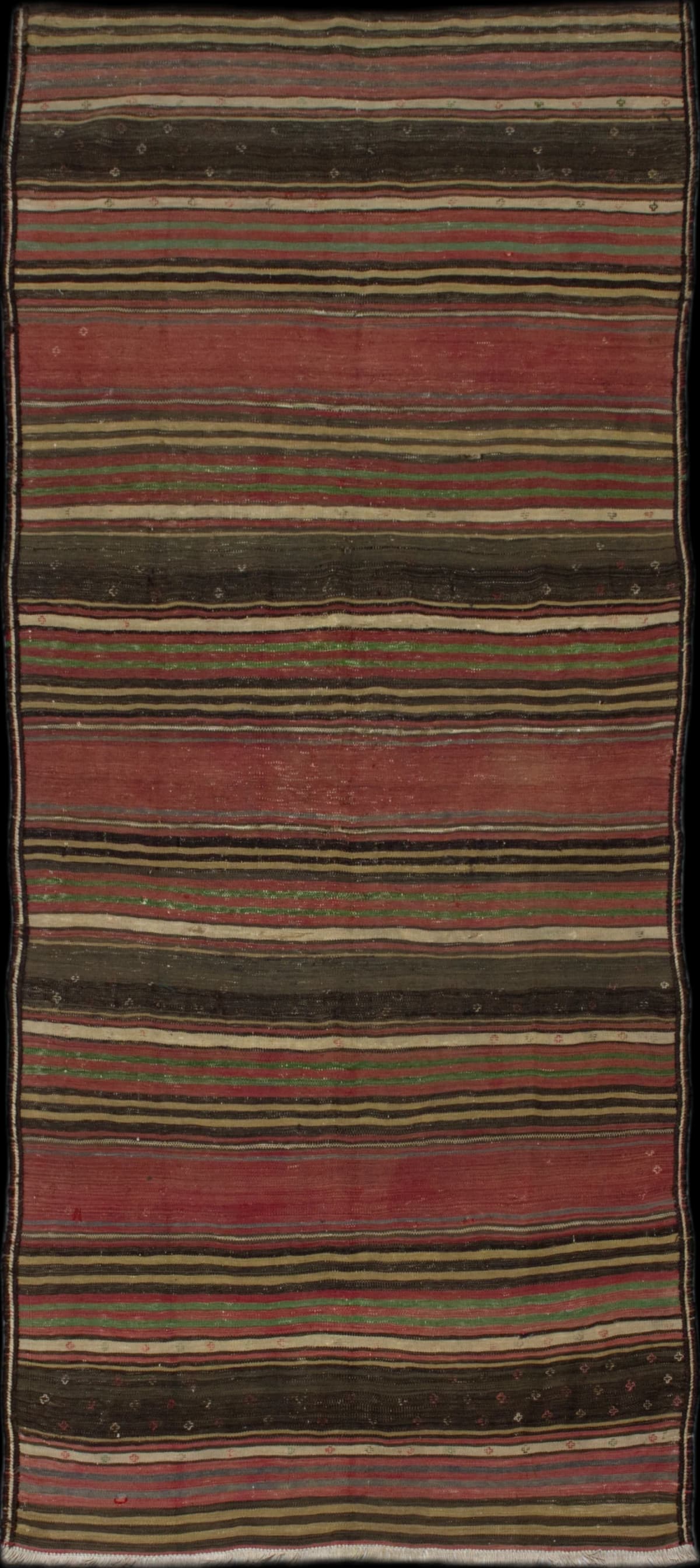
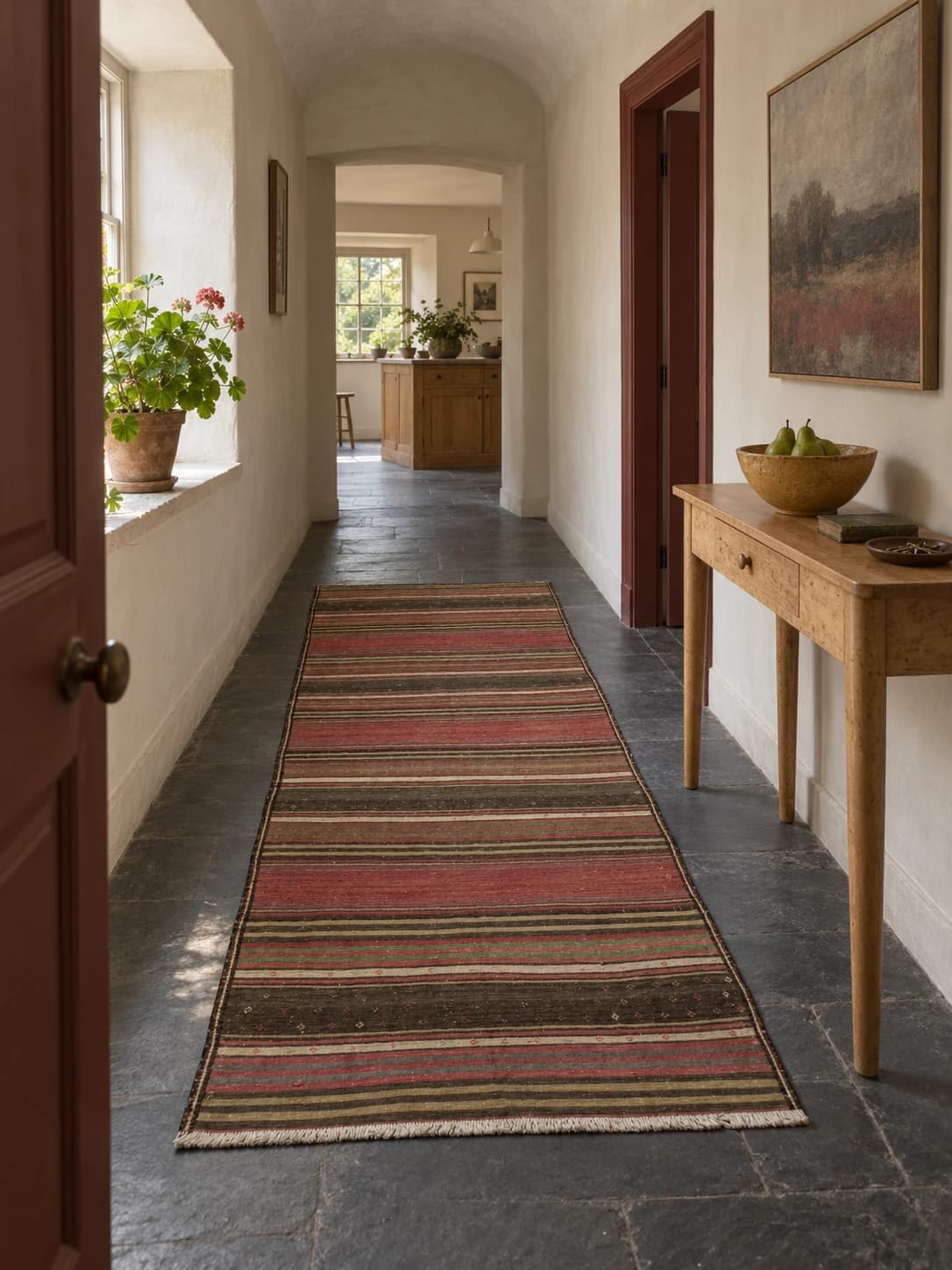
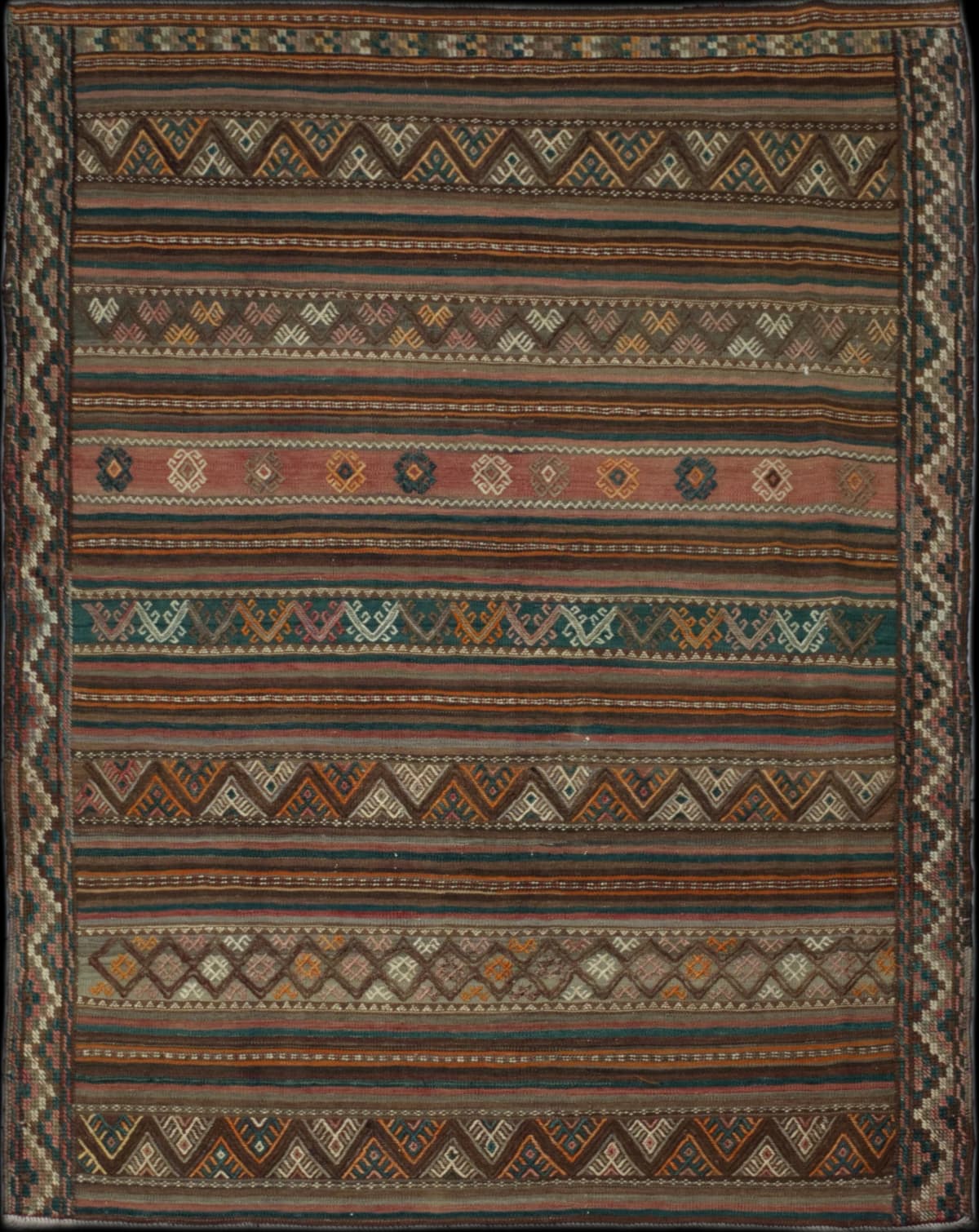
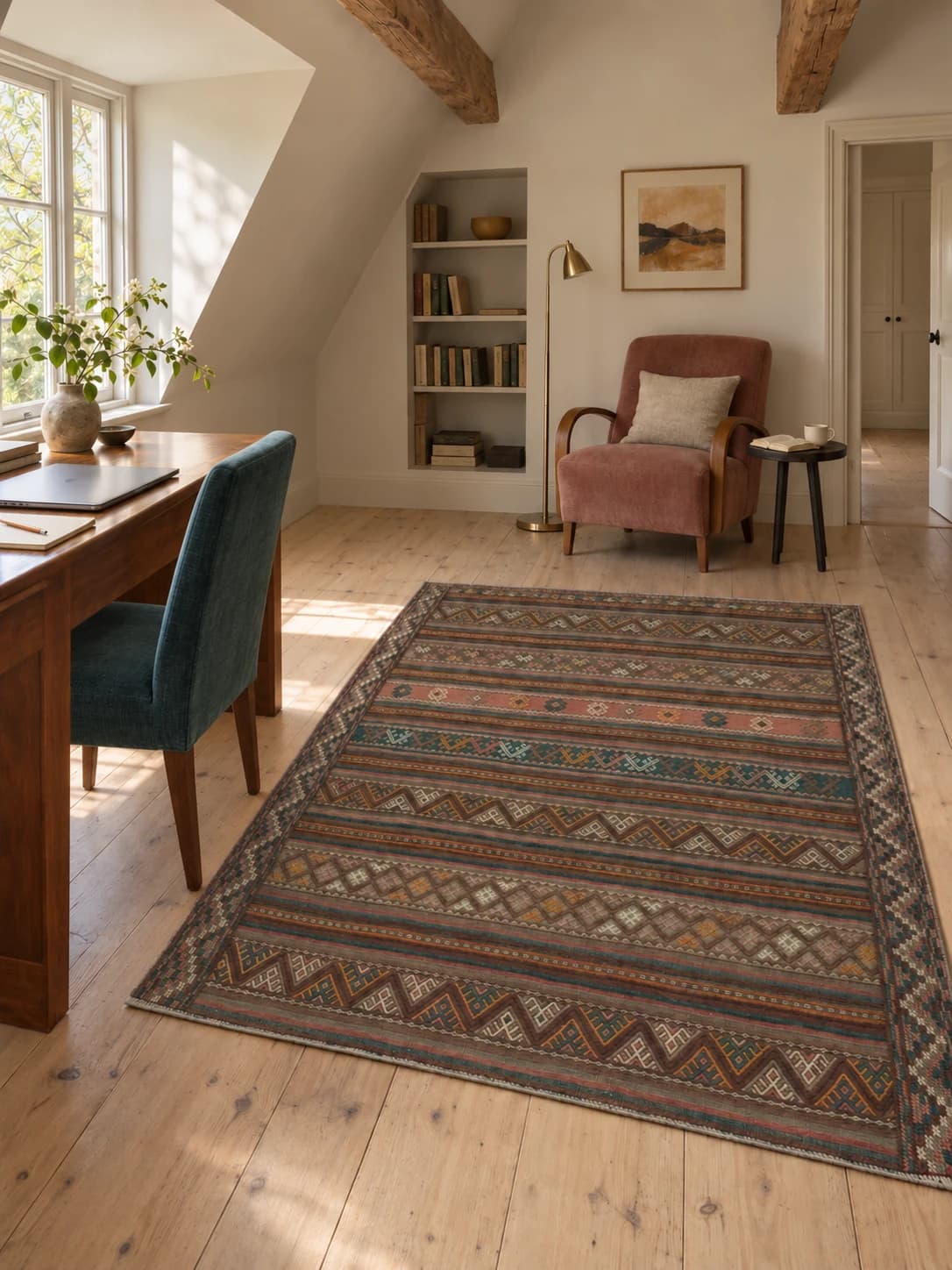
From the region ofشیرازShiraz
Up close
Origin: Shiraz
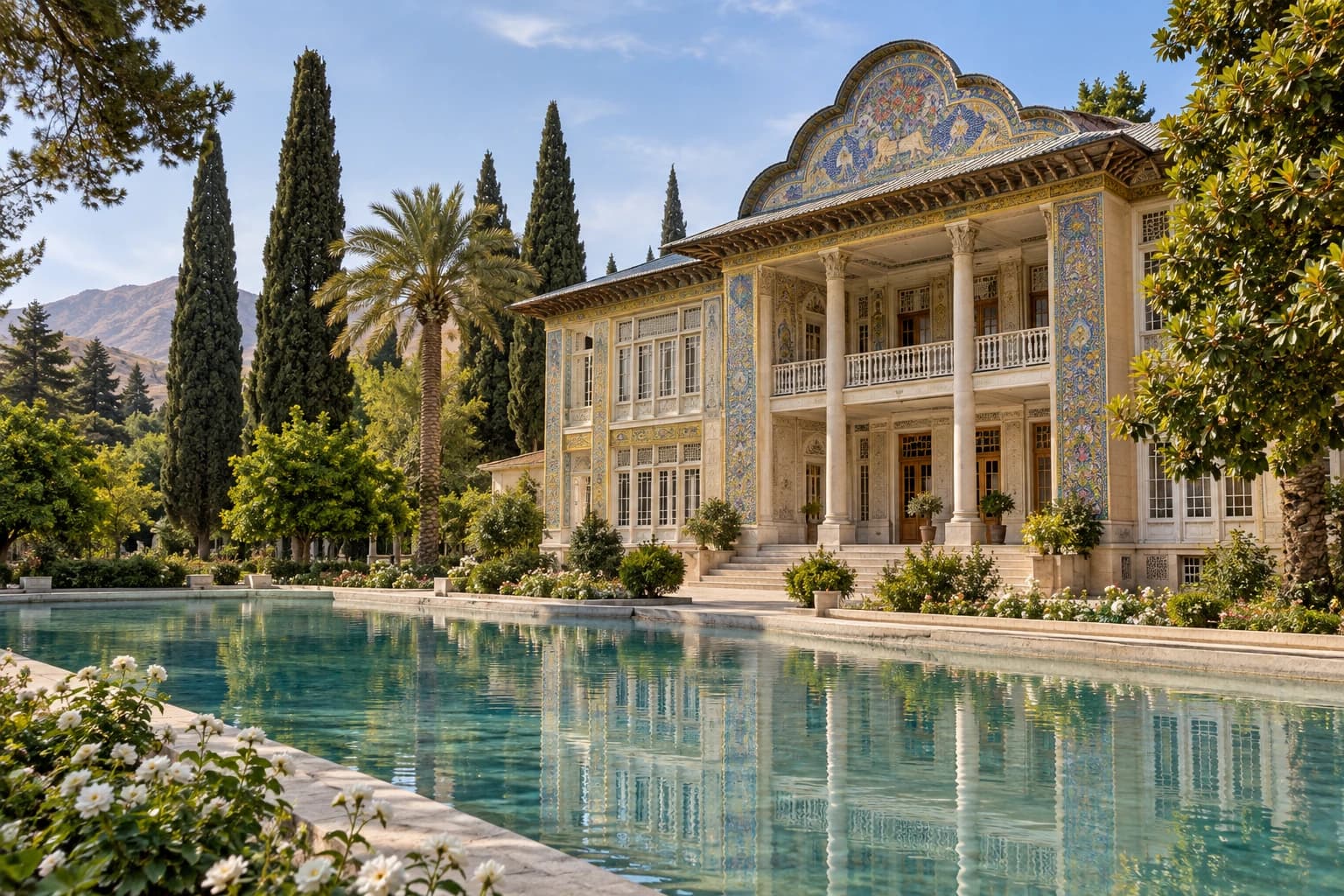
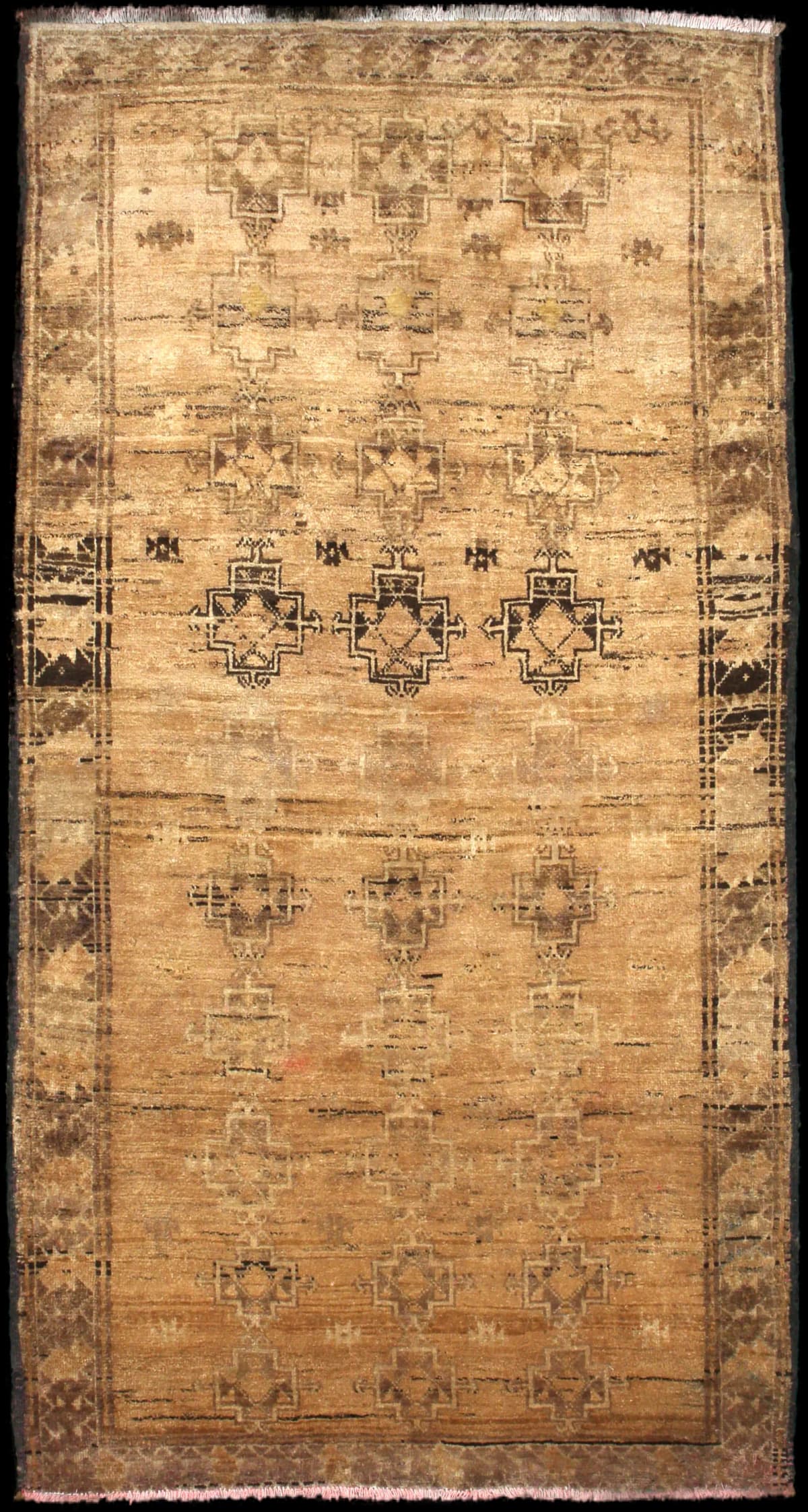
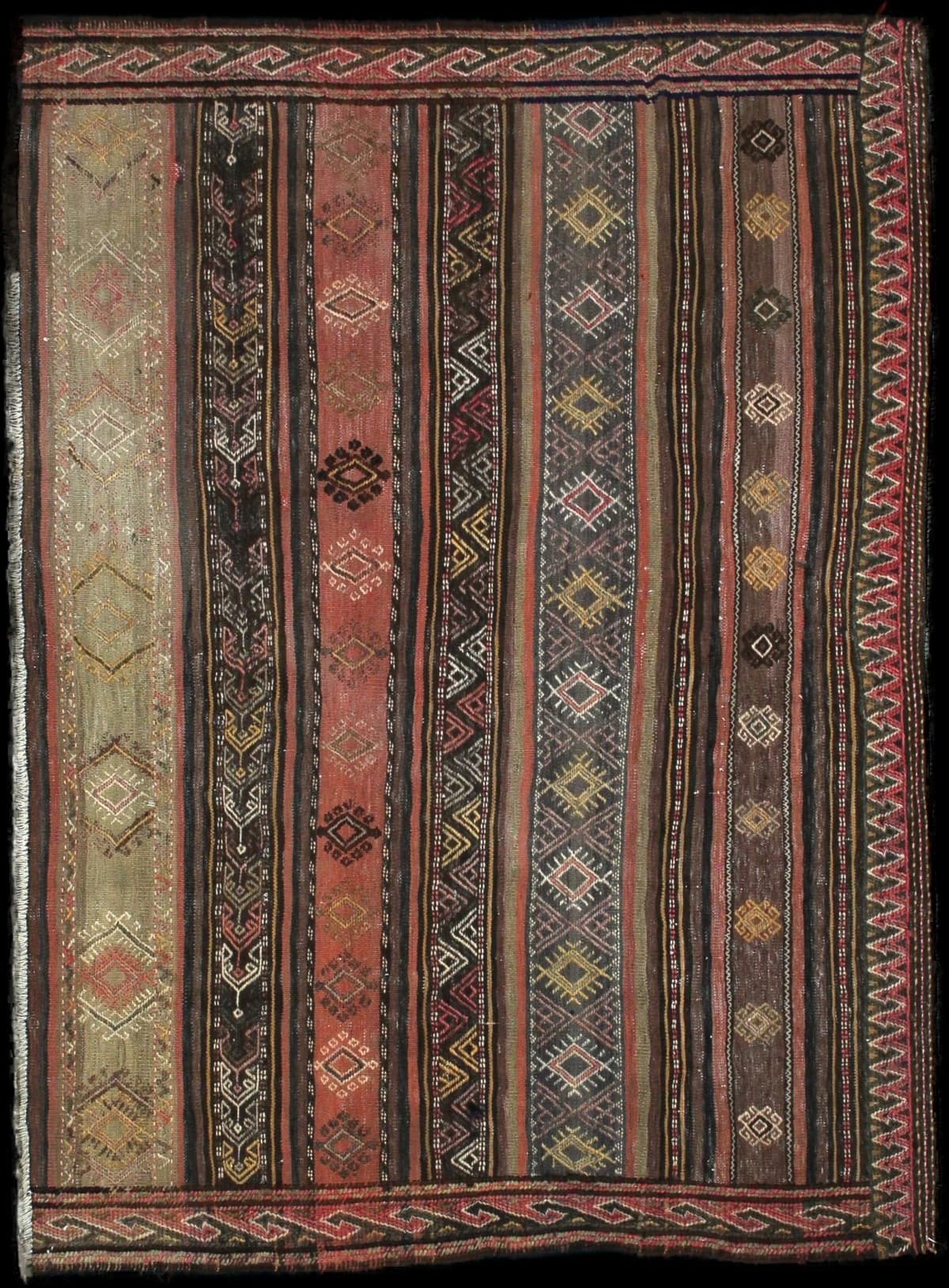
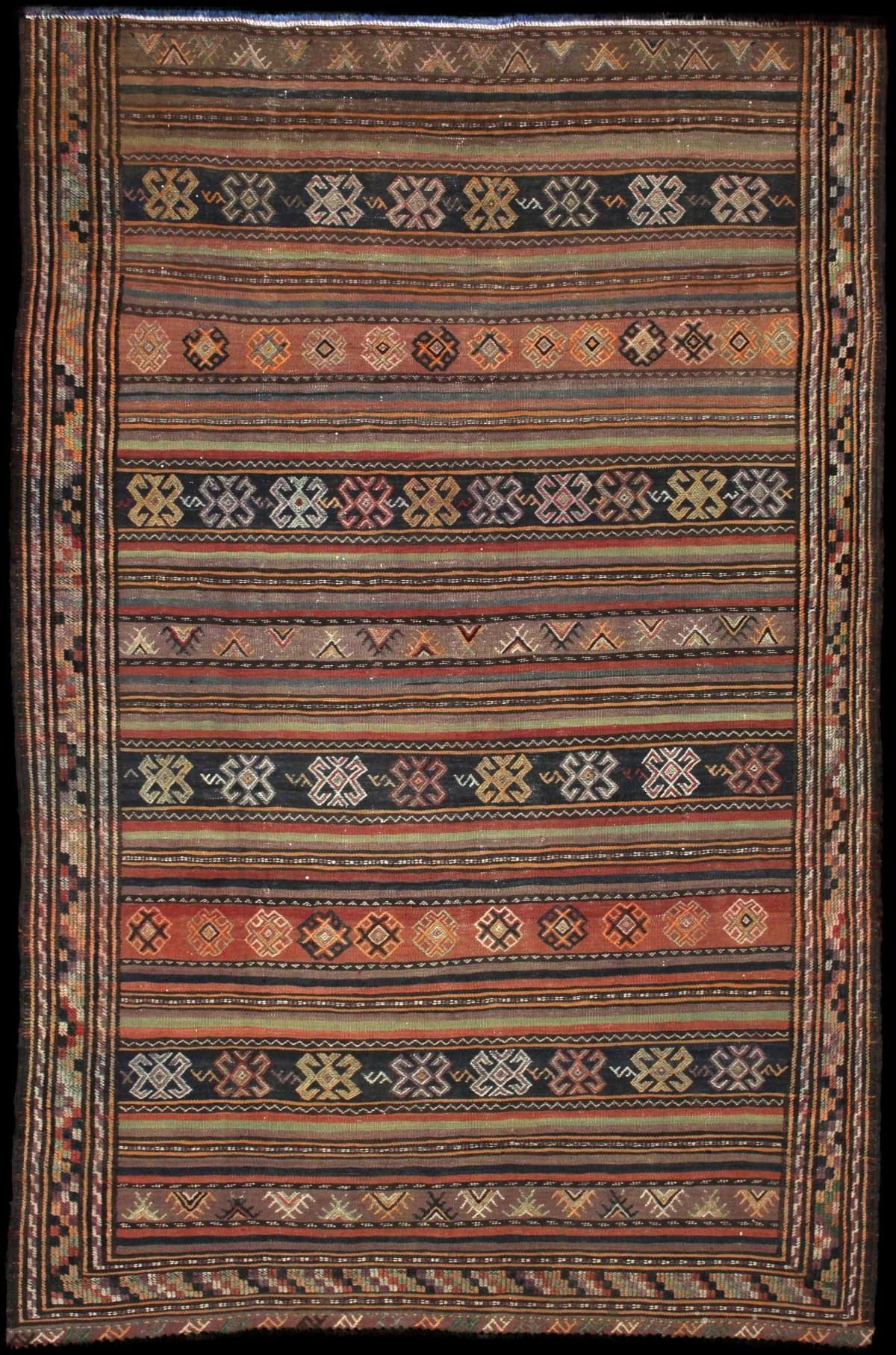
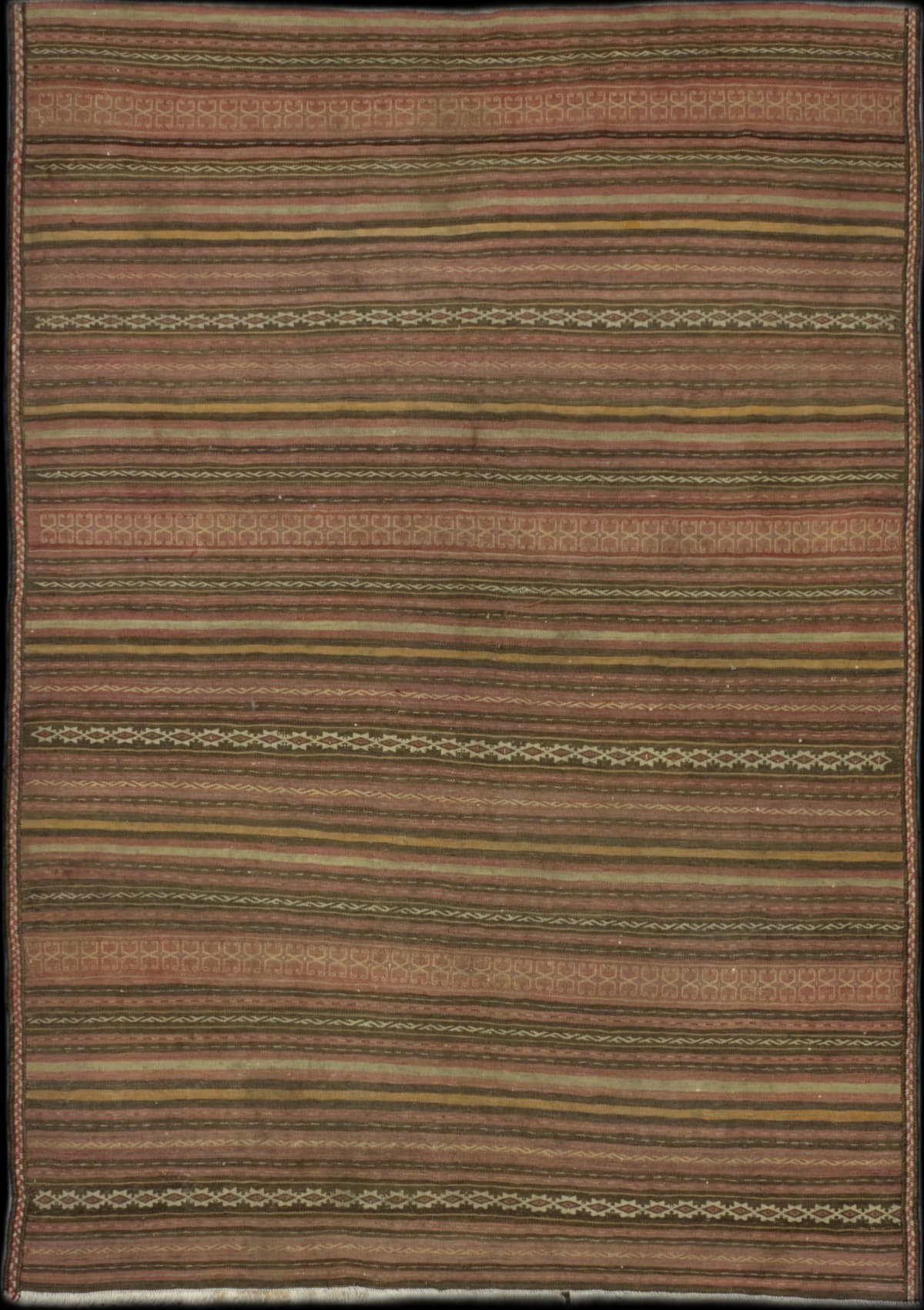
Shiraz lies in the south-west of Iran, the capital of Fars Province and the selling market for the whole of it. Fars, in its older spelling Pars, is the province that gave the rest of the world the words Persian and Farsi. The city was the seat of the Zand dynasty in the later eighteenth century, it holds the tombs of the poets Hafez and Saadi, and the ruins of Persepolis stand roughly sixty kilometers to its north-east. Rugs sold under its name are woven in the city itself and in the villages spread around it across the surrounding Fars countryside.
Weaving here is the work of tribal families who have settled. The looms are handmade and fixed in place, standing inside the weavers' own houses rather than being rolled up and carried between pastures, and that is the practical difference between this weave and a rug made on the move. When a piece comes off the loomThe frame on which the warp (vertical) threads are strung first and held under tension so the weft (horizontal) threads can be interlaced through them and the knots tied onto them. Hand-knotted rugs are made on simple looms, from those set up in weavers' homes to the compact, transportable ones of nomadic weavers, where every knot is tied by hand. Loom size sets rug size: nomads' small looms typically yield rugs no larger than about 4 x 6 or 5 x 7 ft (1.2 x 1.8 m or 1.5 x 2.1 m), city workshops with very large looms weave palace sizes, and the number of looms a workshop runs gauges its scale. Wooden looms in tribal and village weaving expand and contract over time, one cause of crooked rugs. Power looms such as Wilton, Axminster, and Jacquard, the industrial descendants, make machine-woven carpet.See in the carpet dictionary the family takes it into the local bazaar and sells it to the rug merchants there. The habit has turned the city into a clearing house for its neighbors too: the town of Abadeh, away to the north, is too small to support a rug market of its own, so its weavers bring their work here to sell.
Much of what makes the design recognizable comes from migration. Most of the weavers around the city arrived from the surrounding regions and brought with them the patterns they already knew how to tie, learned at home before they moved, and those repertoires then mixed. The result is a hybrid rather than a single house style, and the two parent traditions are usually easy to name: Abadeh, the small town that sits on the road running north towards Isfahan, and QashqaiTribal rugs woven by the Qashqai, a nomadic tribe of southwestern Iran that unites Turkic, Arab, Kurdish and Lur groups and has lived in the region since at least the 16th century. Designs come from memory rather than written plans, pairing geometric and medallion layouts, occasionally in a simpler, sparsely detailed form, with animals, plants and household objects, in jewel-tone reds, saffron gold and indigo, often on deep red or dark navy grounds. The thick, hard-weaving wool of the tribe's own flocks is durable yet soft, forming a medium-height, dense pile on a cotton or wool foundation that suits busy areas; compact looms keep sizes small, typically 4 x 6 ft (1.2 x 1.8 m) or 5 x 7 ft (1.5 x 2.1 m) plus runners.See in the carpet dictionary, the work of the region's best-known tribal confederation. This is tribal drawing meeting tribal drawing, not a city workshop dressing up village work.
Layouts are geometric almost without exception, and three arrangements keep recurring. One is a single large geometric medallionA layout in which one large angular medallion stands at the center of the field, with separate corner designs and a much lighter pattern over the remaining ground, so the medallion is the clear focal point. Smaller geometric medallions often sit above and below the main one. It is typical of village and tribal rugs such as Heriz, Abadeh, Zanjan, Karaja and Qashqai, and is the angular counterpart of the floral center medallion.See in the carpet dictionary held in the center of the field. Another is a column of repeating medallions running the length of the rug. The third dispenses with the medallionA large motif at the center of a rug's field, around which the rest of the design is organized; the large central medallion is said to have been introduced in the Safavid era (16th-17th centuries). Floral medallions, typical of city rugs such as Tabriz, Kashan and Sarouk, are often read as a lotus blossom, and the motif has also been read as mirroring the interior dome of a mosque; geometric ones, often hexagonal or diamond-shaped, mark village and tribal rugs such as Heriz and Zanjan. A medallion may stand alone, come with four corner pieces, be flanked by smaller medallions above and below, or repeat down a runner. Rugs with no central motif are called allover. In a well-made rug the medallion sits at the center and the corners mirror one another, as closely as handwork allows.See in the carpet dictionary altogether and covers the whole ground with an all-over geometric pattern. Even when a medallion anchors the center, the taste runs towards a filled field rather than an open one, so the surface reads as busy and lively rather than calm and formal.
BotehA teardrop-shaped motif with a curved upper tip, ubiquitous in Persian and Kashmiri weaving for centuries. The Persian word is glossed as “budding flower or plant,” and the motif stands for growth and regeneration; it is also read as a cypress that bends in the wind but rarely breaks, a flame, a seed, a pine cone or a stylized almond. When Scottish mills began imitating Kashmir shawls in the 19th century, the boteh became known in the West as “paisley,” after the town of Paisley. In rugs it usually repeats throughout the field, notably in Tabriz, Sarouk, Kerman, Mashhad and Malayer pieces.See in the carpet dictionary is the one named motif that turns up reliably in this group. It is drawn as a teardrop with a curled tip, read sometimes as a flame and sometimes as a pine cone, and it is usually repeated in rows across the field. The word means a budding flower or plant in Farsi, and in Persian culture the shape stands for growth and regeneration. European buyers will recognize the same figure as paisley, named after the Scottish town whose mills imitated Kashmir shawls and so kept the Persian shape while losing the Persian name.
From the Abadeh side of the family come hexagonal geometry, a small rosetteA round, flower-like ornament in which petals radiate evenly from a center, like a blossom seen from above. From about the 16th century, as floral design entered Persian rugs, weavers began placing a rosette at the center of the field, which produced the central medallion of floral city rugs, as in the circular rosette medallion with scrolling lines on a round Shah Abbasi Tabriz. On Abadeh rugs a small rosette worked in navy, red or cream marks the center of the medallion, one way to tell the type apart. Rosettes also repeat along borders, as in Tabriz and Bakhtiari rugs, and among the vines and palmettes of Sultanabad rugs.See in the carpet dictionary set at the heart of the medallion, and a scattering of stylized living things across the ground: horses, sheep, birds, trees and flowers, squared off into straight lines and right angles. These are not naturalistic pictures, and at this weave they could not be. A horse is four legs, a back and a tail, reduced until it can be tied square by square at a coarse knot countThe number of knots in one square inch of a hand-knotted rug (KPSI; 1 KPSI is about 15.5 knots per 10 x 10 cm), counted on the back with a ruler by multiplying the knots along one inch of height by those along one inch of width, averaged over two or three areas. More knots give sharper detail, like a higher-resolution screen, and, all else equal, somewhat more durability and a higher price, but density alone does not grade quality: Heriz and Bijar are durable at low to medium counts, while floral curvilinear designs blur without enough knots. Figures run from under about 80 for coarse tribal weaves such as Gabbeh and Qashqai, through roughly 120 to 225 for many village rugs and 300 to 700 for fine city rugs such as Nain and Isfahan, to 600 to 1,000 or more for pure silk Qum.See in the carpet dictionary, and that reduction is exactly why tribal drawing of this kind still reads clearly from across a room.
What the Qashqai side contributes is a way of working rather than a set of shapes. Nothing is drawn out first; there is no cartoon pinned above the loom and no squared paper to follow. The pattern is carried in memory and handed down from one generation to the next, and the weaver fills the field with what surrounds her, animals, household objects, plants and the scenes of the year. A family that does not write its history down weaves it instead, which is why two rugs from the same household rarely match each other exactly.
Color is where the group is at its most consistent. The field is usually a strong red or a warm brown, with the pattern picked out over it in cream, yellow, blue and green. The reds run deep rather than bright, and the cream does most of the work of legibility, outlining the forms so the geometry stays readable at a distance. Set beside a Qashqai, which favors jewel tones of saffron gold and indigo over deep red or navy grounds, a rug from around Shiraz reads a little earthier and a little quieter.
The pileThe surface of a rug or carpet, made of upright fibers in cut tufts or loops. In a hand-knotted rug it is formed by the cut ends of thousands of wool or silk knots tied onto the warp row by row, trimmed lightly during weaving and given its final height by shearing at finishing. Pile thickness, measured from the back of the rug to the top of the pile, typically runs from low, about 1/8 to 1/4 inch (3 to 6 mm), to high, about 1/2 to 5/8 inch (13 to 16 mm). Fine, dense designs are cut short to keep the pattern sharp; higher pile suits traffic and heavy furniture, lower pile suits door clearance and humid rooms.See in the carpet dictionary is almost always woolA natural animal fiber used for the pile, and in some rugs also the foundation, of high-quality rugs. It is durable, resilient, stain resistant and flame resistant, feels soft and cushioned underfoot, insulates against cold, and takes up dye readily and holds it for many years. It also traps dust particles, which helps reduce allergic reactions. Quality depends above all on where the sheep graze: high-elevation pastures and good feed give thicker, oilier wool, with Manchester, New Zealand and Ghazni wools the best-known prized examples. Early-spring shearing and hand spinning (finer, softer thread than machine spinning) improve it further, while thin, dry wool from dead sheep goes into cheaper rugs.See in the carpet dictionary, and the tribal flocks of Fars graze the Zagros highlands that the city itself sits among. Fleece of that kind is known in the trade as hard weaving wool: thicker than the clip the workshop cities buy, harder to spin and harder to tie at the loom. It repays the difficulty in wear. Rugs built from it take punishment and still keep a soft handle underfoot, which is the combination that makes this a floor covering rather than something to be hung up and admired.
Foundations are either cotton or wool, and which one a rug has changes how it feels in the hand. A wool foundationA rug base in which the warp and weft threads are wool instead of cotton. It is typical of tribal rugs such as Baluchi, Turkoman and Gabbeh (Gabbeh and Quchan sometimes use goat hair instead), turns up in some Qashqai, Shiraz, small Bakhtiari and Iranian Azerbaijan pieces, and is common in older village and tribal rugs, including some Hamadan and very antique Karaja. Experts use it as a clue to age, since rugs made after about the 1930s usually have a cotton foundation, once machine-spun cotton became widely available. Wool's soft, less rigid structure gives the design a fluid, warm character, and the fringes are sometimes braided or in different colors. The drawback is that wool shrinks and stretches with humidity, so these rugs tend to be less straight than cotton-based ones.See in the carpet dictionary goes together with the Turkish, or symmetrical, knot and produces a looser pile with some give in the body of the rug. A cotton foundation packs tighter, holds its shape more firmly and carries tighter knots. Neither is the better choice; they are different rugs sold under one name, and bending a corner back to see which foundation is underneath tells you more about how a piece will behave than the name on it does.
Knot density is low to medium, averaging around 120 knots per square inch (KPSI). That places these rugs in the everyday-durable band rather than the fine one, and it suits the drawing, because bold geometry needs no great resolution and a coarser weave gives a thicker, more forgiving carpet. Neighboring Abadeh, by comparison, runs to roughly 225 KPSI, since its small animals and flowers need the extra detail simply to be readable. A higher count is not automatically better. It is better for finer patterns, and this is not a fine pattern.
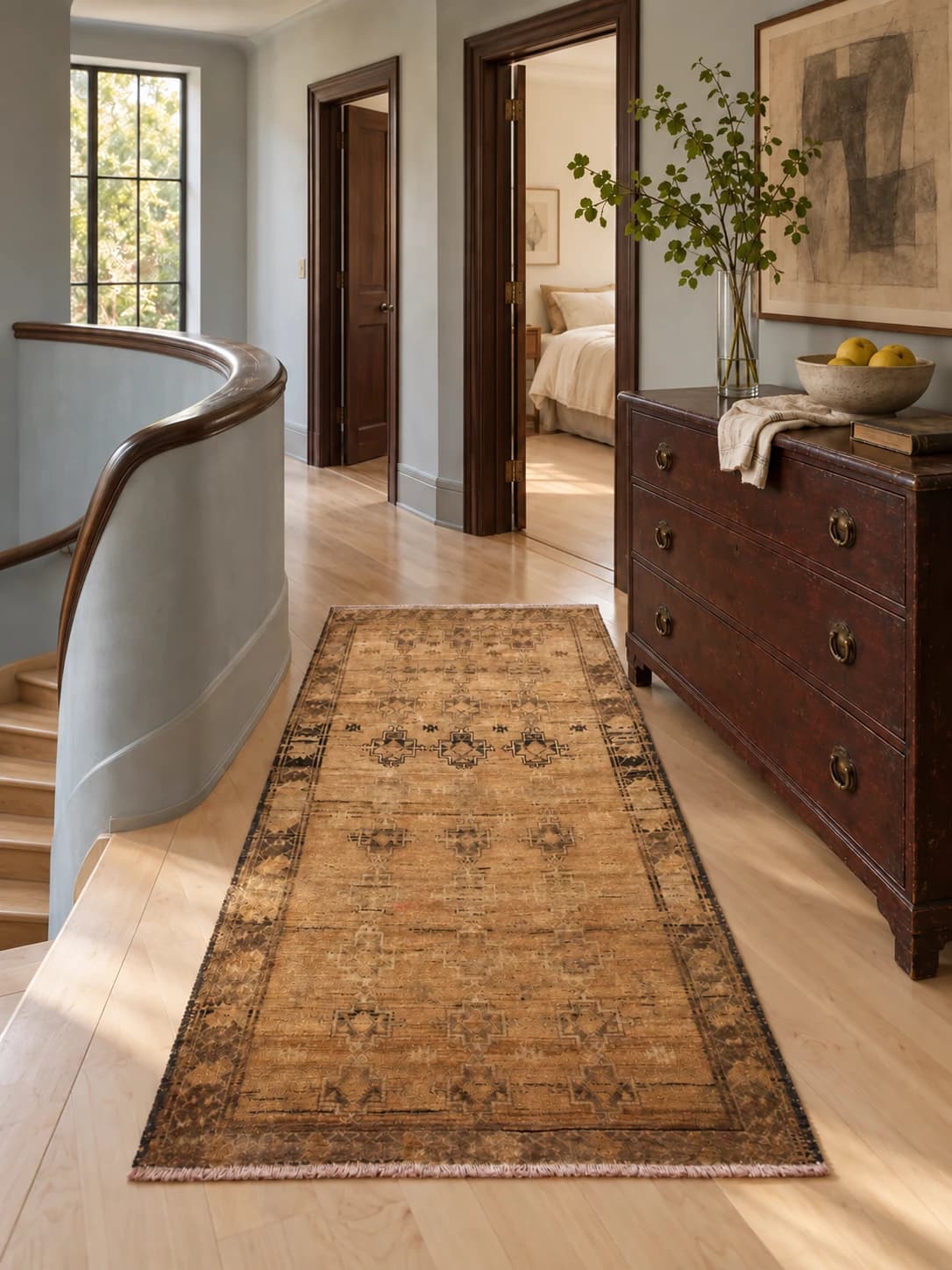
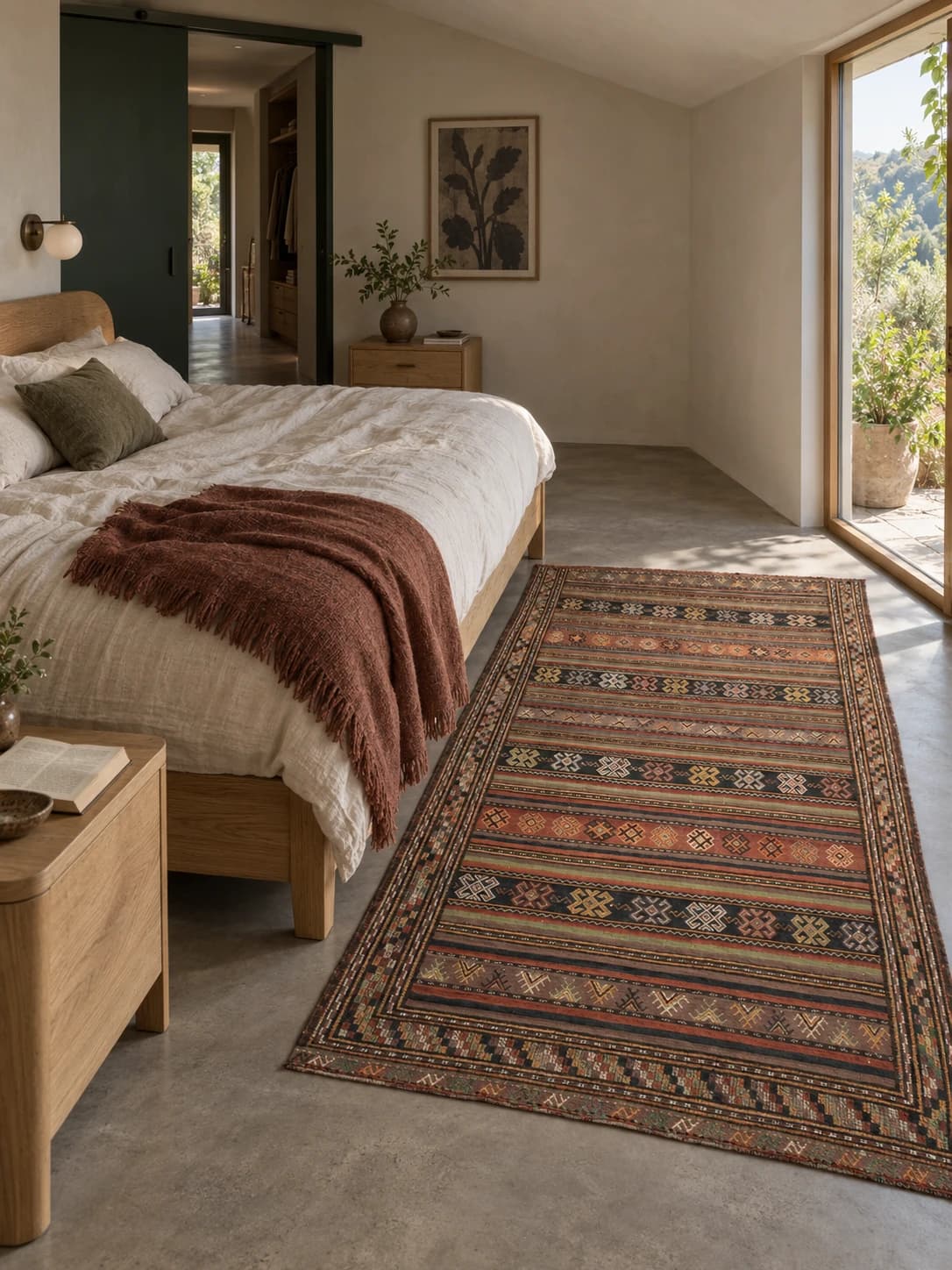
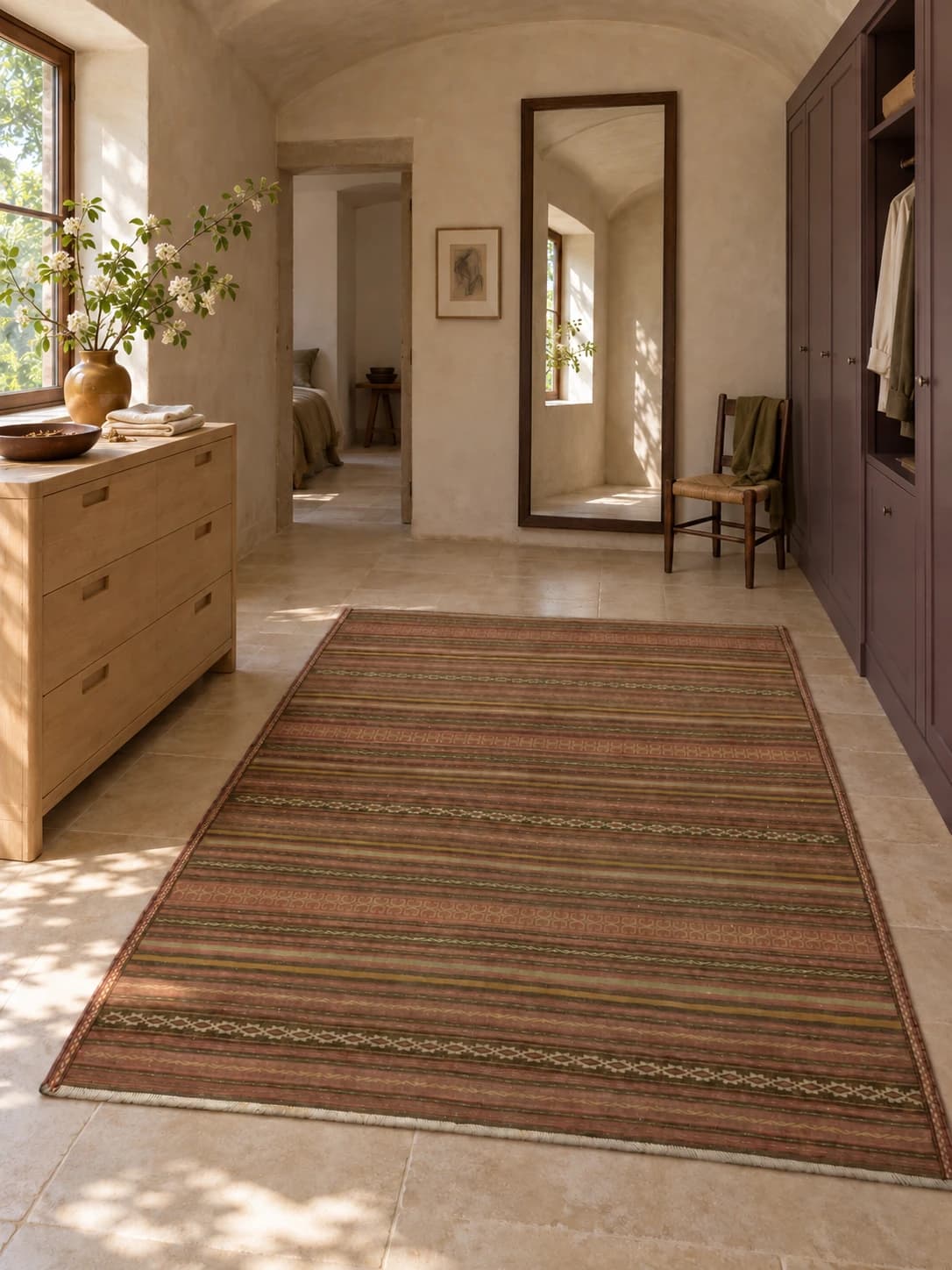
Because the looms are fixed and stand in a house rather than folding into a saddlebag, the sizes reach further than genuinely nomadic weaving allows. A portable frame holds its rugs to roughly 120 by 180 centimeters, 150 by 210 centimeters and runners, whereas a loom built into a home can be sized to the room it serves. Expect small and mid-room formats in quantity and larger pieces less often. These are carpets made to be walked on, and the weave and the wool together take hallway and living-room traffic without complaint.
India
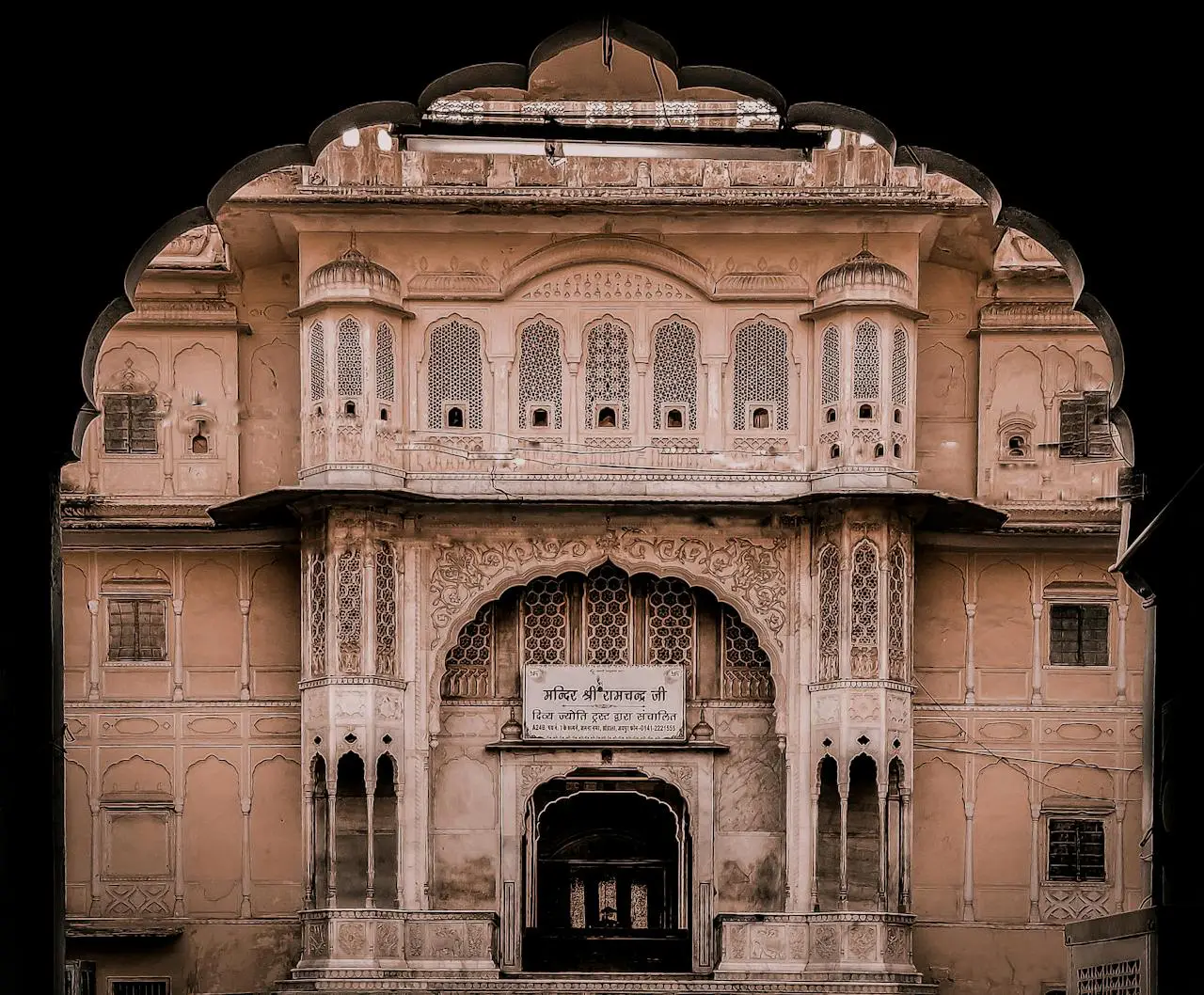
Indian rugs belong to one of the world's most diverse and historically rich weaving traditions, encompassing styles that range from intricate Persian-inspired designs to bold tribal patterns and contemporary work. They reflect India's long position as a cultural crossroads.
Dating back to the Mughal Empire, Indian carpet weaving blends indigenous artistry with influences from Persia, Central Asia, and later, European design sensibilities. This fascinating fusion has created a distinctive aesthetic that combines flowing arabesques, naturalistic florals, and geometric patterns with India's characteristic use of vibrant color combinations.
The material palette of Indian rugs showcases the subcontinent's natural resources. The finest pieces feature woolA natural animal fiber used for the pile, and in some rugs also the foundation, of high-quality rugs. It is durable, resilient, stain resistant and flame resistant, feels soft and cushioned underfoot, insulates against cold, and takes up dye readily and holds it for many years. It also traps dust particles, which helps reduce allergic reactions. Quality depends above all on where the sheep graze: high-elevation pastures and good feed give thicker, oilier wool, with Manchester, New Zealand and Ghazni wools the best-known prized examples. Early-spring shearing and hand spinning (finer, softer thread than machine spinning) improve it further, while thin, dry wool from dead sheep goes into cheaper rugs.See in the carpet dictionary from the Himalayan highlands, prized for its exceptional length and luster, while premium variants incorporate lustrous silk from Bengal and Karnataka. Many contemporary pieces also feature innovative fiber blends that enhance durability while maintaining traditional elegance.
Color plays a central role in Indian rug design, with dyers working a wide spectrum that runs from jewel-toned rubies and sapphires to vegetable-dyed earth tones. Modern Indian rugs often carry bold, contemporary palettes that stretch the traditional boundaries without abandoning them.
Construction techniques vary across India's weaving centers, with knot counts ranging from moderate 100 KPSIThe number of knots in one square inch of a hand-knotted rug (KPSI; 1 KPSI is about 15.5 knots per 10 x 10 cm), counted on the back with a ruler by multiplying the knots along one inch of height by those along one inch of width, averaged over two or three areas. More knots give sharper detail, like a higher-resolution screen, and, all else equal, somewhat more durability and a higher price, but density alone does not grade quality: Heriz and Bijar are durable at low to medium counts, while floral curvilinear designs blur without enough knots. Figures run from under about 80 for coarse tribal weaves such as Gabbeh and Qashqai, through roughly 120 to 225 for many village rugs and 300 to 700 for fine city rugs such as Nain and Isfahan, to 600 to 1,000 or more for pure silk Qum.See in the carpet dictionary to extraordinarily fine 500 KPSI in premium pieces. The versatility of Indian weaving traditions allows for both plush, deep-piled luxury carpets and flat-woven dhurrieA flat-woven rug from India, traditionally made of cotton or wool, characterized by geometric patterns and reversible design.See in the carpet dictionary rugs that suit different climates and preferences.
Notably, Indian rugs lend themselves well to custom work. Contemporary Indian workshops expertly adapt traditional patterns to modern interior requirements, offering bespoke sizing, color matching, and design modifications while maintaining authentic weaving techniques.
Modern Indian rug production embraces both time-honored handcraft and innovative sustainable practices. Many workshops now use eco-friendly dyes, ethical wool sourcing, and fair labor practices, making these rugs an excellent choice for environmentally conscious consumers.
Indian rugs offer sound value across the whole market, from elegant everyday pieces to museum-quality masterworks, with a favorable ratio of quality to price and, in the hand-knottedA rug construction in which the weaver ties each knot of wool or silk pile yarn by hand around adjacent warp threads on a loom, then runs a weft through the row and beats it down. The cut knot ends form the pile, the warps and wefts form the foundation, and the warp ends become the fringe. A rug can take months or even years, and the work leaves subtle irregularities: patterns not perfectly symmetrical, opposite edges a few inches different in length, an uneven fringe. Authentic Persian, Oriental and Turkish rugs are hand-knotted, unlike hand-tufted rugs (sometimes sold as “handmade”) and machine-made ones, whose backs feel stiff and evenly aligned.See in the carpet dictionary grades, the longevity that comes with wool and honest construction.
Each Indian carpet carries a story of cultural inheritance and craft. Whether it lands in a contemporary apartment or a traditional home, it brings warmth, character and a note of the subcontinent into the room.
Questions about this carpet?
Our family has traded carpets for two generations. Ask us anything — photos, video calls, advice on sizes.
Message us
Keep exploring
Guides from our family workshop: how to clean, place and care for hand-knotted rugs.