From the region ofکلات نادریKalat-e Naderi
Up close
Origin: Kalat-e Naderi
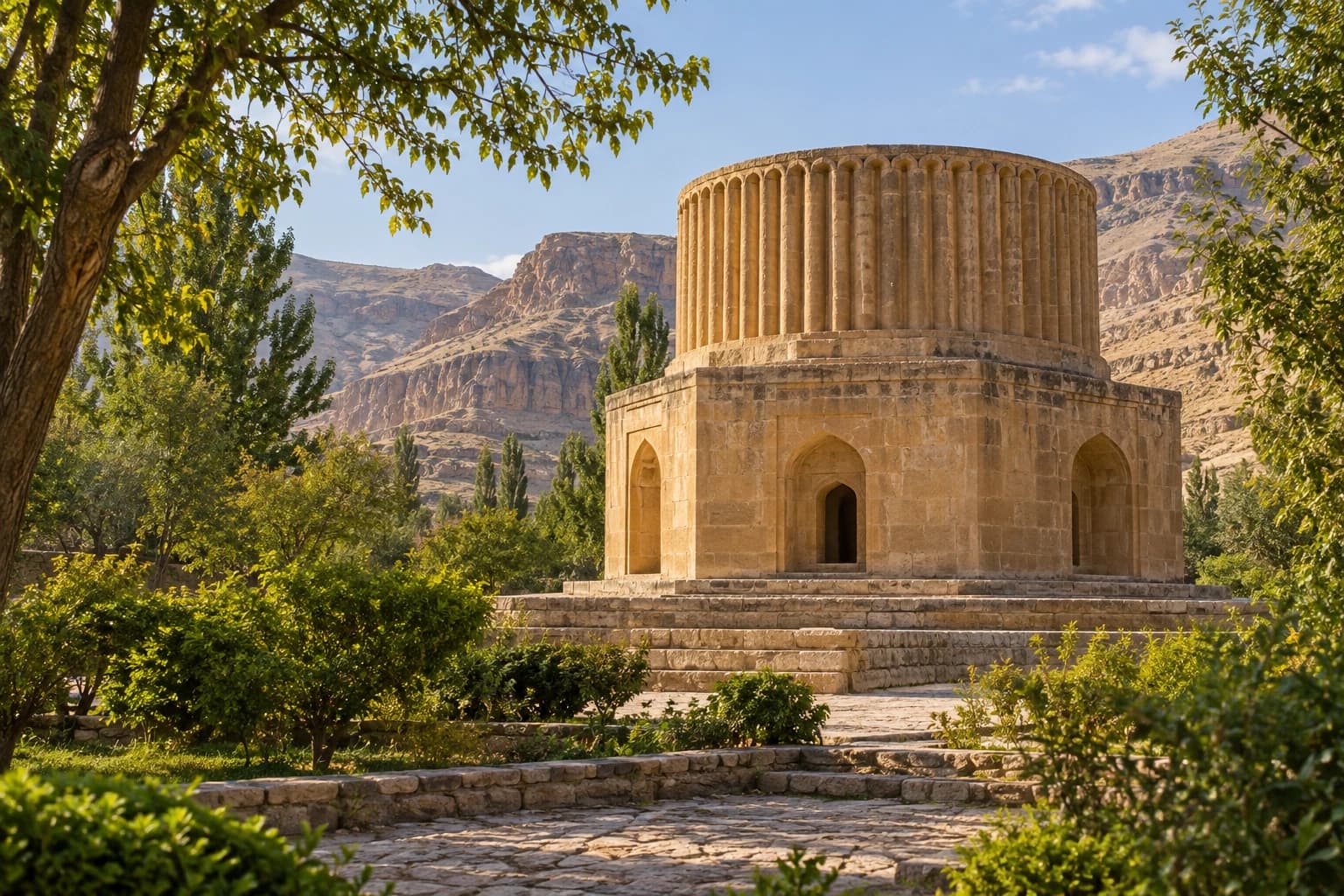
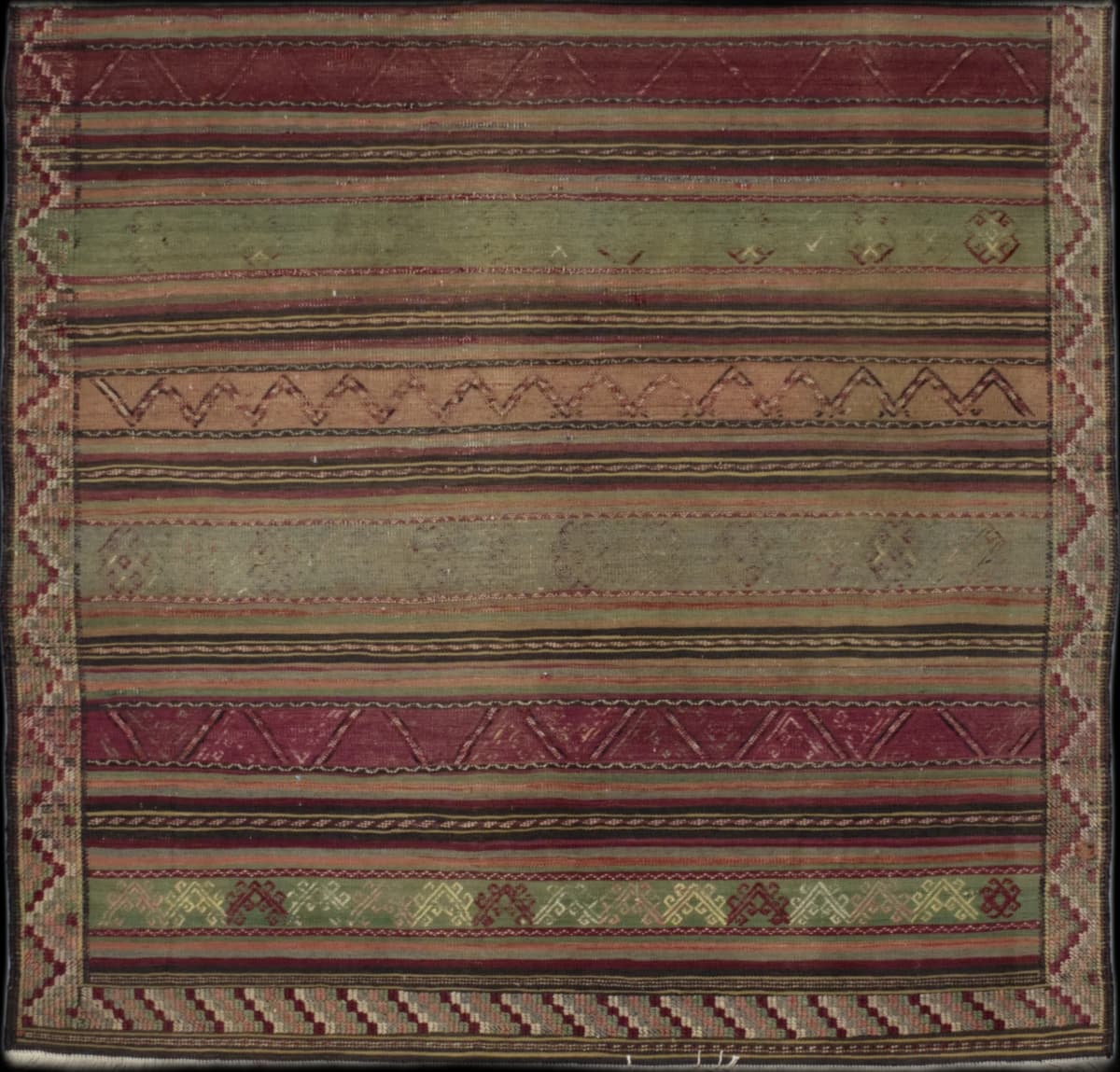
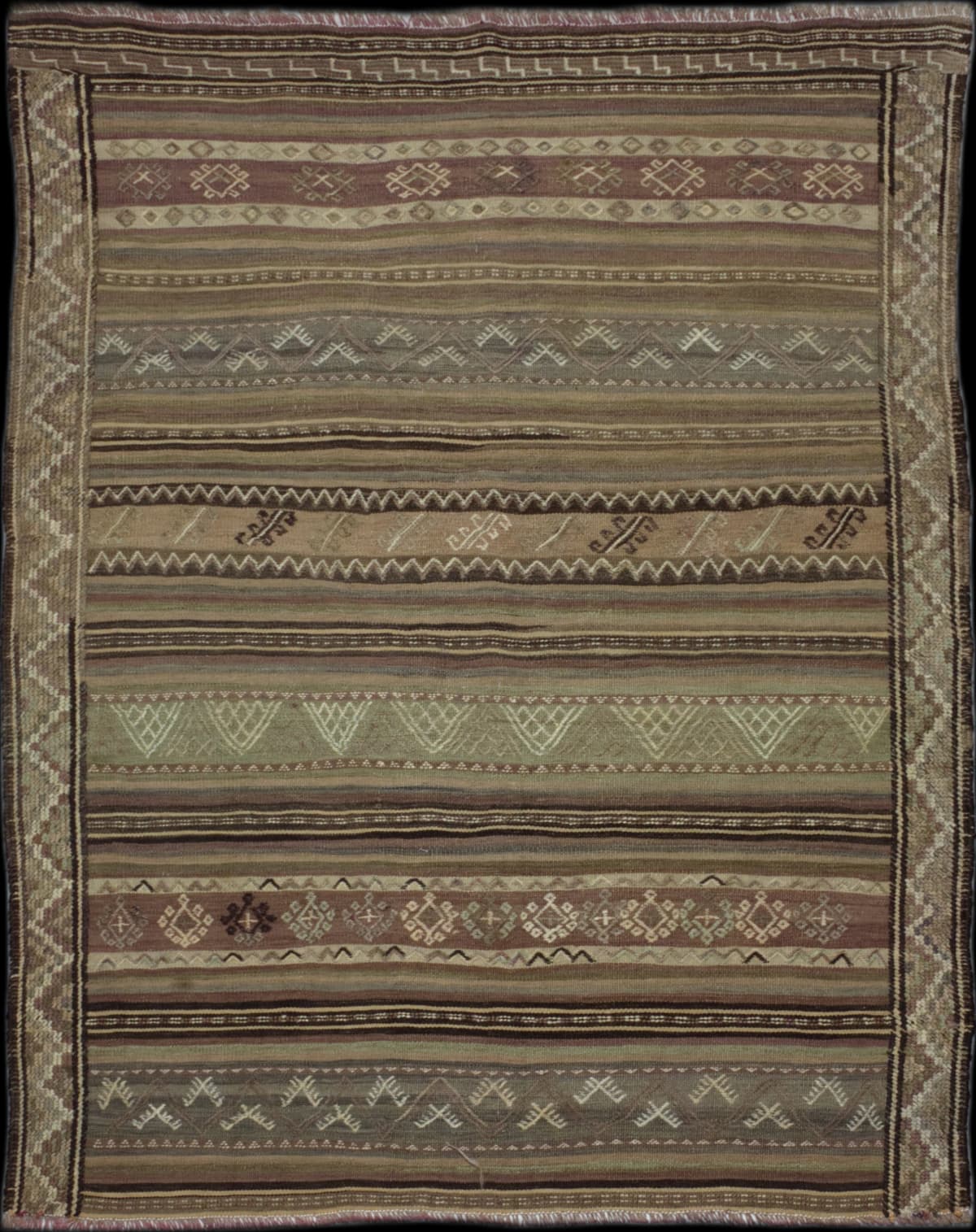
Kalat-e Naderi lies in Razavi Khorasan, the north-eastern corner of Iran, some eighty kilometres due north of Mashhad and pressed hard against the border with Turkmenistan. The name means the Kalat of Nader: kalat is an old word in Persian for a fortified mountain stronghold, and the place is exactly that, a bowl of farmland and villages ringed by the rock walls of the Hezar Masjed range and entered through a handful of narrow gorges. Nader Shah Afshar, who ruled Persia from 1736 to 1747, kept his treasury inside that natural fortress and built the Kakh-e Khorshid, the Sun Palace, within it. The town still carries his name, though the county around it is now usually written simply as Kalat.
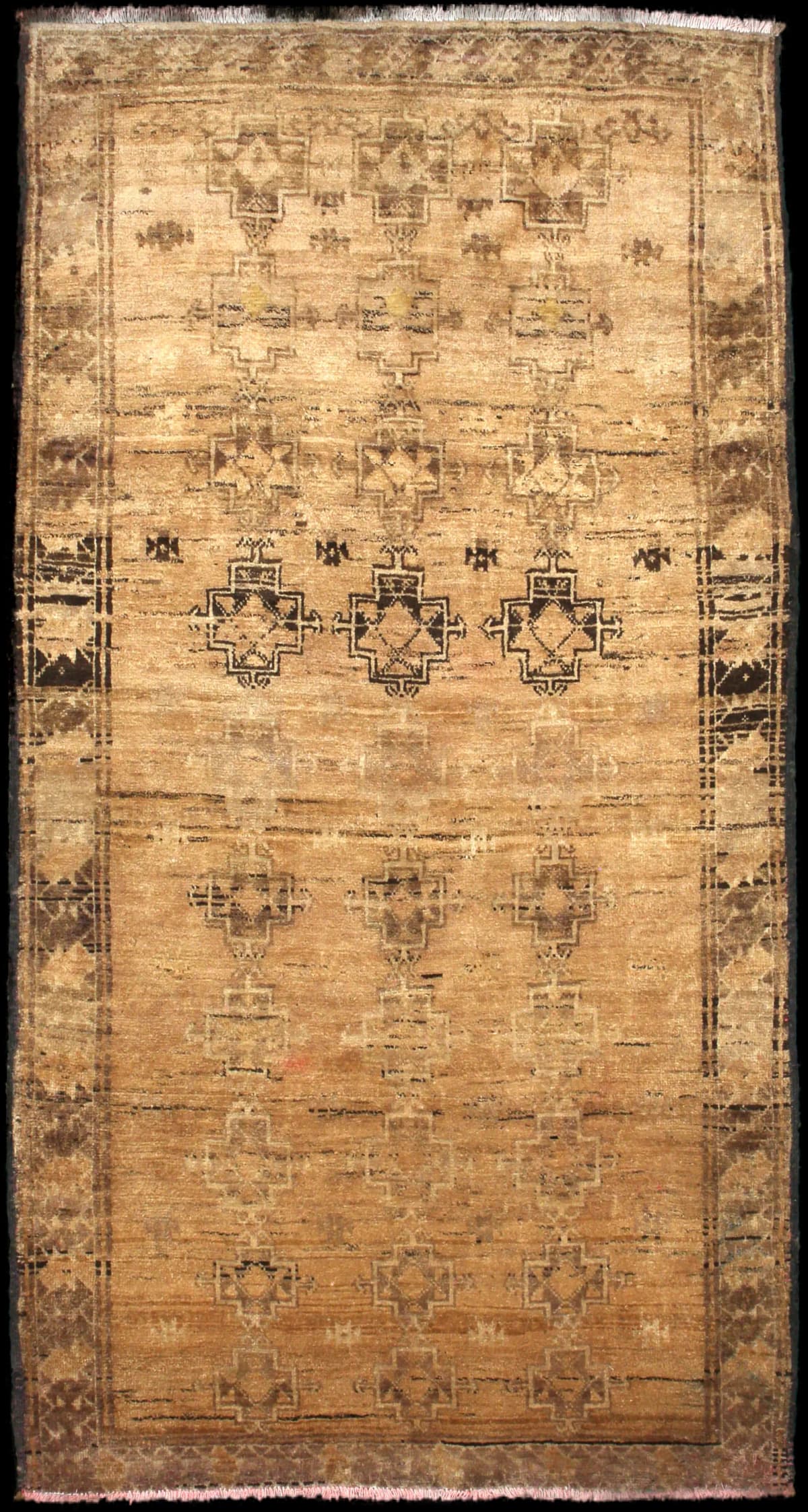
Weaving here belongs to the frontier rather than to the city. Around the turn of the seventeenth century the Safavid shahs could not hold this stretch of border against Uzbek and TurkmenTribal rugs woven by Turkoman (Turkmen) nomads, whose forebears came from the Afghan and Uzbek region and who later settled in the Turkmen region of Iran. Rows of octagonal guls (“flowers”) cover a deep red, reddish-brown or occasionally cream field, accented in black, blue, green or beige; prayer designs also occur. Foundation and pile are usually wool, said to come from the soft undercoat of Karakul sheep, though a cotton foundation is occasionally used. In older pieces each tribe kept its own gul design, whereas newer rugs freely mix them. Turkoman designs inspired Bokhara and Khal Mohammadi rugs and are the Persian design closest to Baluchi work, which they predate; the low-to-medium pile suits places where doors swing over the rug.See in the carpet dictionary raiding, so they moved Kurdish tribes east and settled them along it, trusting to a reputation as formidable fighters. Their descendants, Kurmanji-speaking Khorasani Kurds, still make up much of the population of this corner of Khorasan alongside Turkmen communities, which is how a Kurdish weaving tradition ended up more than a thousand kilometres from Kurdistan. On this frontier the work is village work, done in settled houses in the valleys rather than in migrating camps.
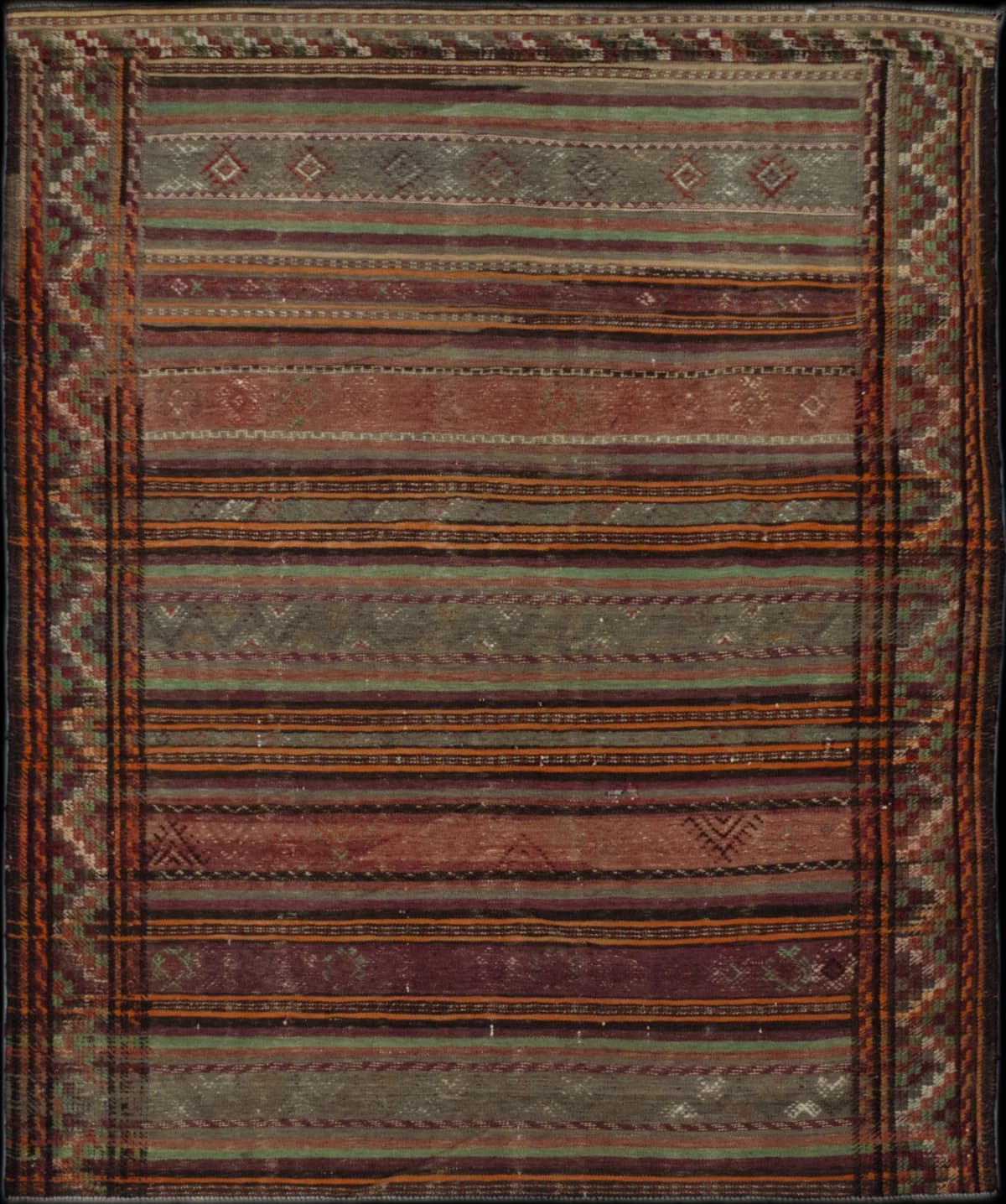
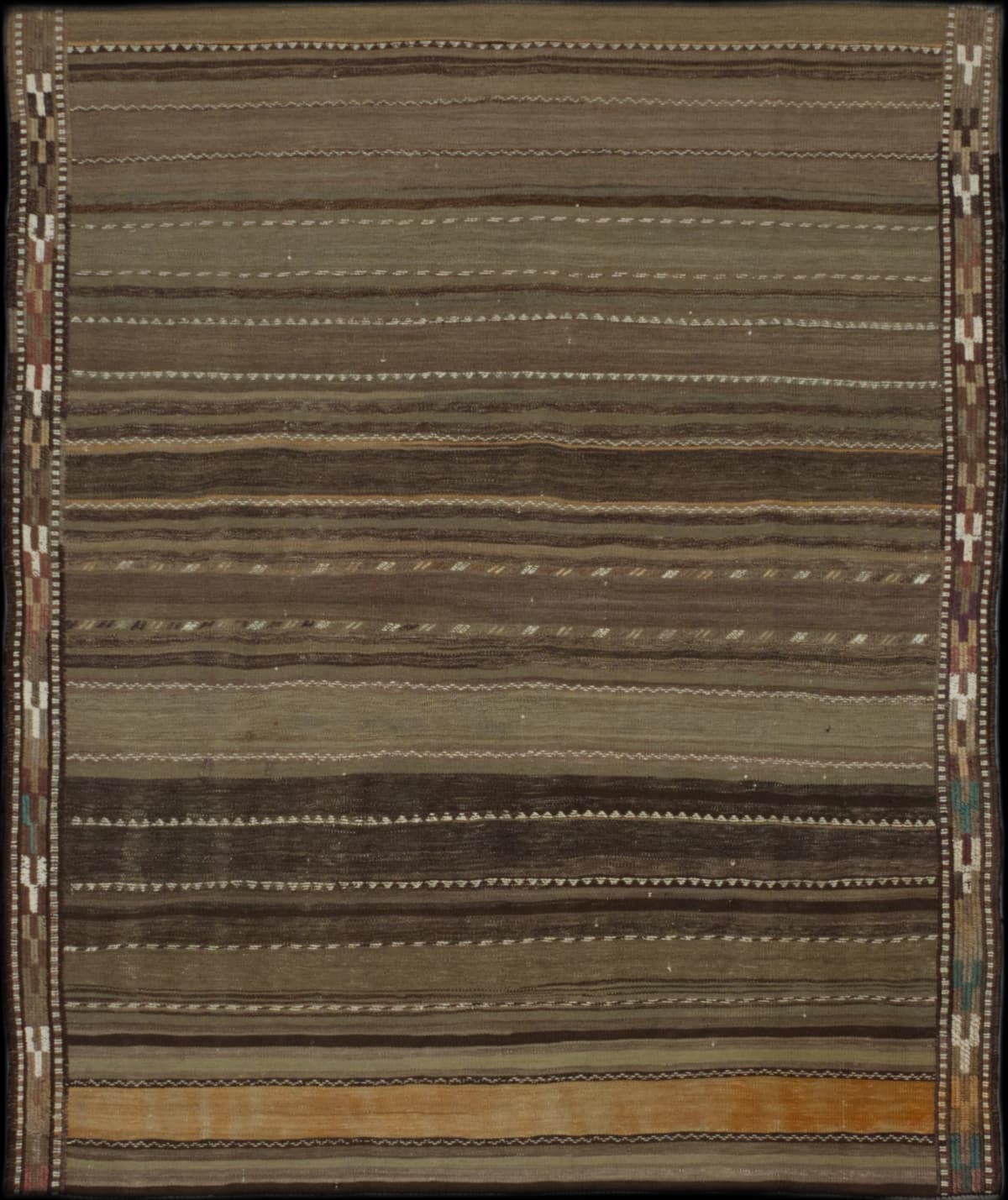
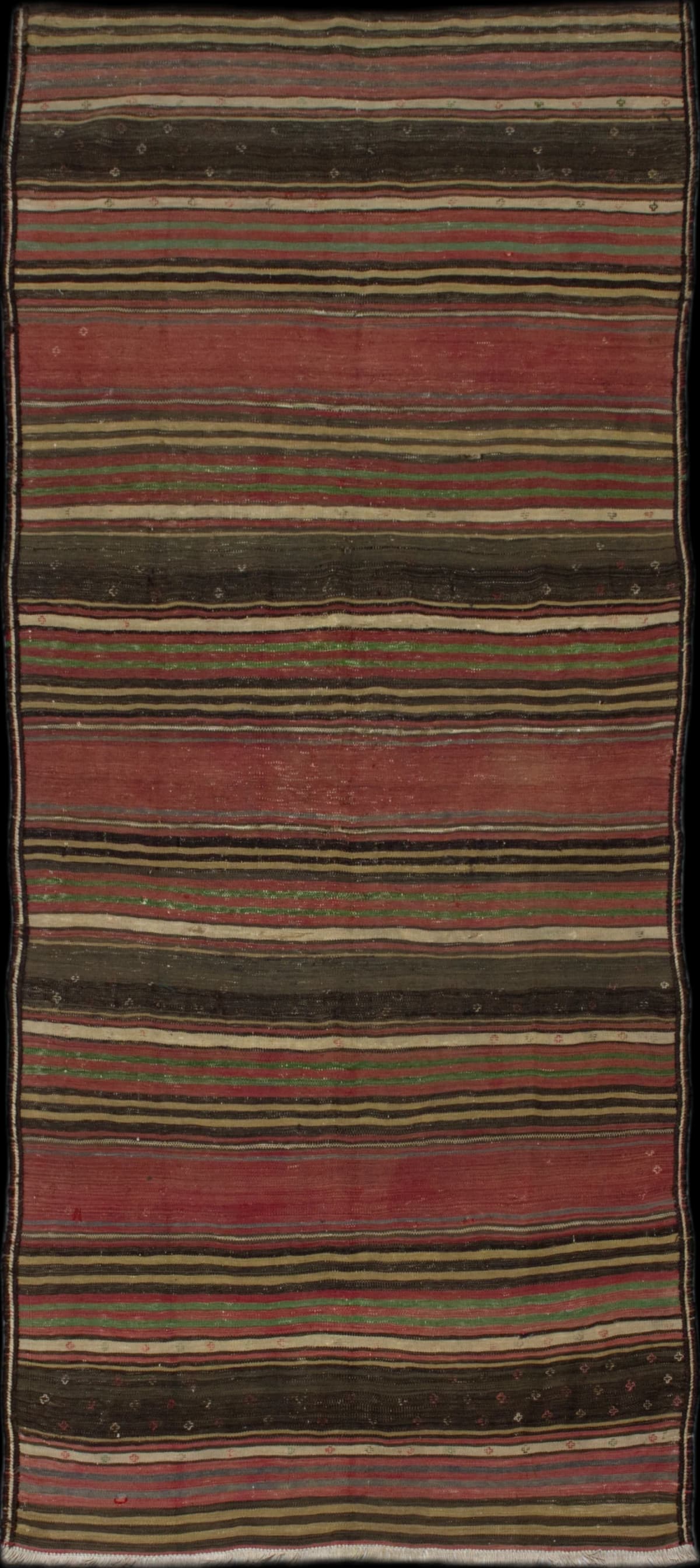
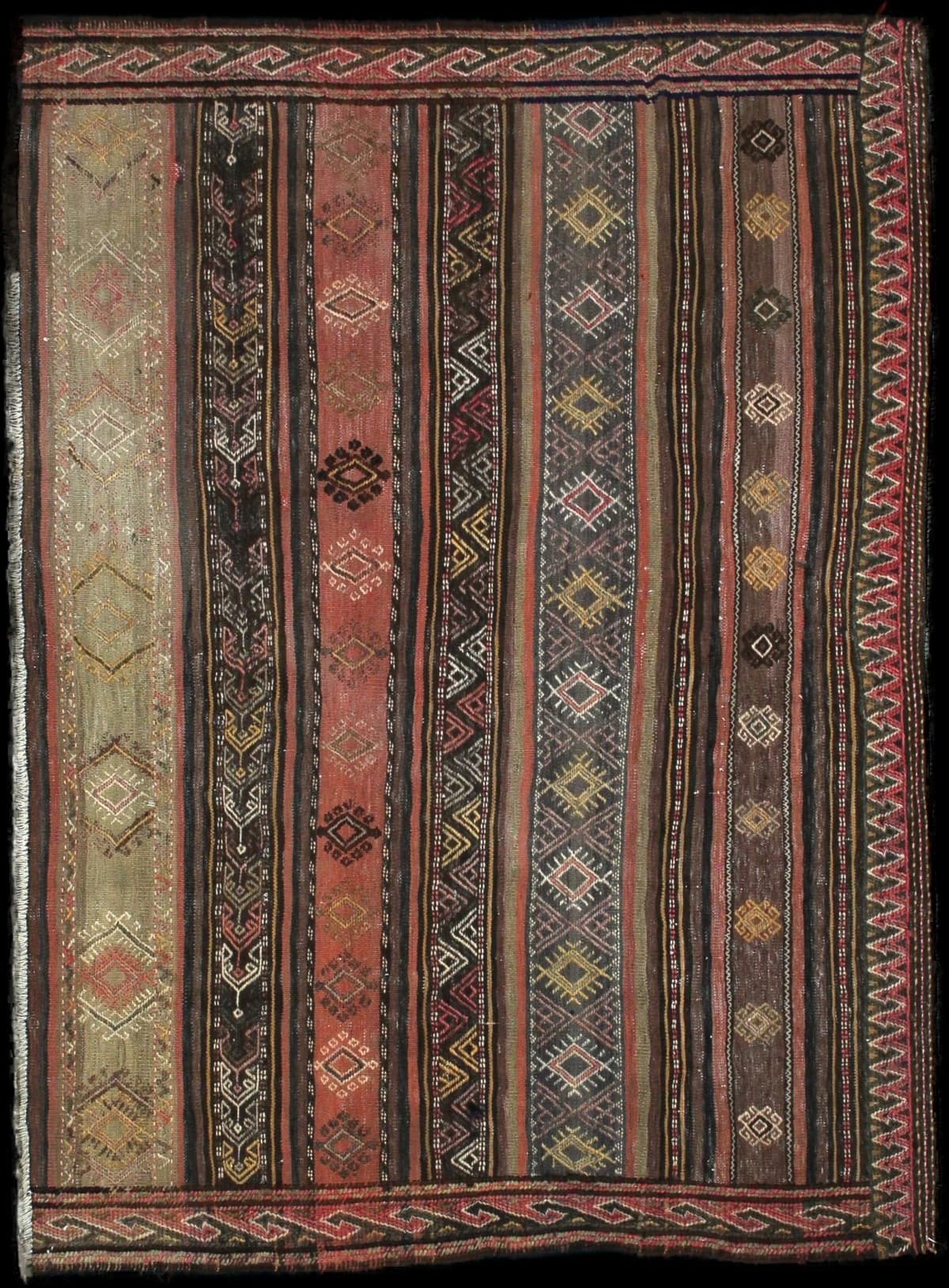
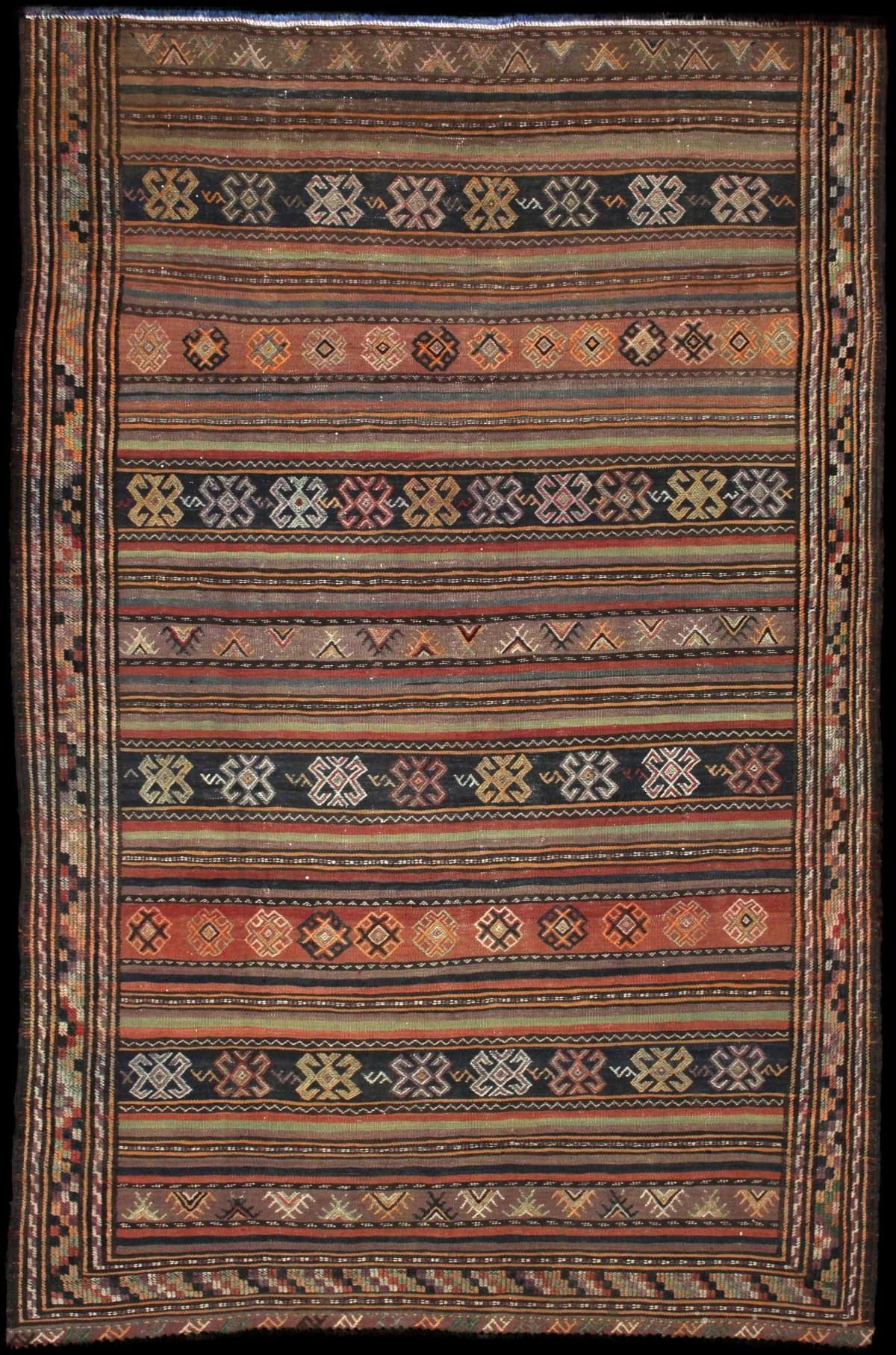
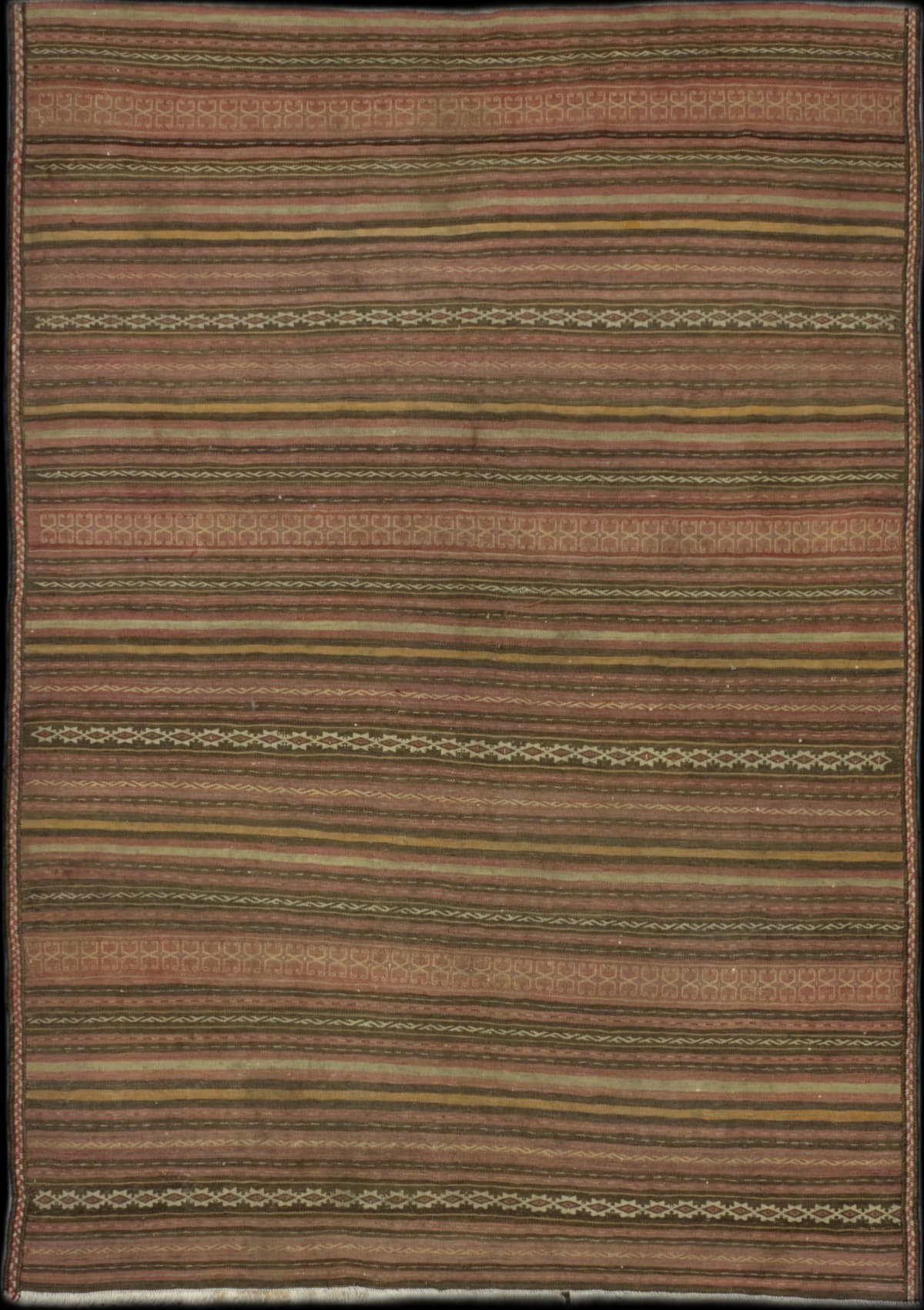
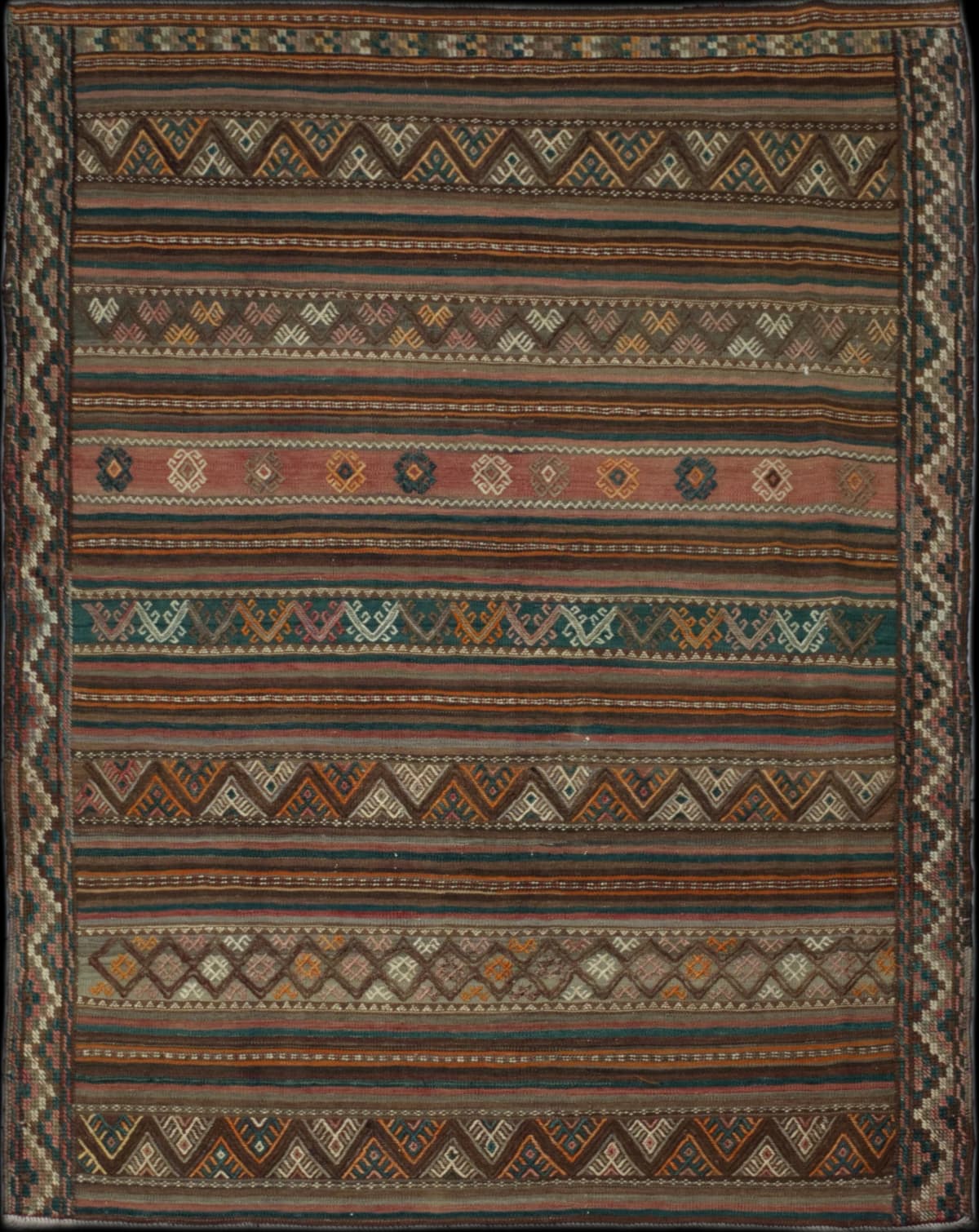
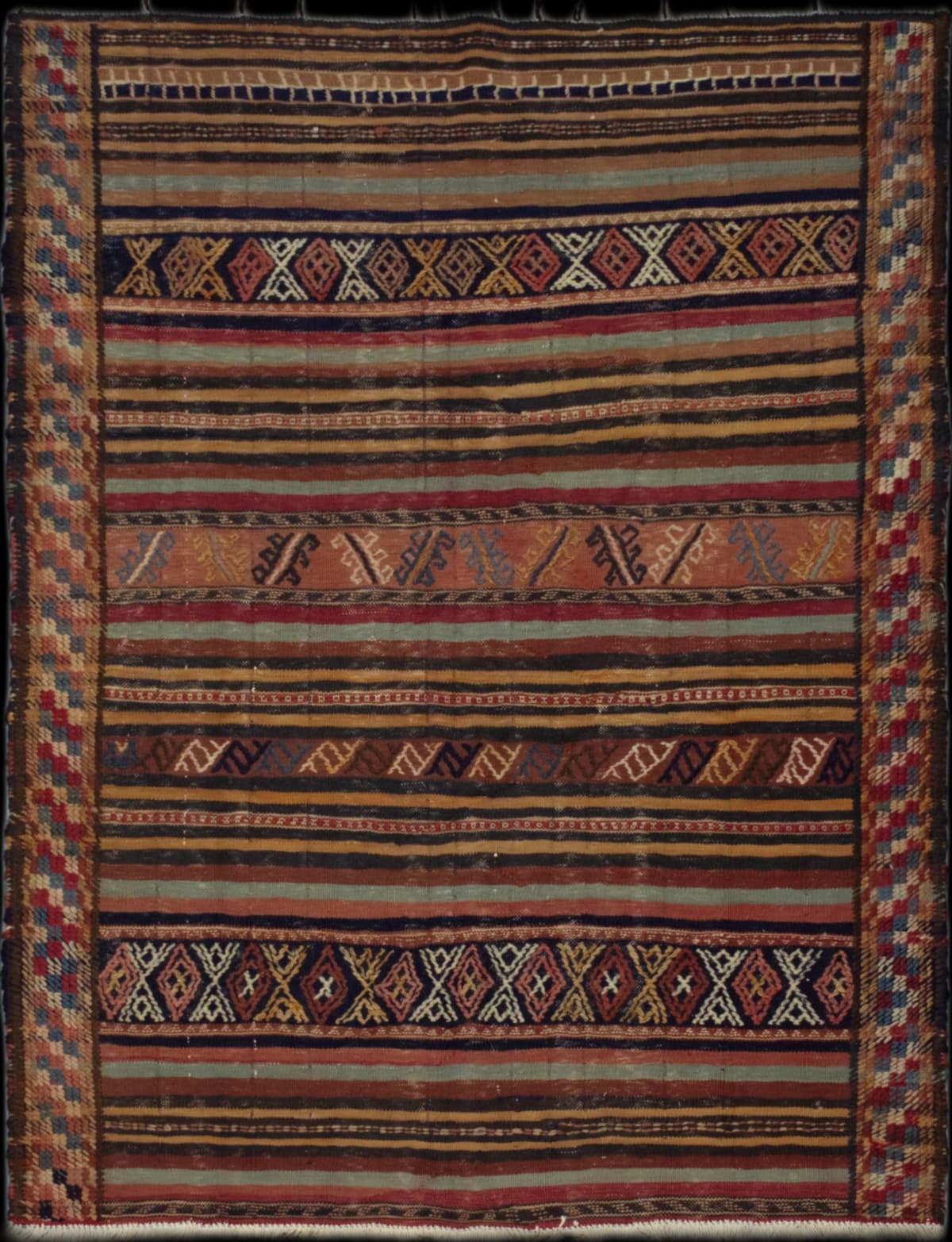
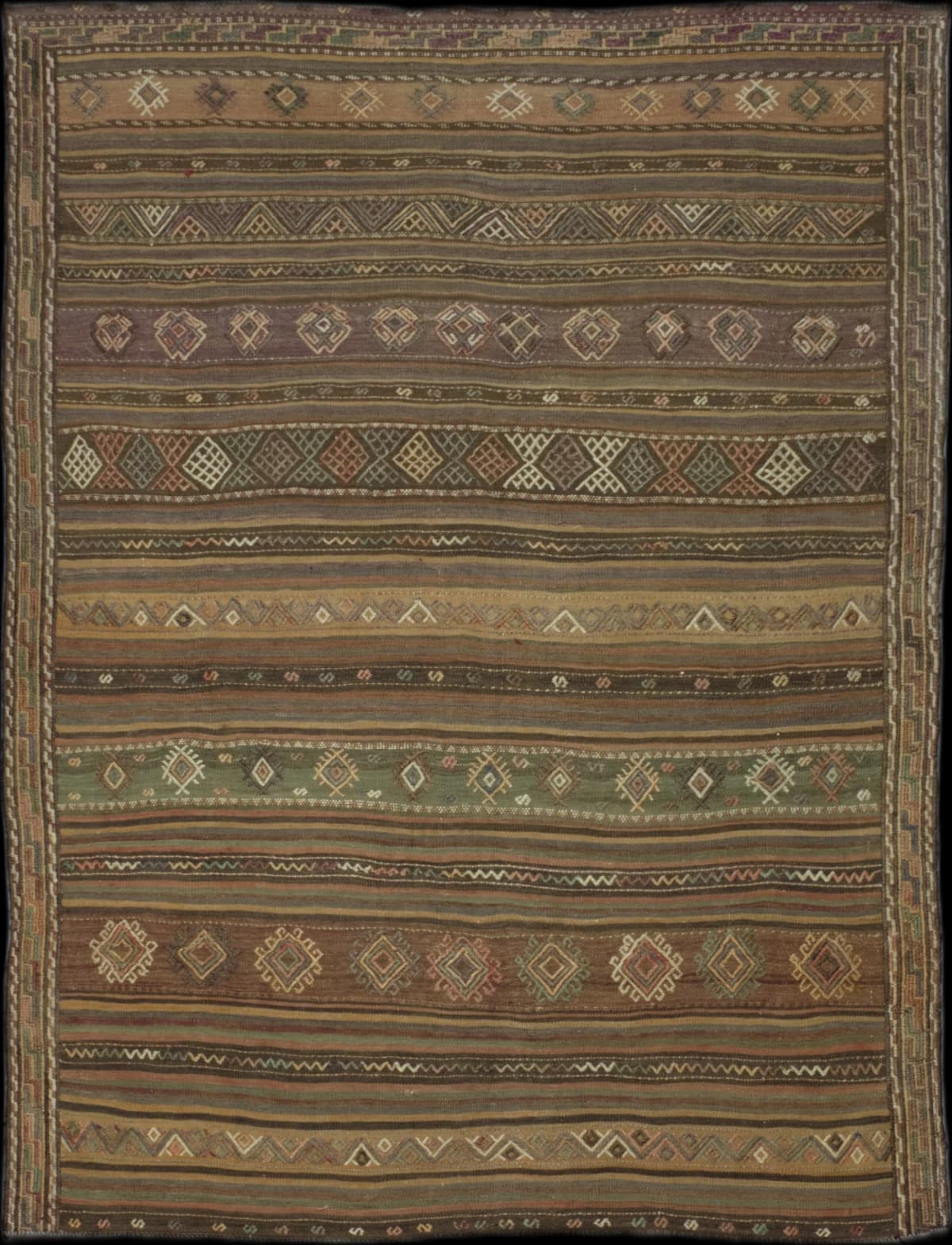
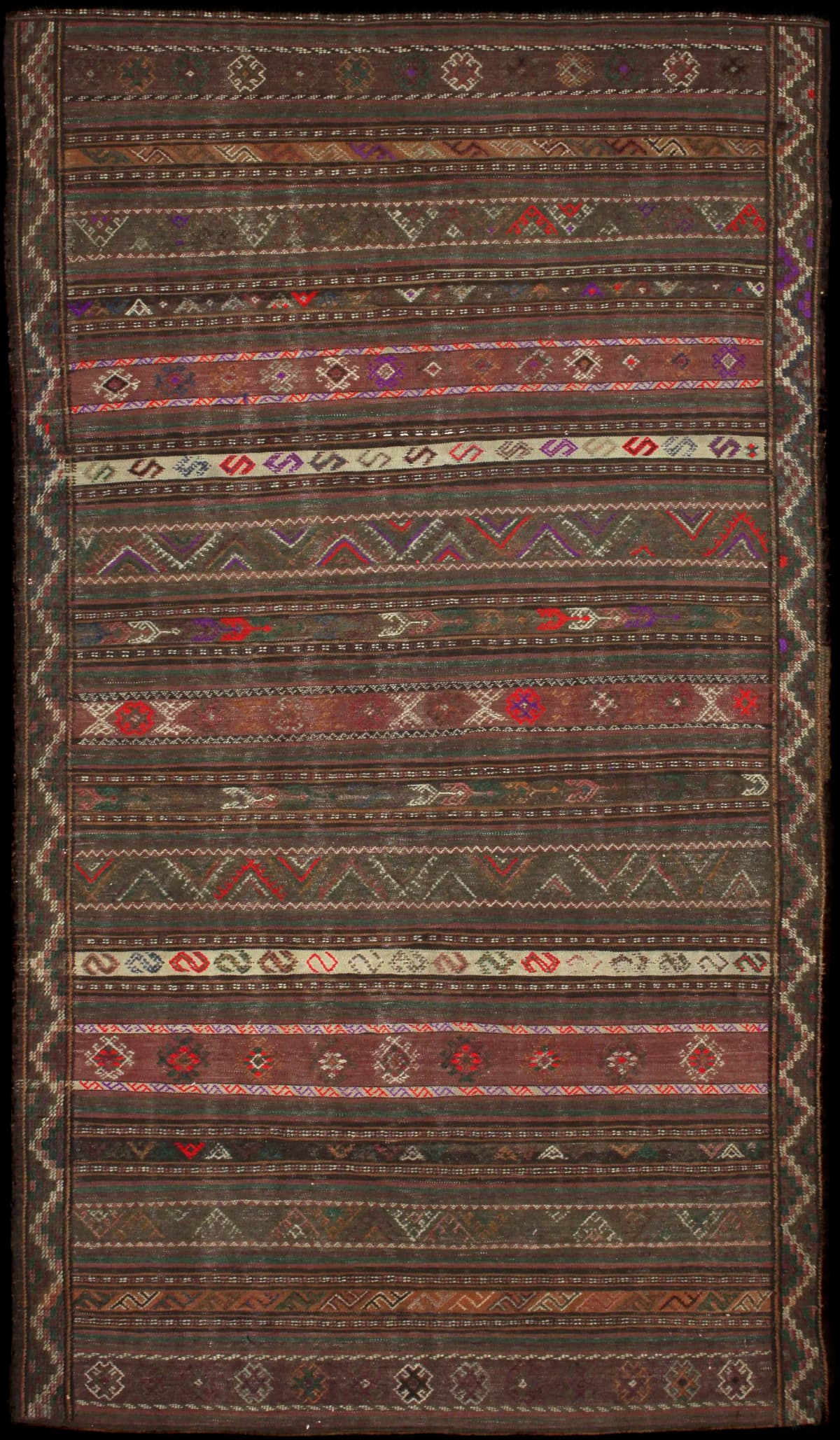
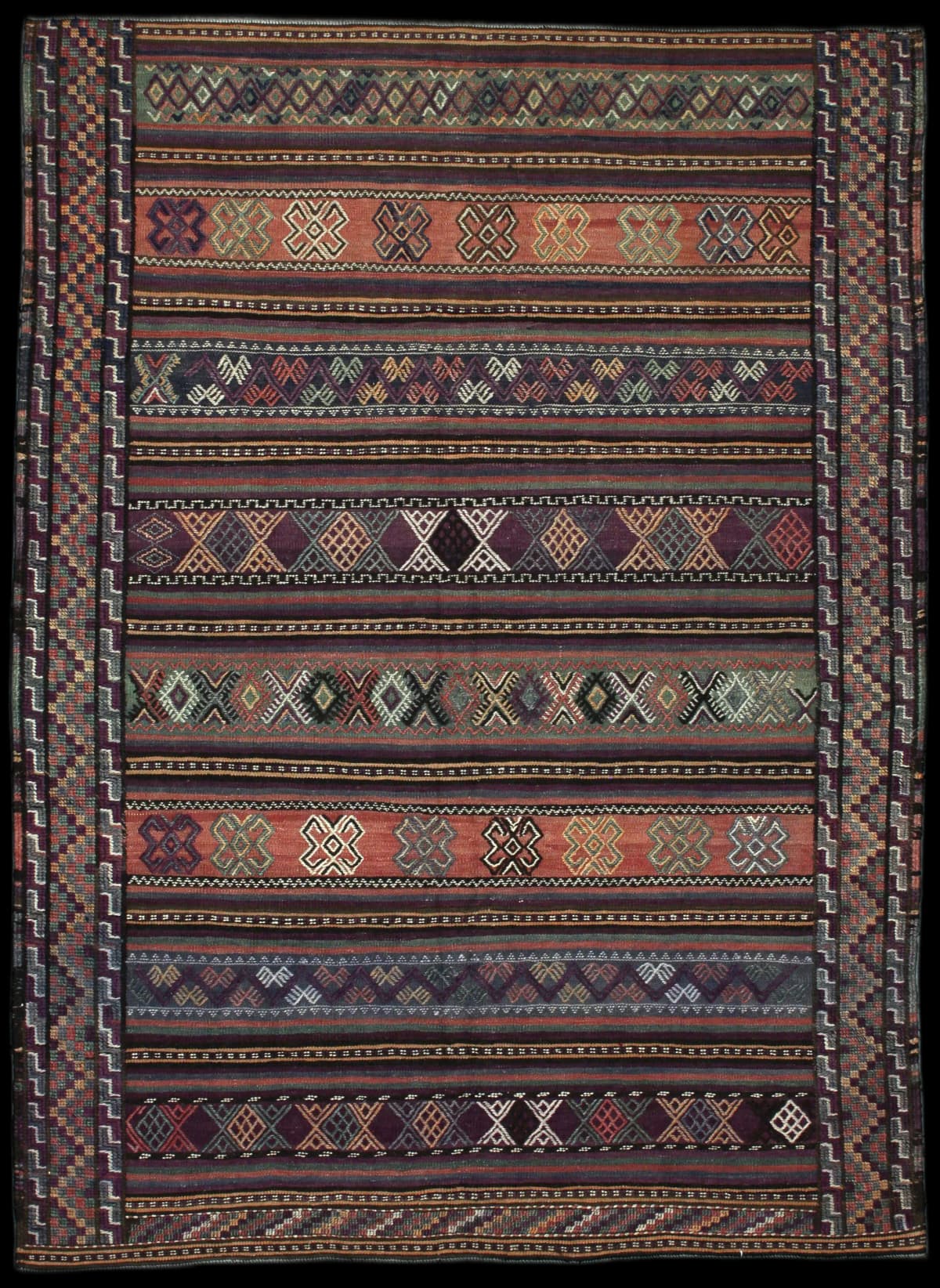
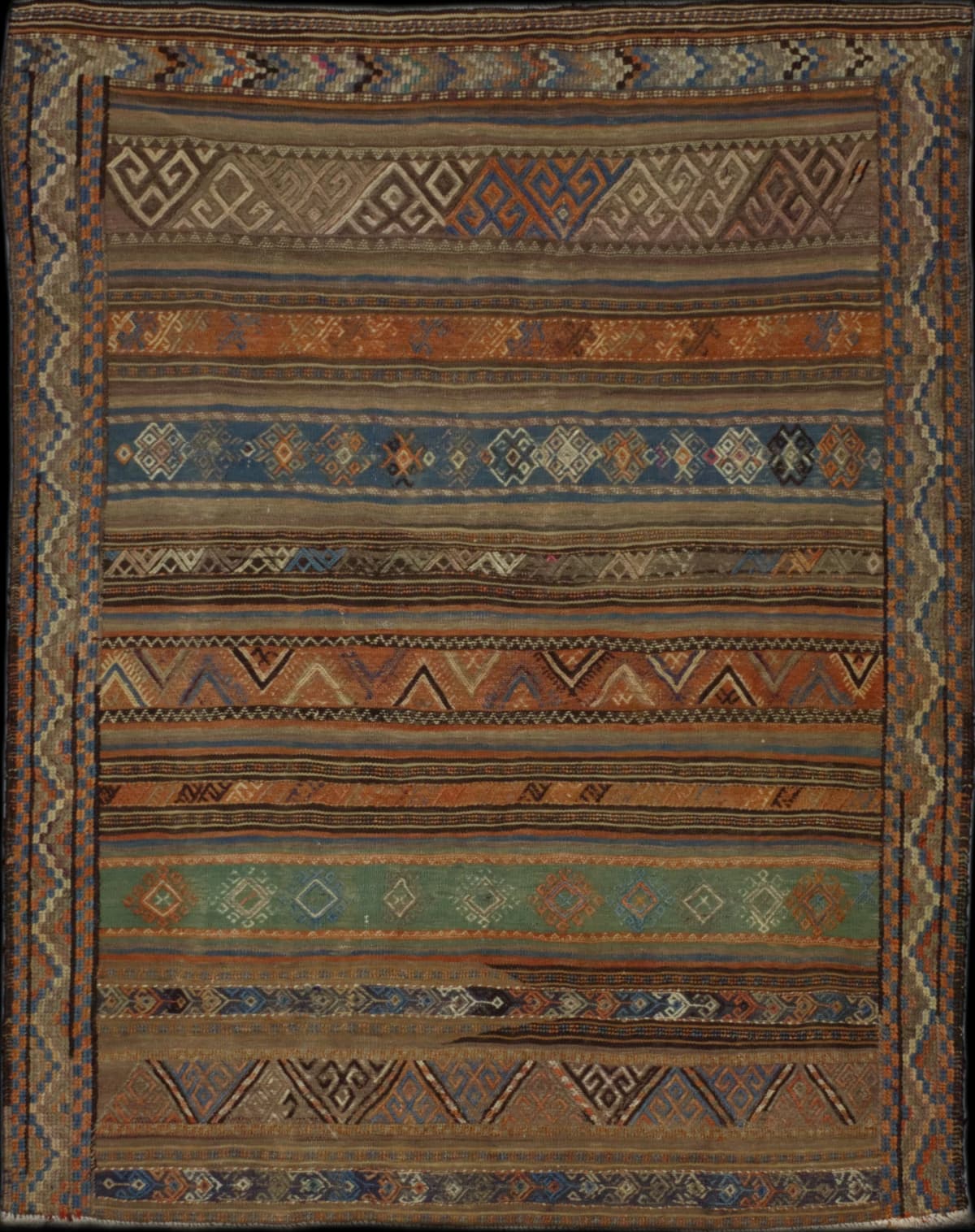
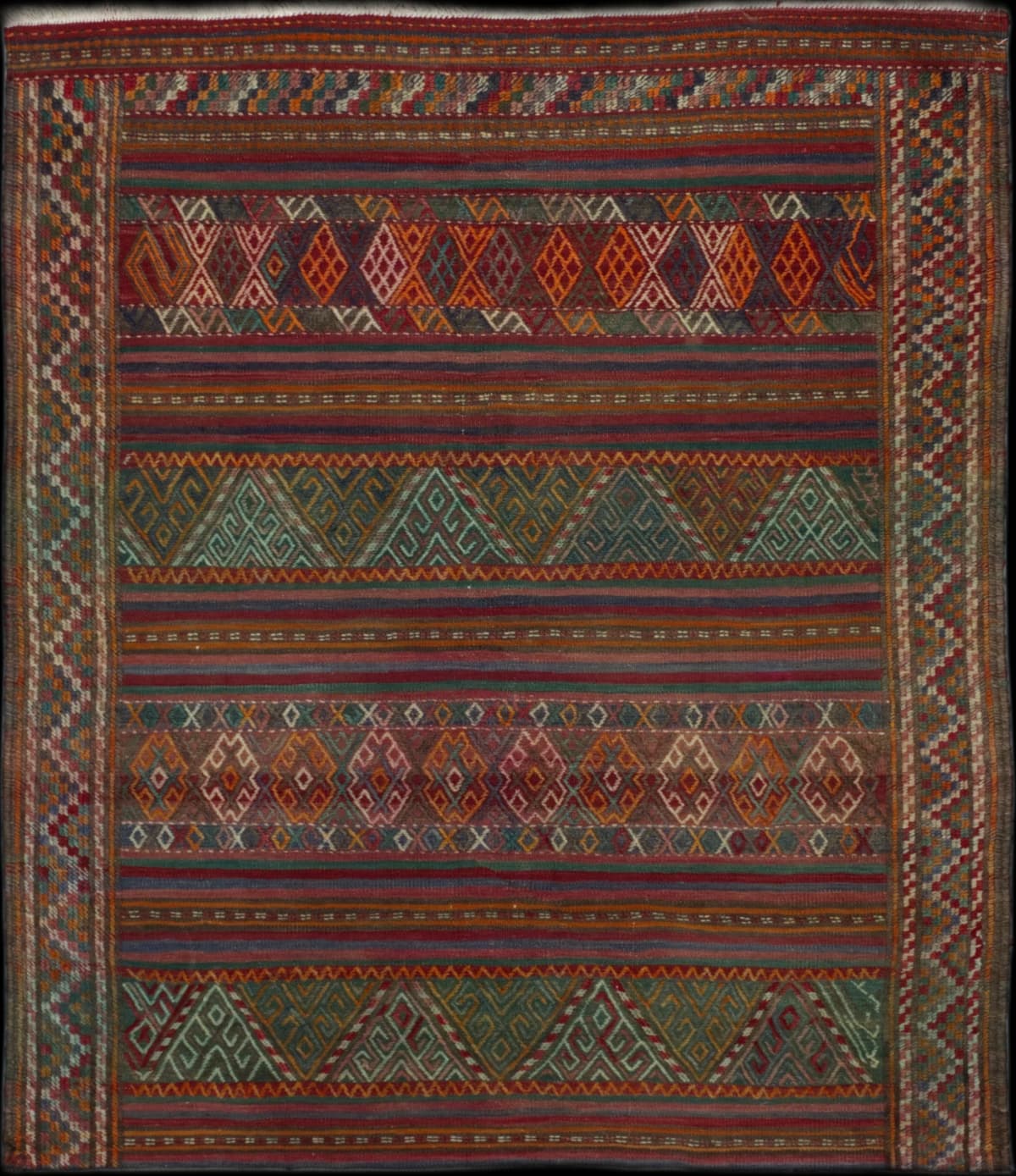
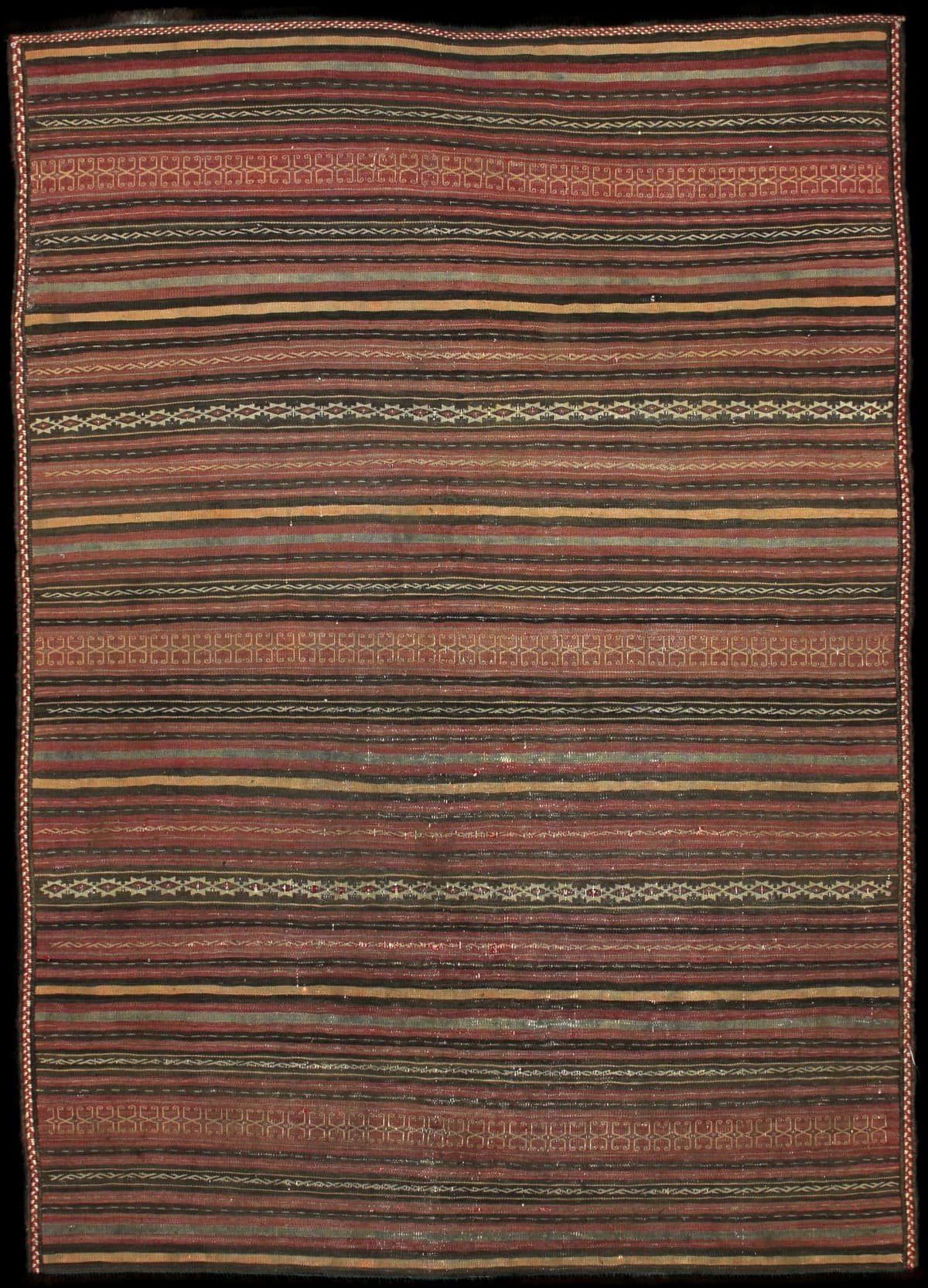
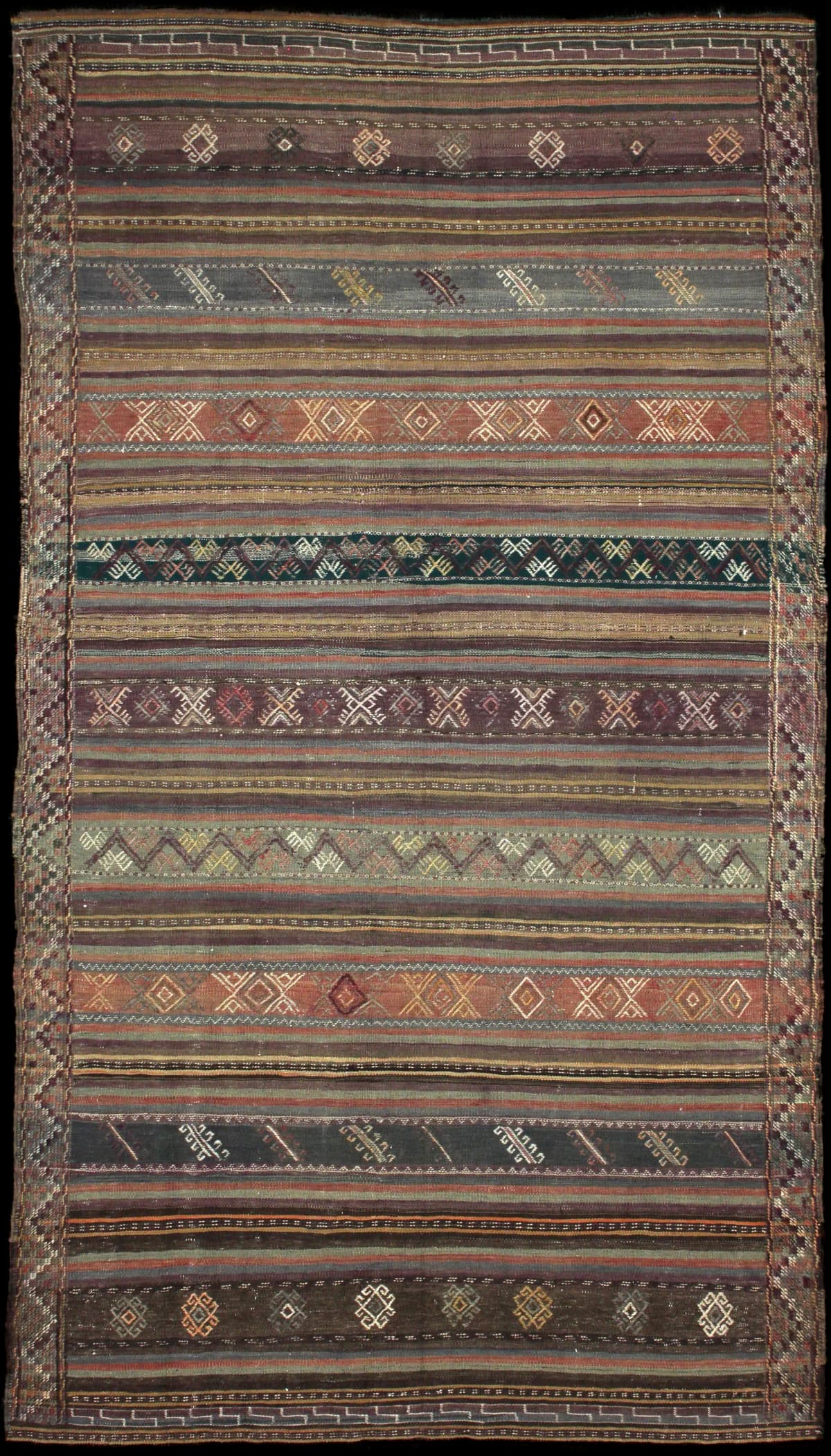
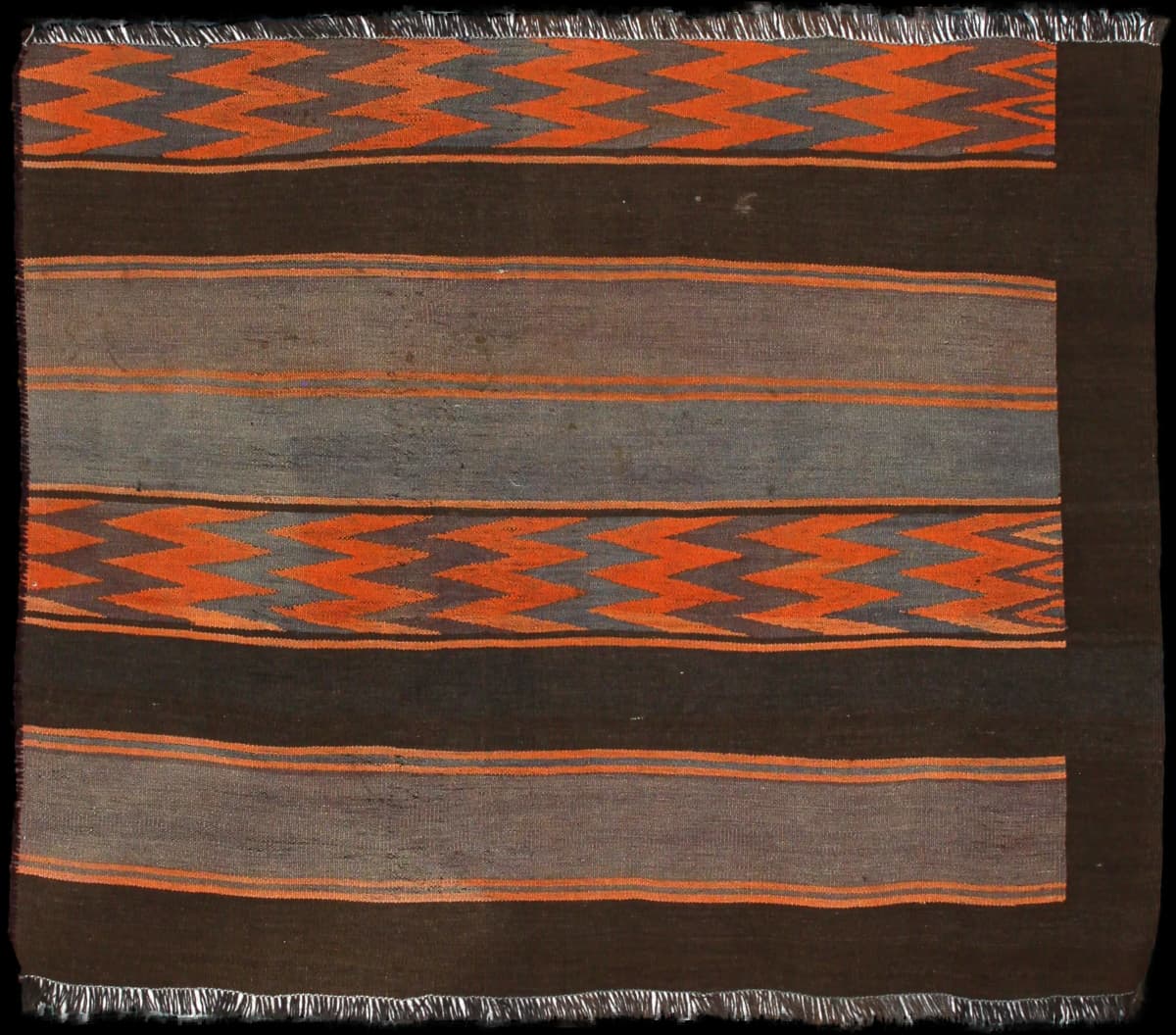
Rugs carrying the Kalat-e Naderi name are flatweaves of the soumakA flat-woven rug technique that creates a textured surface resembling braiding or embroidery. Unlike kilims, soumaks have a raised pattern created by wrapping weft threads around warp threads. This technique produces durable rugs with distinctive geometric designs and a textured surface, traditionally made in the Caucasus region, Iran, and Turkey.See in the carpet dictionary type, and that is the first thing to understand about them. A soumak has no pileThe surface of a rug or carpet, made of upright fibers in cut tufts or loops. In a hand-knotted rug it is formed by the cut ends of thousands of wool or silk knots tied onto the warp row by row, trimmed lightly during weaving and given its final height by shearing at finishing. Pile thickness, measured from the back of the rug to the top of the pile, typically runs from low, about 1/8 to 1/4 inch (3 to 6 mm), to high, about 1/2 to 5/8 inch (13 to 16 mm). Fine, dense designs are cut short to keep the pattern sharp; higher pile suits traffic and heavy furniture, lower pile suits door clearance and humid rooms.See in the carpet dictionary and no knots: coloured wefts are wrapped around the warp threads in a continuous motion, building the pattern directly into the surface and giving it a fine, slightly raised grain that looks embroidered rather than woven. Because nothing is knotted, a knots per square inchThe number of knots in one square inch of a hand-knotted rug (KPSI; 1 KPSI is about 15.5 knots per 10 x 10 cm), counted on the back with a ruler by multiplying the knots along one inch of height by those along one inch of width, averaged over two or three areas. More knots give sharper detail, like a higher-resolution screen, and, all else equal, somewhat more durability and a higher price, but density alone does not grade quality: Heriz and Bijar are durable at low to medium counts, while floral curvilinear designs blur without enough knots. Figures run from under about 80 for coarse tribal weaves such as Gabbeh and Qashqai, through roughly 120 to 225 for many village rugs and 300 to 700 for fine city rugs such as Nain and Isfahan, to 600 to 1,000 or more for pure silk Qum.See in the carpet dictionary (KPSI) figure does not apply and should never be quoted for one. What matters instead is the quality of the woolA natural animal fiber used for the pile, and in some rugs also the foundation, of high-quality rugs. It is durable, resilient, stain resistant and flame resistant, feels soft and cushioned underfoot, insulates against cold, and takes up dye readily and holds it for many years. It also traps dust particles, which helps reduce allergic reactions. Quality depends above all on where the sheep graze: high-elevation pastures and good feed give thicker, oilier wool, with Manchester, New Zealand and Ghazni wools the best-known prized examples. Early-spring shearing and hand spinning (finer, softer thread than machine spinning) improve it further, while thin, dry wool from dead sheep goes into cheaper rugs.See in the carpet dictionary and the fineness of the wrapping.
Two practical differences separate a soumak from a plain kilimA flat-woven rug with no pile, traditionally made in Turkey, Iran, Afghanistan, and the Balkans. Colored weft threads are interlaced with the warp without knots, so both sides look alike. The fibers are typically wool, cotton, or goat hair, and natural dyes often give slight shade variations that are normal, not flaws. Its low profile clears doors easily, and it can hang as wall art. In a knotted rug, "kilim" also names the flat-woven band at each end, where extra weft rows secure the ends beside the fringe.See in the carpet dictionary. The wrapping yarns leave their tails on the reverse, so the rug has one finished face, where a slit-woven kilim can be turned over and used on either side. The wrapping also adds a little body, so a soumak is slightly thicker than a kilim while remaining a low, thin textile far below the height of any pile carpet; the listed thickness of each piece gives the exact figure. In practice that means doors clear it, chairs slide over it, and it settles flat without a struggle.
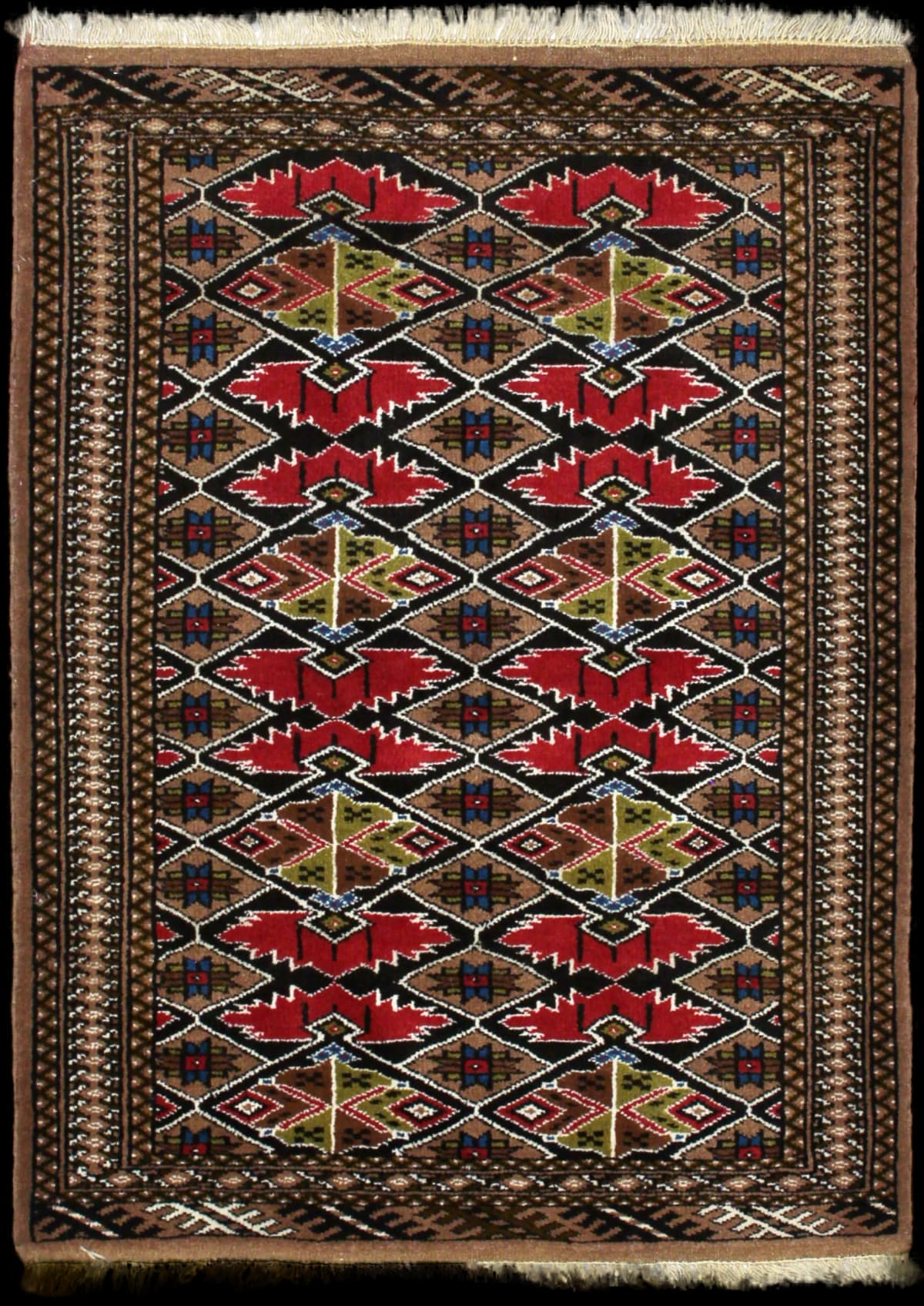
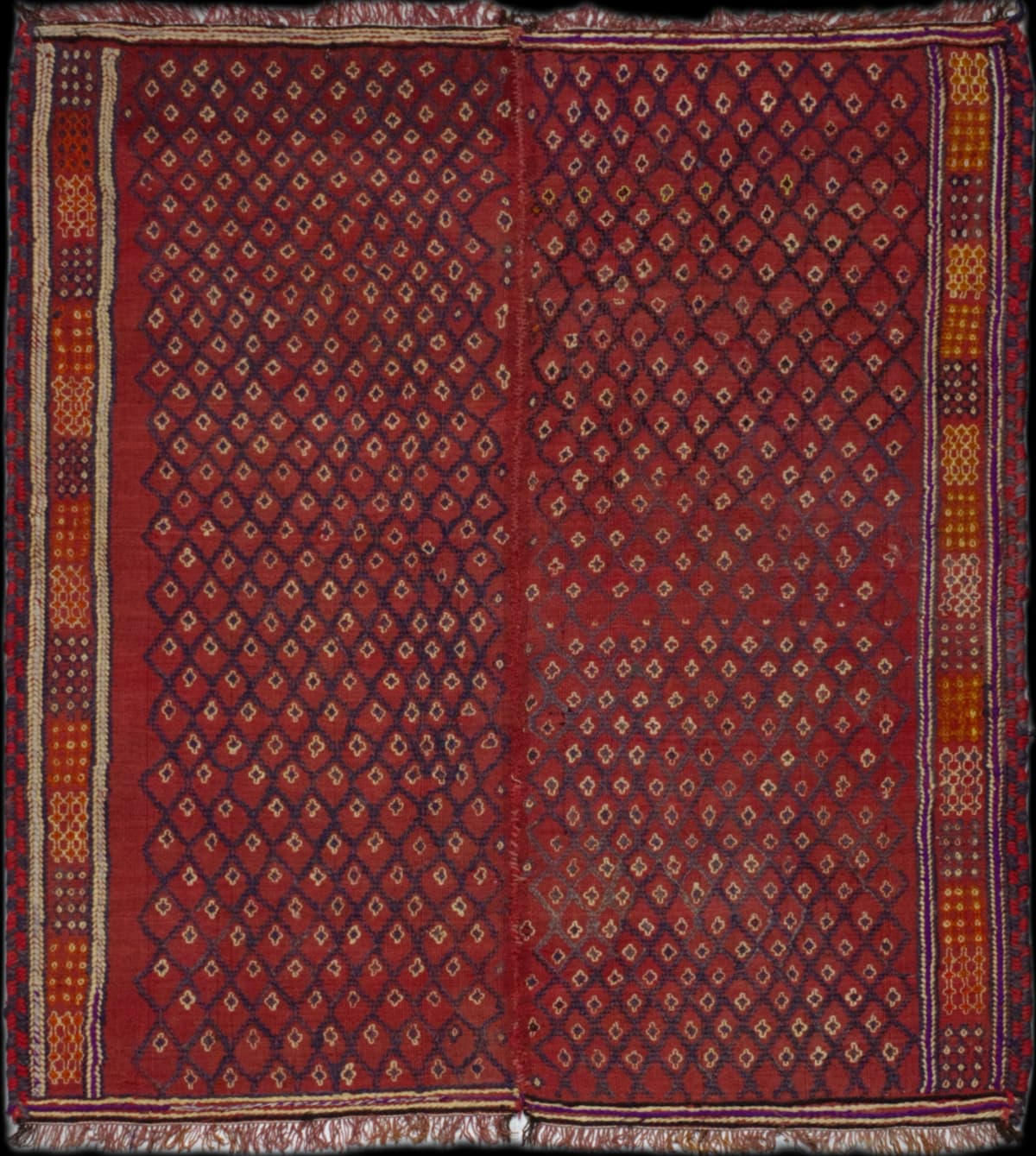
Pattern runs to two families. One is the repeating medallionA large motif at the center of a rug's field, around which the rest of the design is organized; the large central medallion is said to have been introduced in the Safavid era (16th-17th centuries). Floral medallions, typical of city rugs such as Tabriz, Kashan and Sarouk, are often read as a lotus blossom, and the motif has also been read as mirroring the interior dome of a mosque; geometric ones, often hexagonal or diamond-shaped, mark village and tribal rugs such as Heriz and Zanjan. A medallion may stand alone, come with four corner pieces, be flanked by smaller medallions above and below, or repeat down a runner. Rugs with no central motif are called allover. In a well-made rug the medallion sits at the center and the corners mirror one another, as closely as handwork allows.See in the carpet dictionary, a column or grid of angular medallions marching up the field. The other is the allover, the same vocabulary of hooked diamonds, stars, polygons and barbed outlines spread across the ground with no central medallion to anchor it. Curved drawing and floral scrollwork, the stock in trade of the urban workshops in Mashhad down the road, are essentially absent. Everything is built on the diagonal of the weave, which is what gives these rugs their stepped, crystalline look and makes them read clearly from a distance.
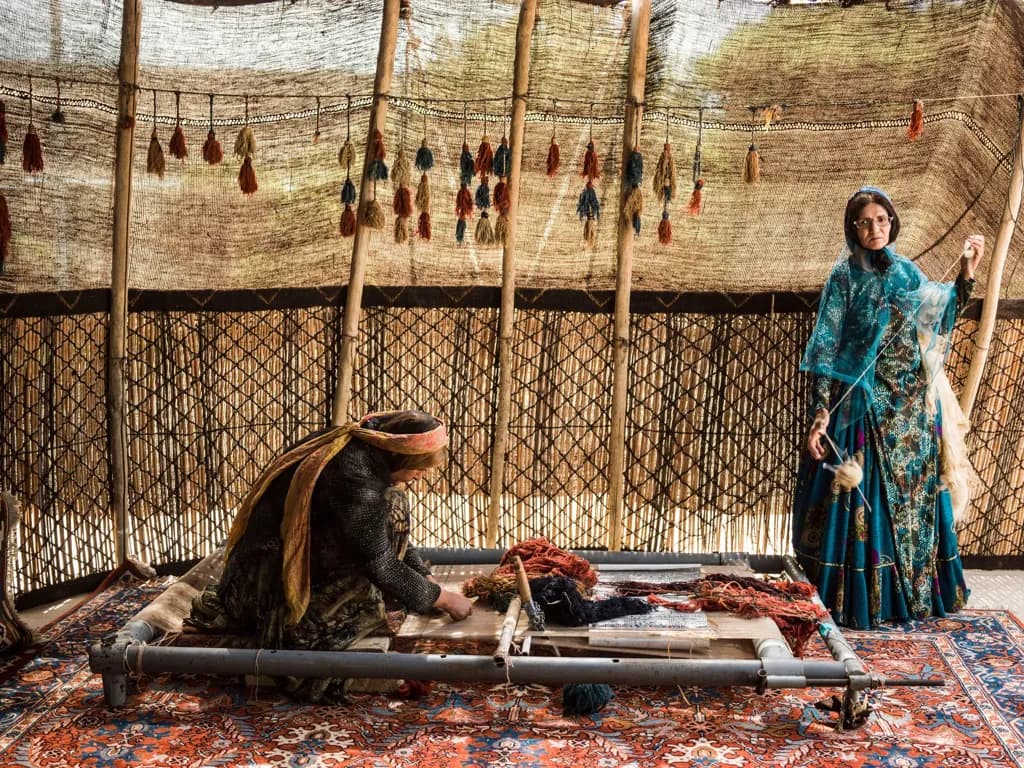
That geometry is inherited rather than invented. The Kurdish tribes of north-eastern Khorasan came from the Anatolian frontier lands in the west and brought their pattern language east with them; generations later it still reads as Anatolian and Caucasian rather than Persian. Weavers work without a cartoon, the squared paper blueprint a city workshop in Tabriz or Kashan would follow, learning designs from older women at the same loomThe frame on which the warp (vertical) threads are strung first and held under tension so the weft (horizontal) threads can be interlaced through them and the knots tied onto them. Hand-knotted rugs are made on simple looms, from those set up in weavers' homes to the compact, transportable ones of nomadic weavers, where every knot is tied by hand. Loom size sets rug size: nomads' small looms typically yield rugs no larger than about 4 x 6 or 5 x 7 ft (1.2 x 1.8 m or 1.5 x 2.1 m), city workshops with very large looms weave palace sizes, and the number of looms a workshop runs gauges its scale. Wooden looms in tribal and village weaving expand and contract over time, one cause of crooked rugs. Power looms such as Wilton, Axminster, and Jacquard, the industrial descendants, make machine-woven carpet.See in the carpet dictionary and reworking what they see around them. The outcome is a recognisable family style carried by strong individual personality, which is also why no two pieces repeat each other exactly.
Colour is strong and unhesitating. Fields are usually deep red or blue, with ivory used as a full ground in its own right rather than only as an accent, and the borders draw on the same three. Highlights come in browns of several shades, along with gold, grey and black. There is no pastel register here and no shadingA condition where areas of carpet appear lighter or darker than surrounding areas due to light reflecting differently off pile fibers that have changed direction. Not a manufacturing defect but a physical characteristic of cut pile carpets. Also known as watermarking or pooling.See in the carpet dictionary or tonal gradation; a colour is either present or it is not. That flat, declarative palette is a large part of why these rugs hold their own in a plain modern room.
Dyestuffs have traditionally been gathered locally rather than bought in, from whatever plants and minerals the district yields. Madder rootThe root of the madder plant (Rubia tinctorum), a natural red dye and the source of the terracotta tones in Persian and Oriental rugs. Together with indigo and walnut husks it is among the plant dyes used to color the wool, bonding to its natural lanolin. Slight shade variations within one color area, known as abrash, are normal in rugs dyed this way.See in the carpet dictionary for reds, indigo for blues and walnut husks for browns, boiled in copper cauldrons, are the classic materials across Persian tribal weaving and stand behind the colours of older pieces. Naturally dyed wool softens with age rather than fading flat, and bands of slightly different tone across a field, where one dye lotA single batch of dye, together with the yarn colored with it, all of which takes the same shade. Natural dyes are made in small artisanal batches, and when one runs out the replacement cannot be matched exactly, so yarn from different lots differs slightly in tone. In a finished rug the difference shows as the color shifts known as abrash, which is read as a sign of hand dyeing, whereas a perfectly flat, uniform color suggests synthetic dyes and machine making.See in the carpet dictionary ran out and the next began, are called abrashSubtle shifts in color within a handmade rug, often visible as horizontal bands across the field. They arise because successive dye batches never match exactly, because differences in the wool's fat and oil content make colors change unevenly with age, and, in cream areas woven from undyed wool, because the fiber changes tone as it ages. Abrash often grows more distinct with age, so in an older rug it counts as a sign of natural dyes and hand production rather than a fault, while a newer rug is still checked for even color. Machine-made and some new hand-knotted rugs imitate it on purpose.See in the carpet dictionary. They are a mark of hand work, not a fault.
Foundation and surface are both animal fibre. Warp and weftThe two thread systems that make up a carpet's foundation: the warp, the vertical threads strung on the loom first, and the weft, the horizontal threads passed through them between rows of knots. The foundation is usually cotton, though wool is common in tribal and older rugs and silk in very fine ones. Single-weft rugs, standard in the greater Hamadan area, show zigzag rows of white warp dots on the back and have a thinner pile, whereas double-weft construction, standard in fine, tightly woven rugs and in Bijar and Heriz, hides the warp and gives a thicker, denser pile. The warp ends form the fringe, and extra weft passes at each end form the flat-woven kilim end that secures the pile.See in the carpet dictionary are wool or goat hairAn animal fiber that tribal weavers sometimes use for a rug's foundation in place of wool, as in Gabbeh and Quchan rugs, while the pile itself stays wool. Together with mohair, camel hair and cow hair it is among the less common rug materials, seen mostly in tribal work, and it also turns up in some flat-woven kilims.See in the carpet dictionary, goat hair being an ordinary structural choice on this frontier rather than an exotic reinforcement, and the wrapping yarn is wool from the weavers' own flocks. Hand-spinning leaves the lanolinThe natural wax that coats wool fibers and serves as the fleece’s own protection, waterproofing it. Wool from sheep raised at higher elevations is thicker and oilier ("fatty"), and a warm, slightly oily hand is a quick sign of real wool. In a carpet, the lanolin that remains repels liquids, so spills bead on the surface for a few moments instead of soaking in, one reason wool resists spills and soil. Hand spinning preserves it, while repeated harsh chemical cleaning strips it away, so gentle washing is recommended.See in the carpet dictionary in the fibre, the sheep's own protection, which is part of why a well-kept tribal wool surface stays springy and hard-wearing. An all-wool structure also gives a supple, light rug that can be rolled tightly, moved without ceremony and hung on a wall without distorting.
Size follows the loom. Households here weave on compact, narrow looms set up inside the house, with no arrangement for the very large formats a commercial workshop handles, so output runs small to medium. Bags, cushion faces and small squares sit at one end of the range, runners and modest room sizes at the other. Wide room-size pieces are uncommon, and a very large flatweaveA type of carpet constructed without pile, where the warp and weft threads are woven together to create a flat surface. Examples include kilims, dhurries, and soumaks. Flatweaves are typically reversible, lightweight, and easier to clean than pile carpets, making them popular for casual spaces and warmer climates.See in the carpet dictionary attributed to this district is an unusual thing that deserves a careful look at its structure.
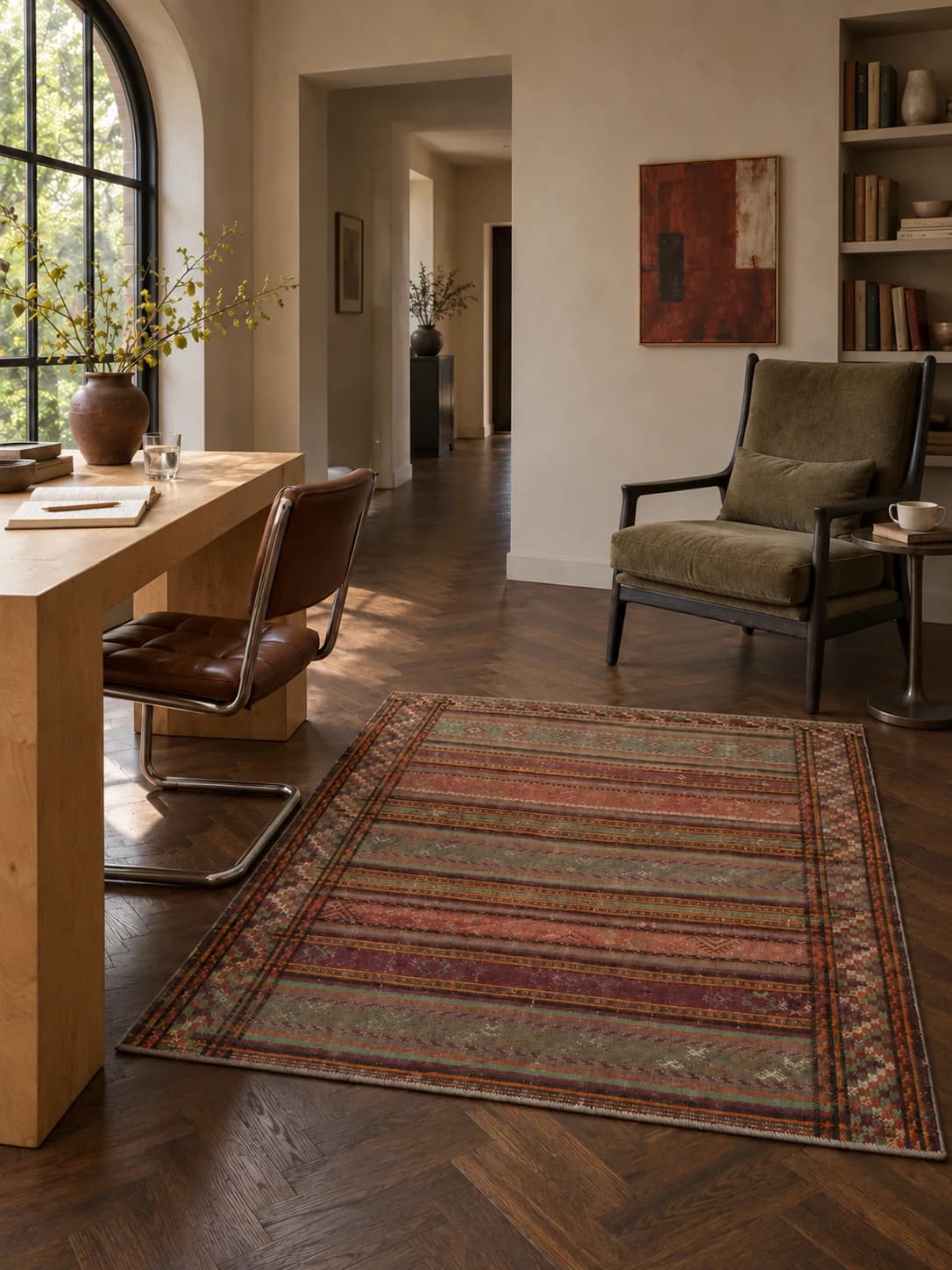
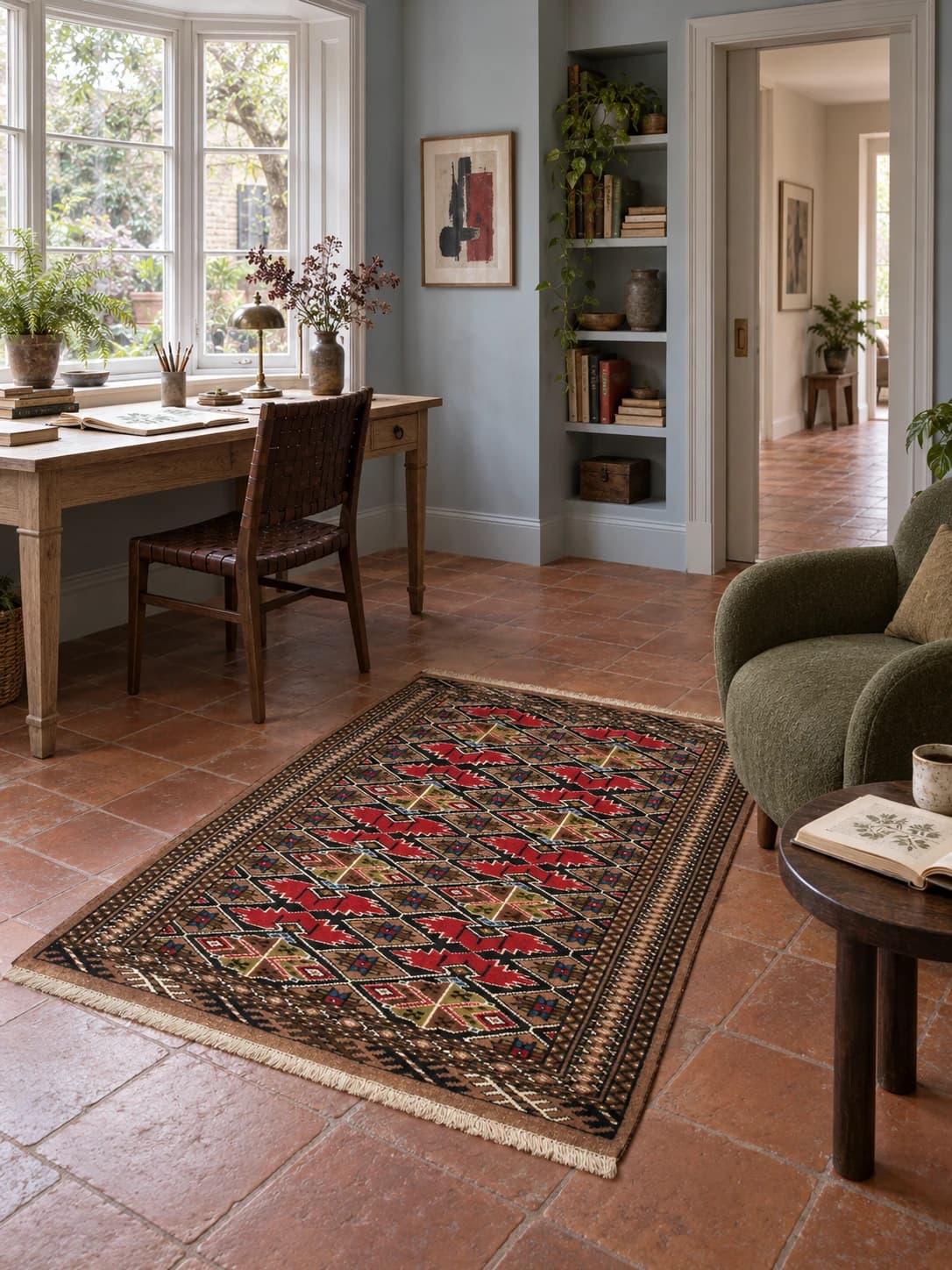
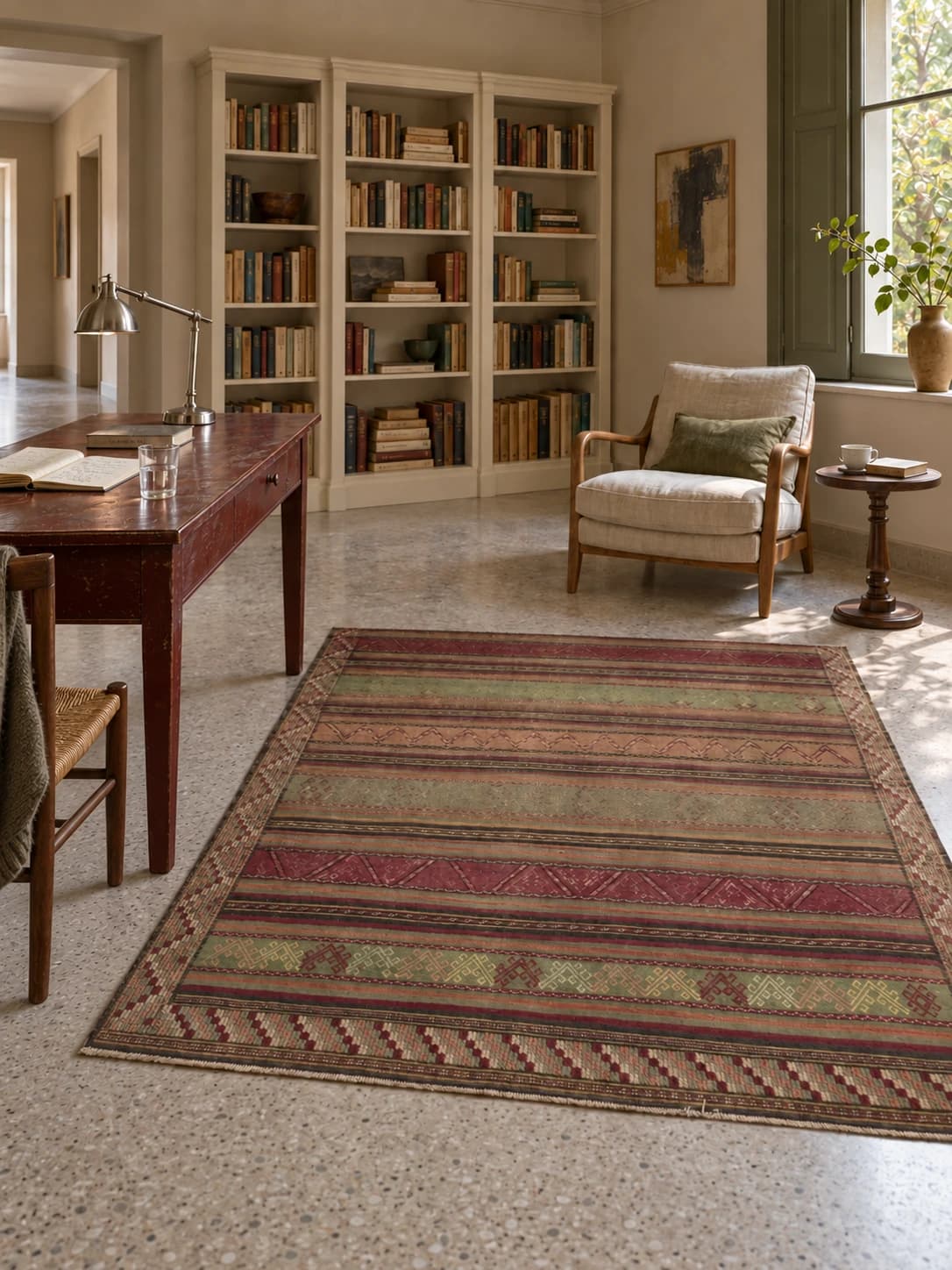
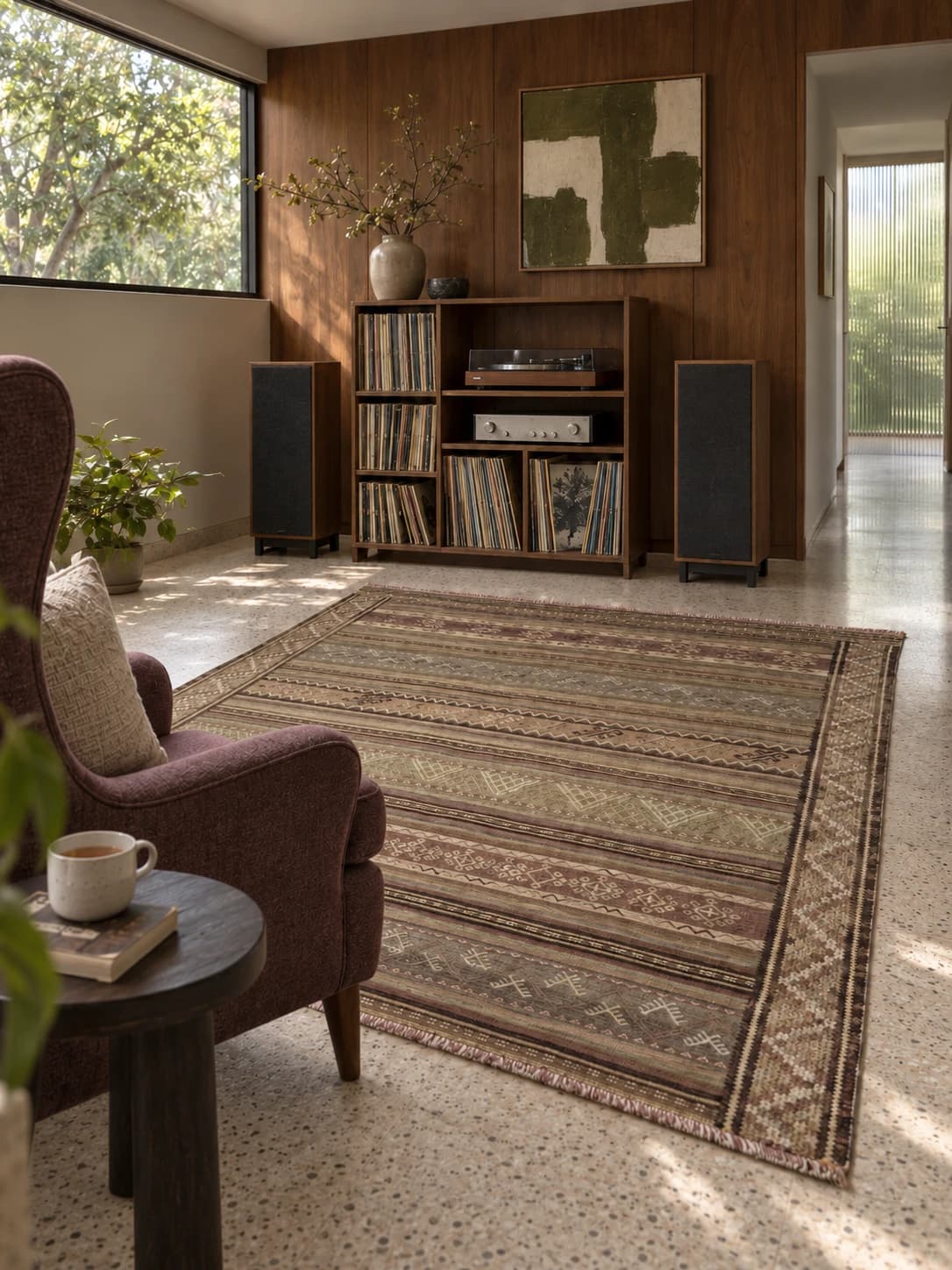
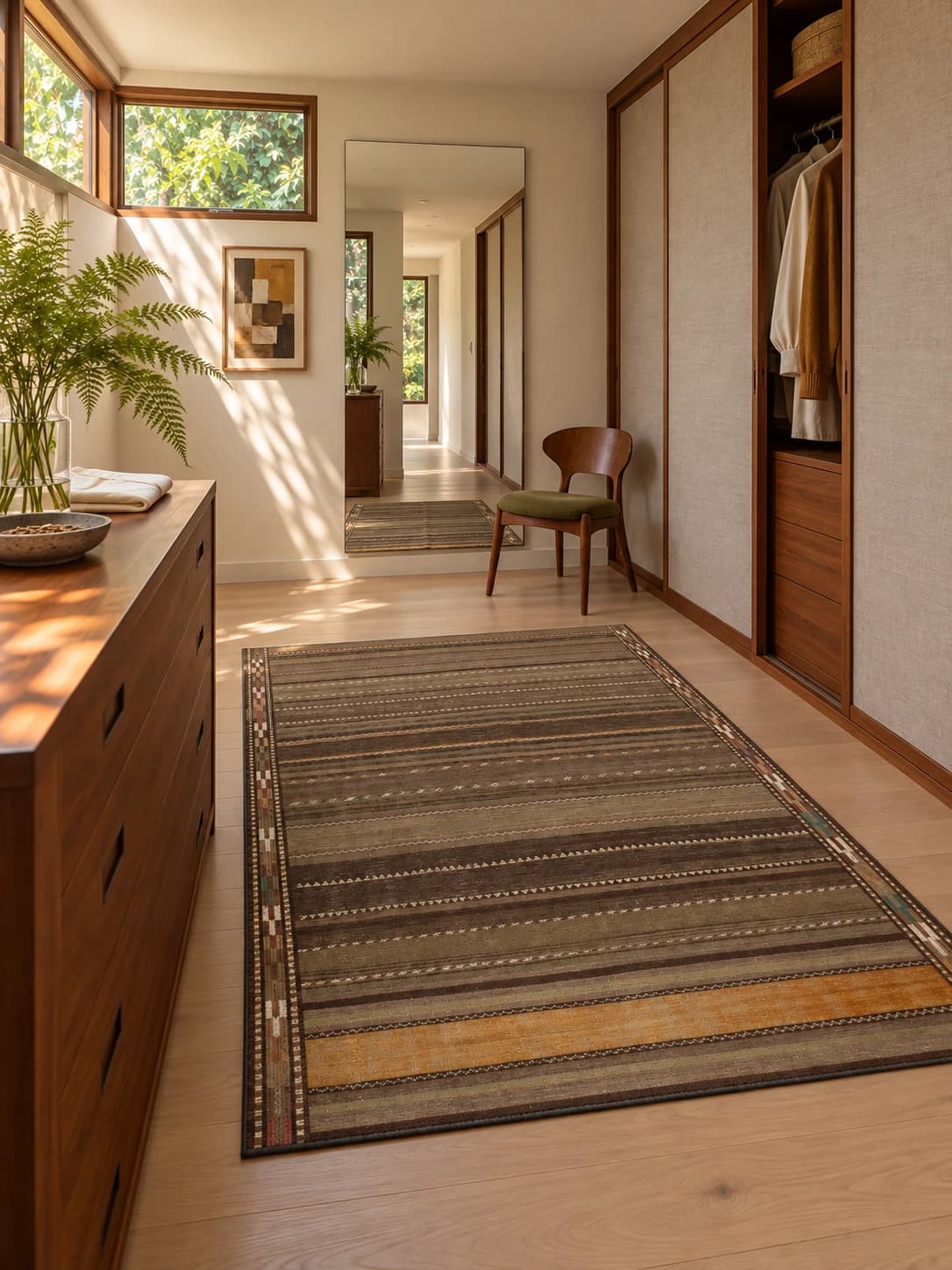
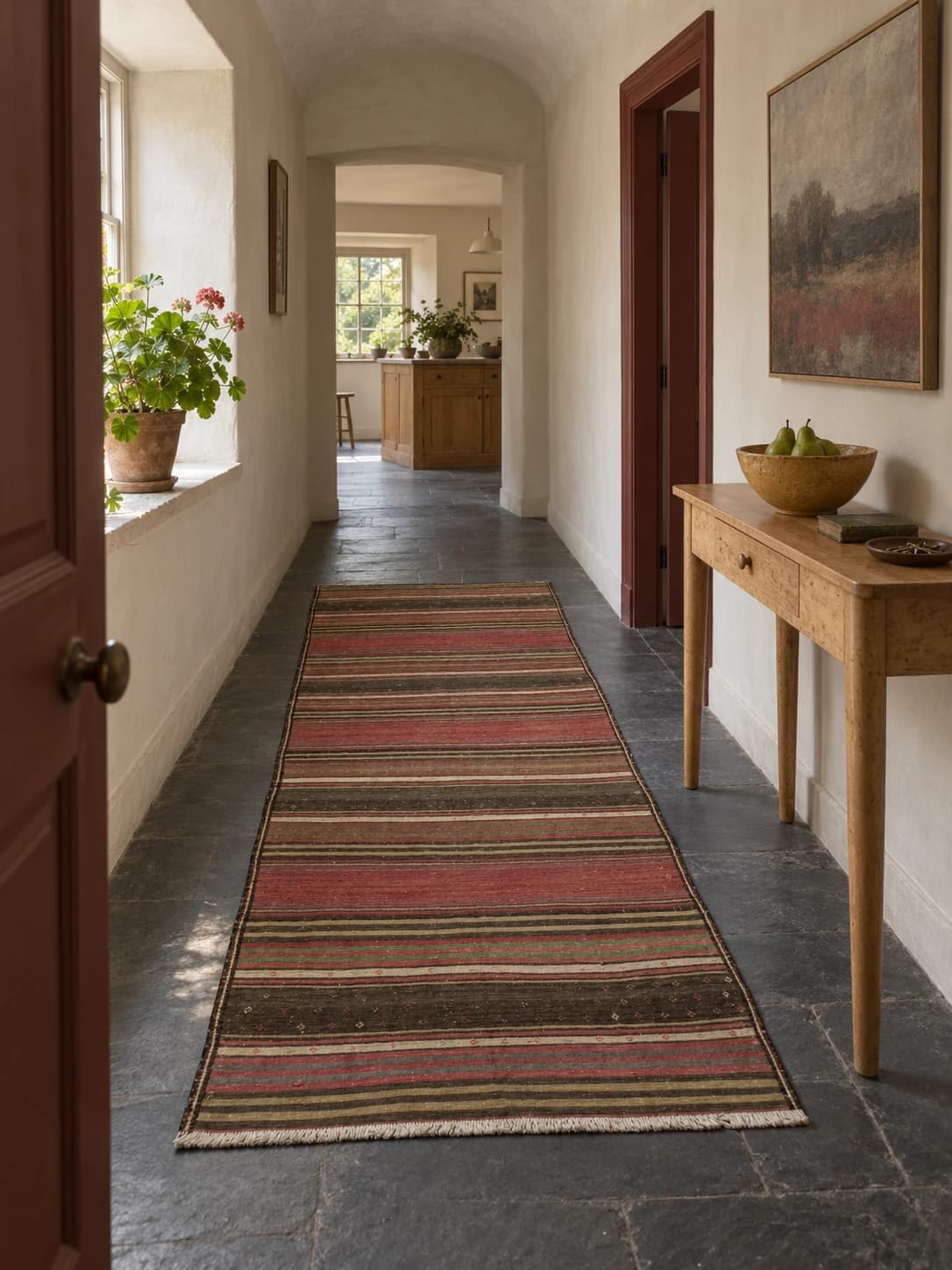
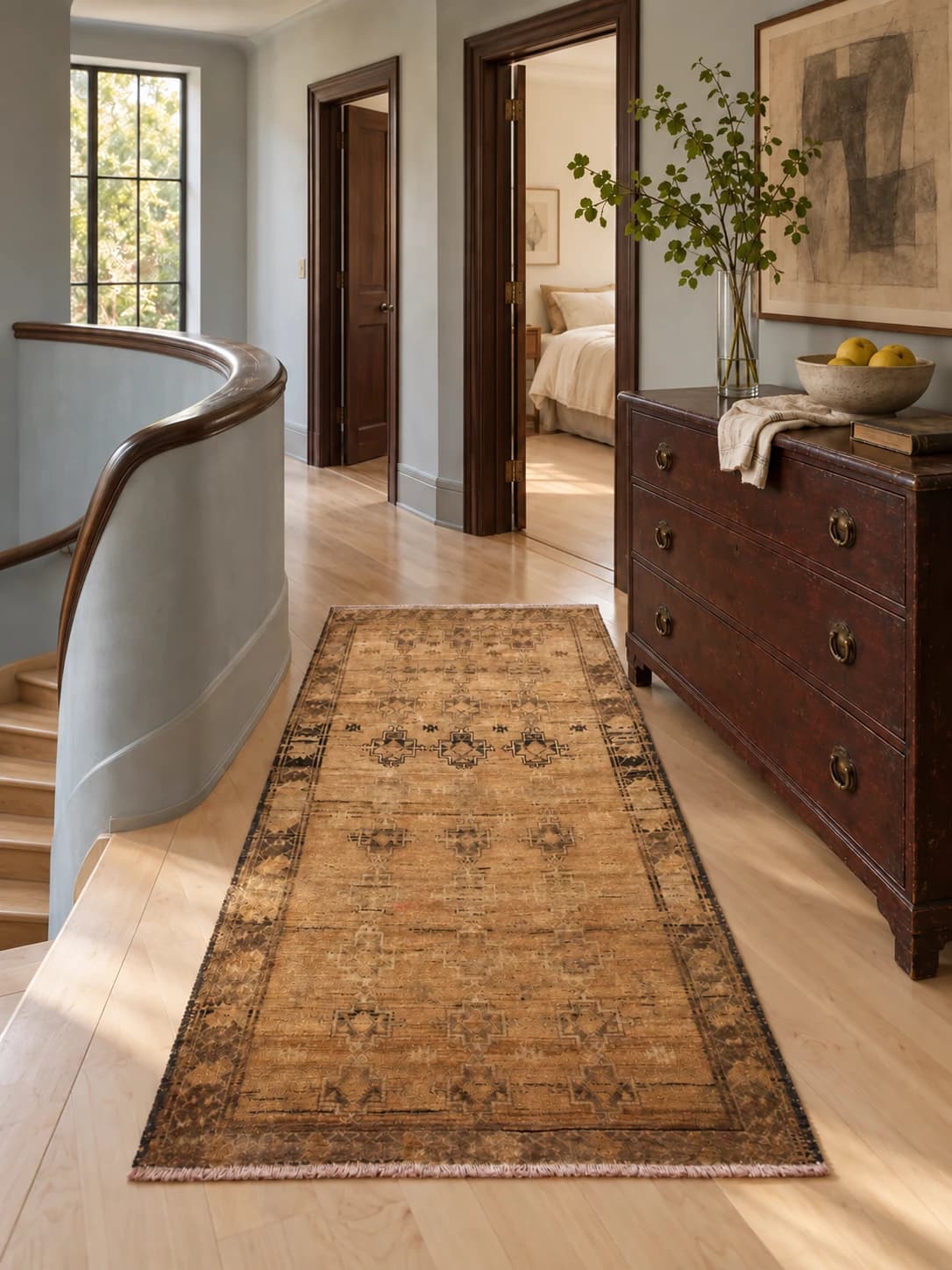
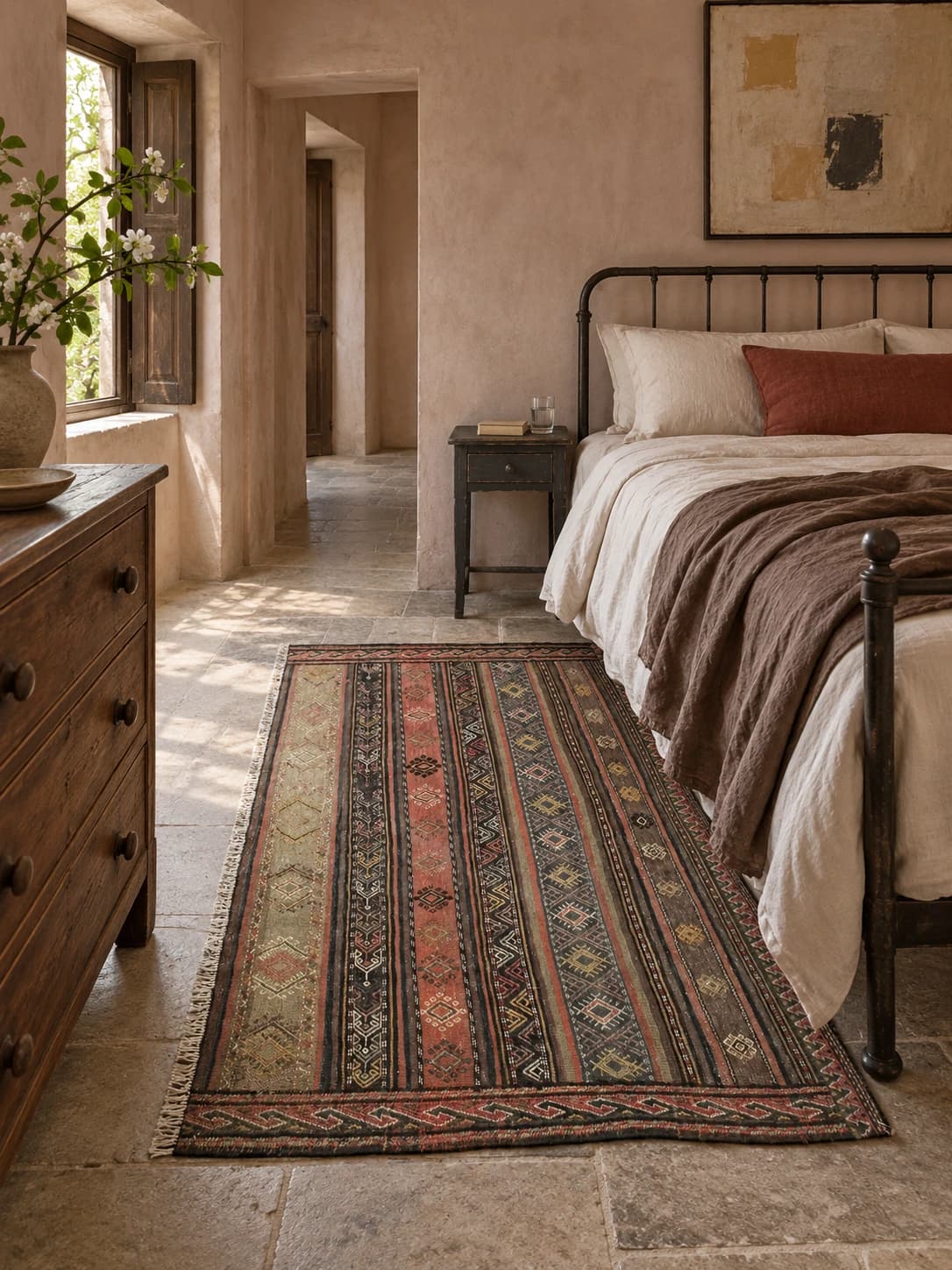
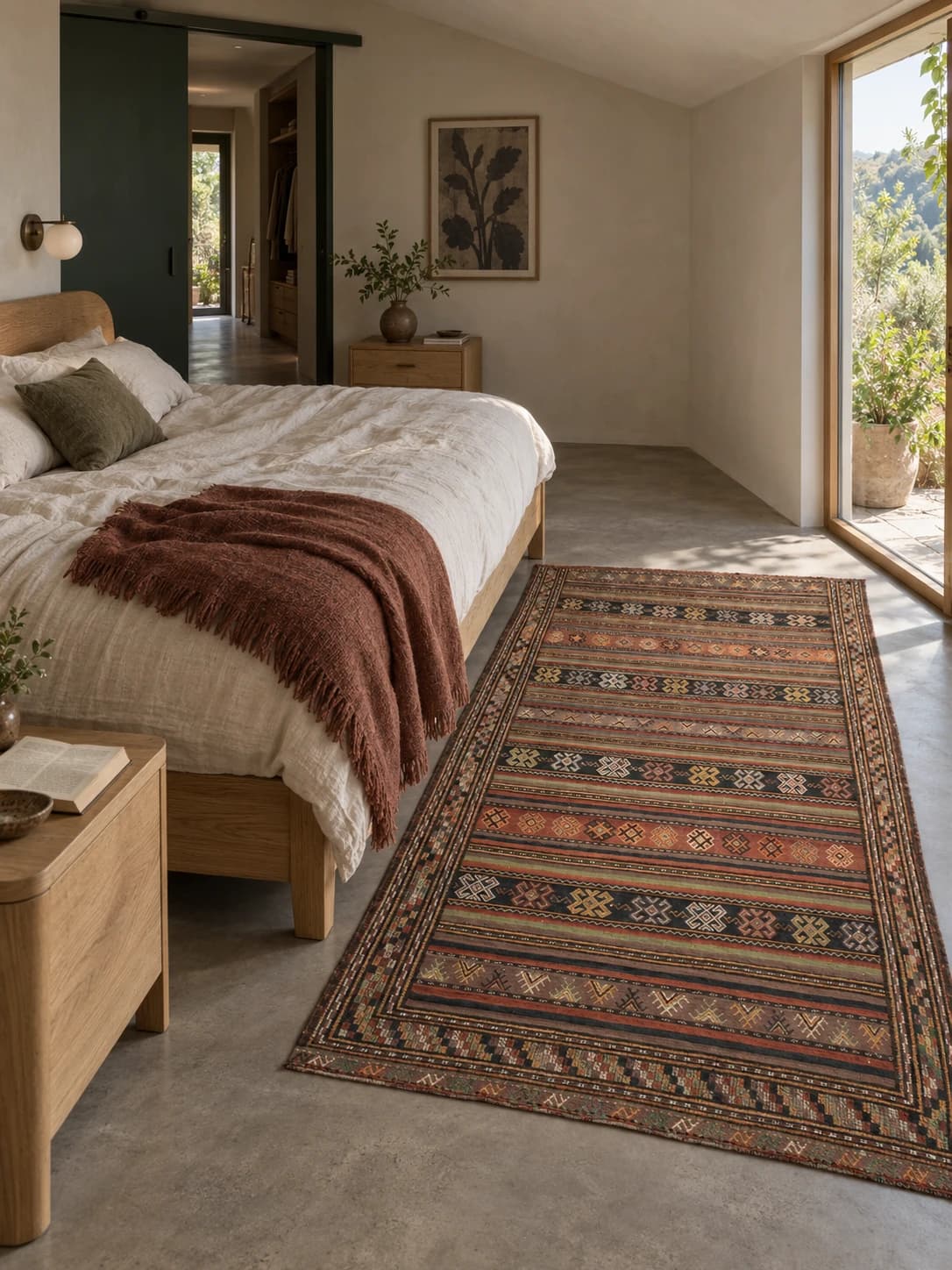
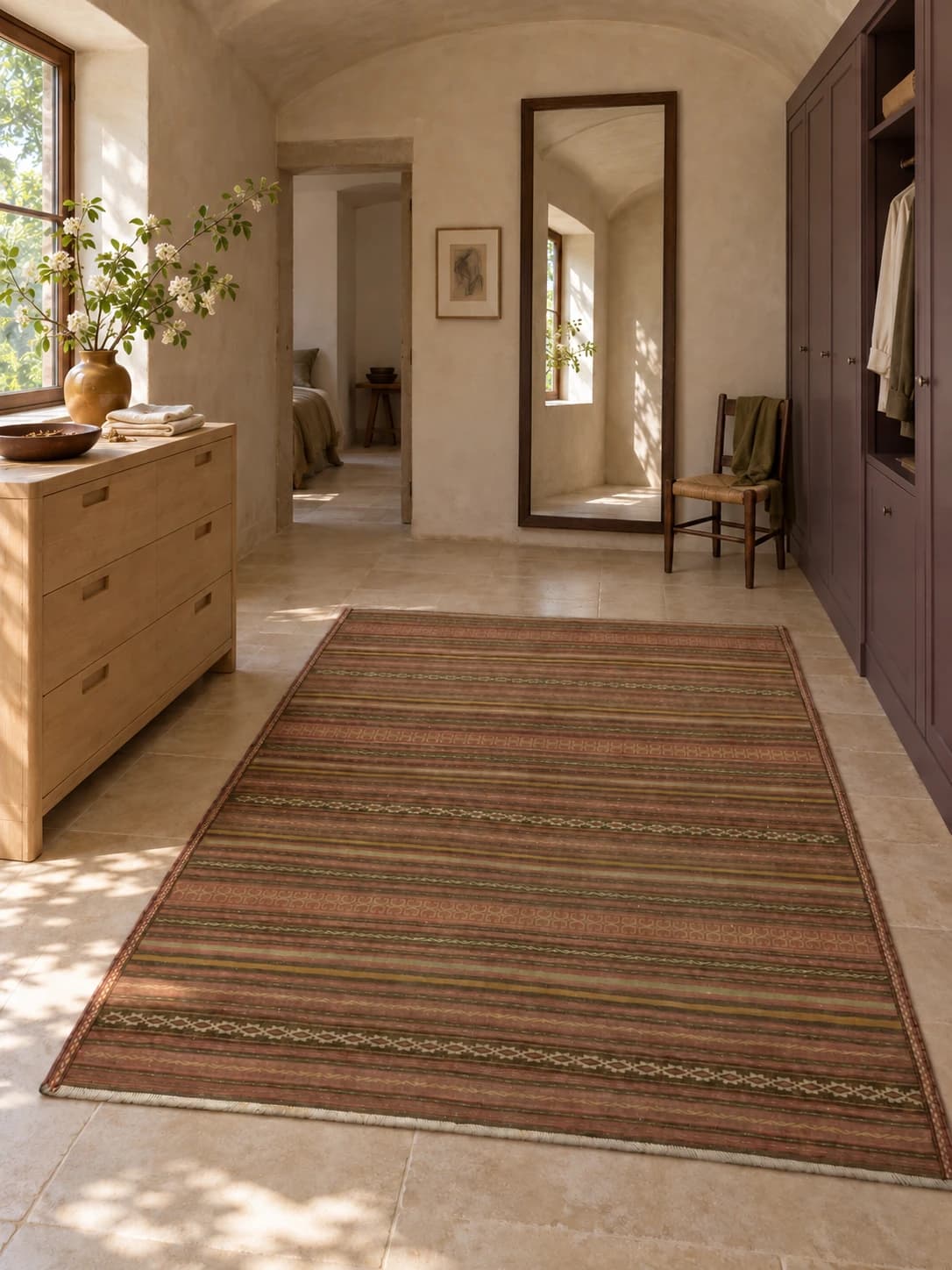
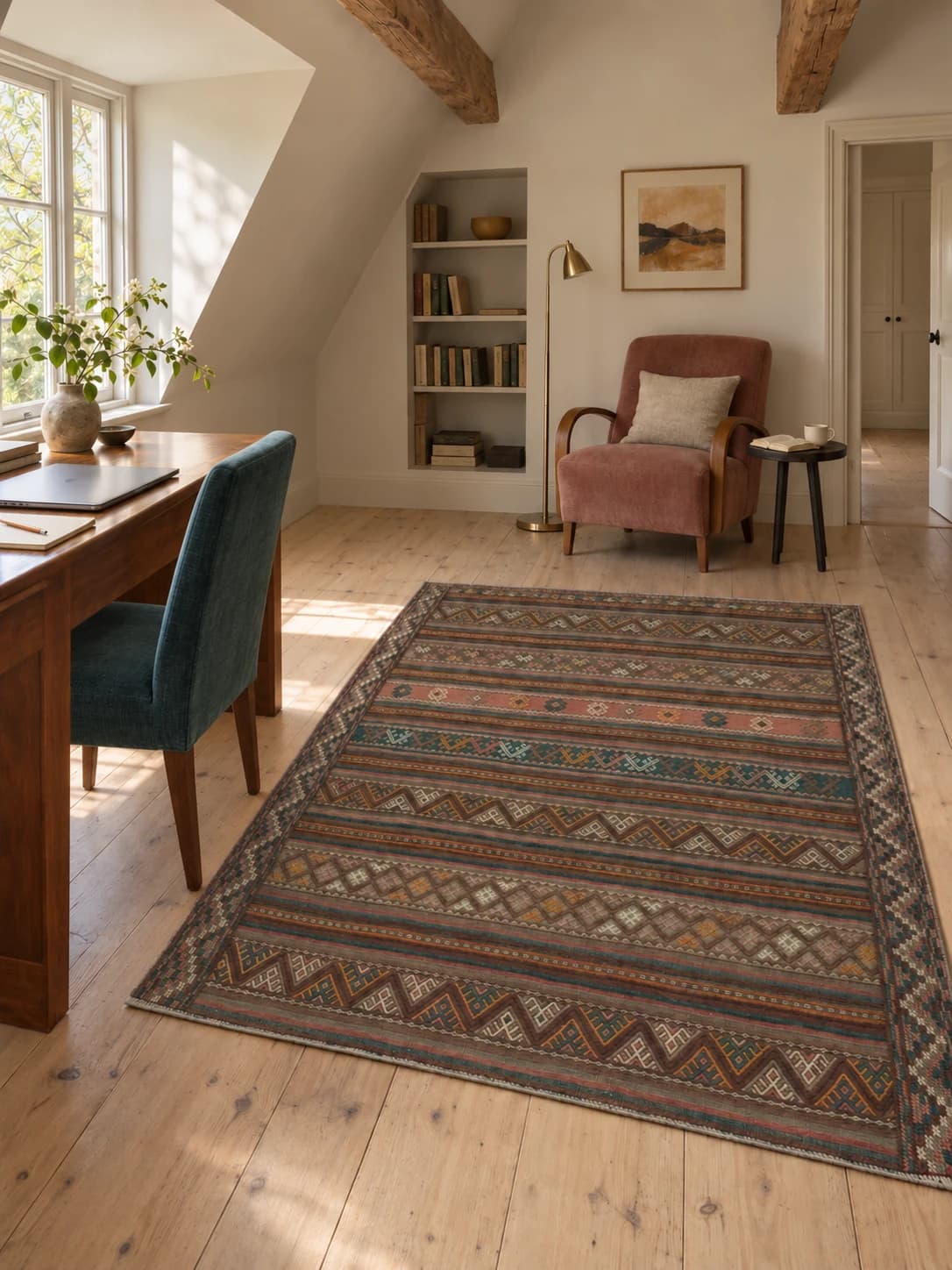
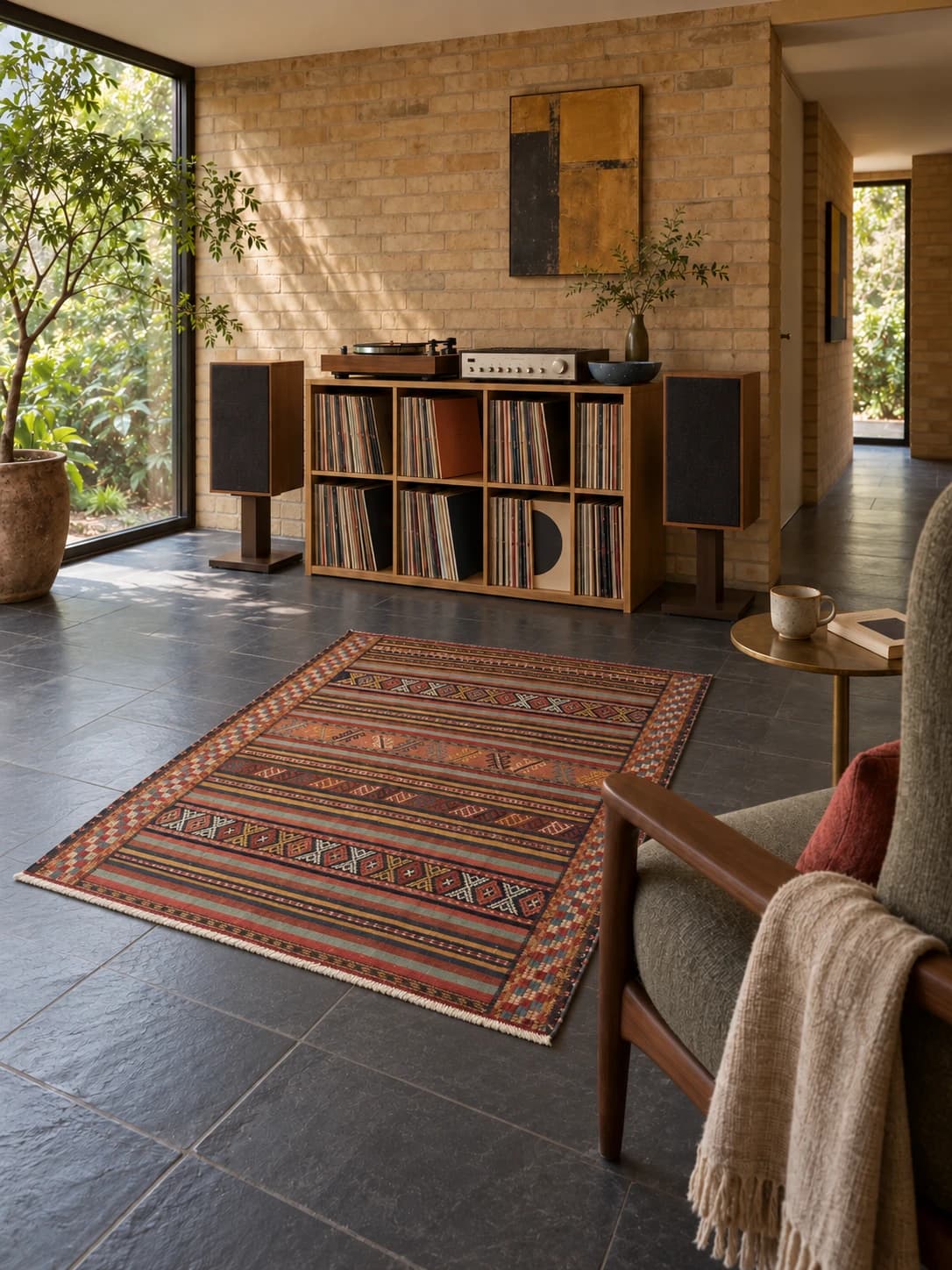
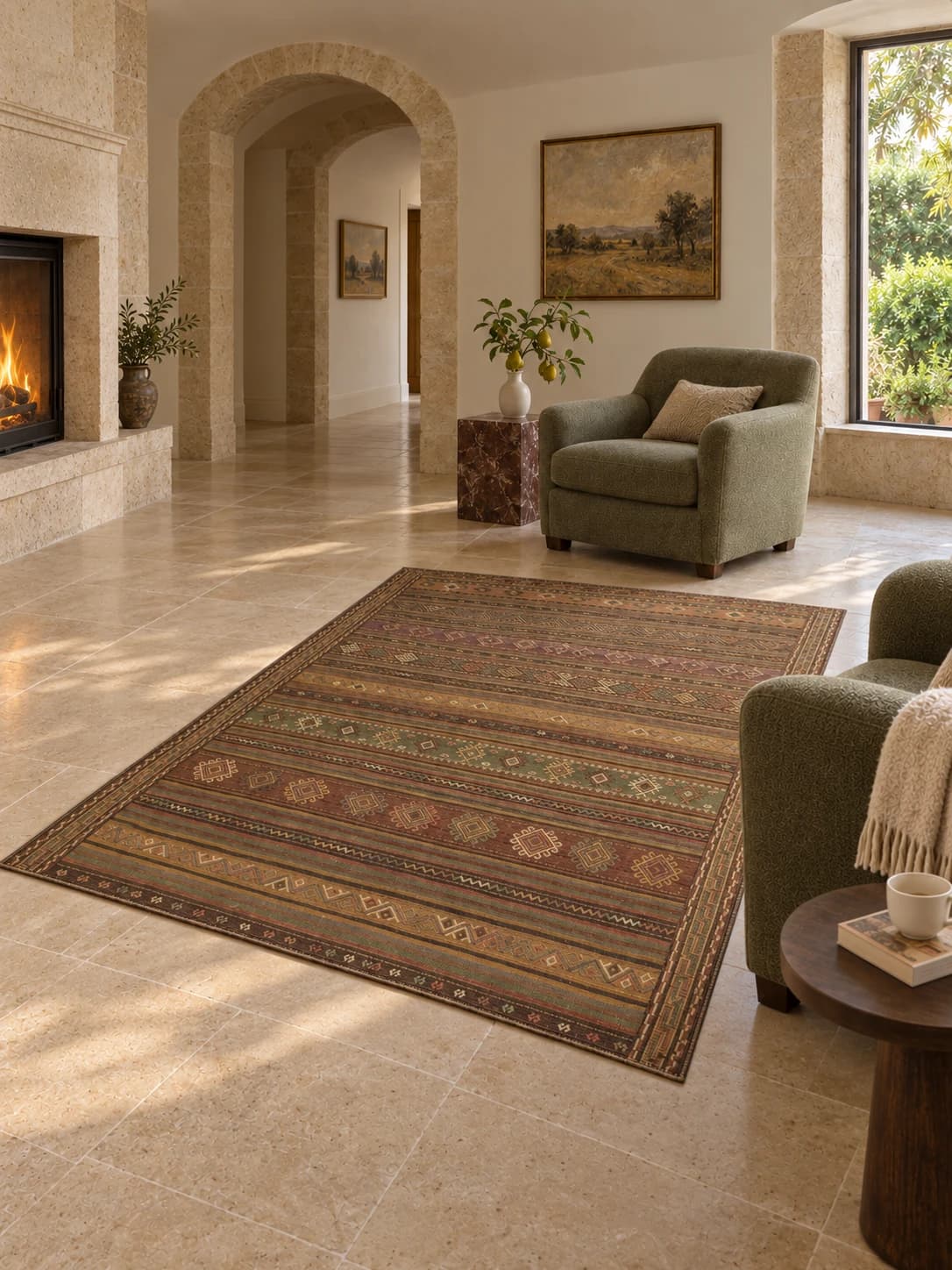
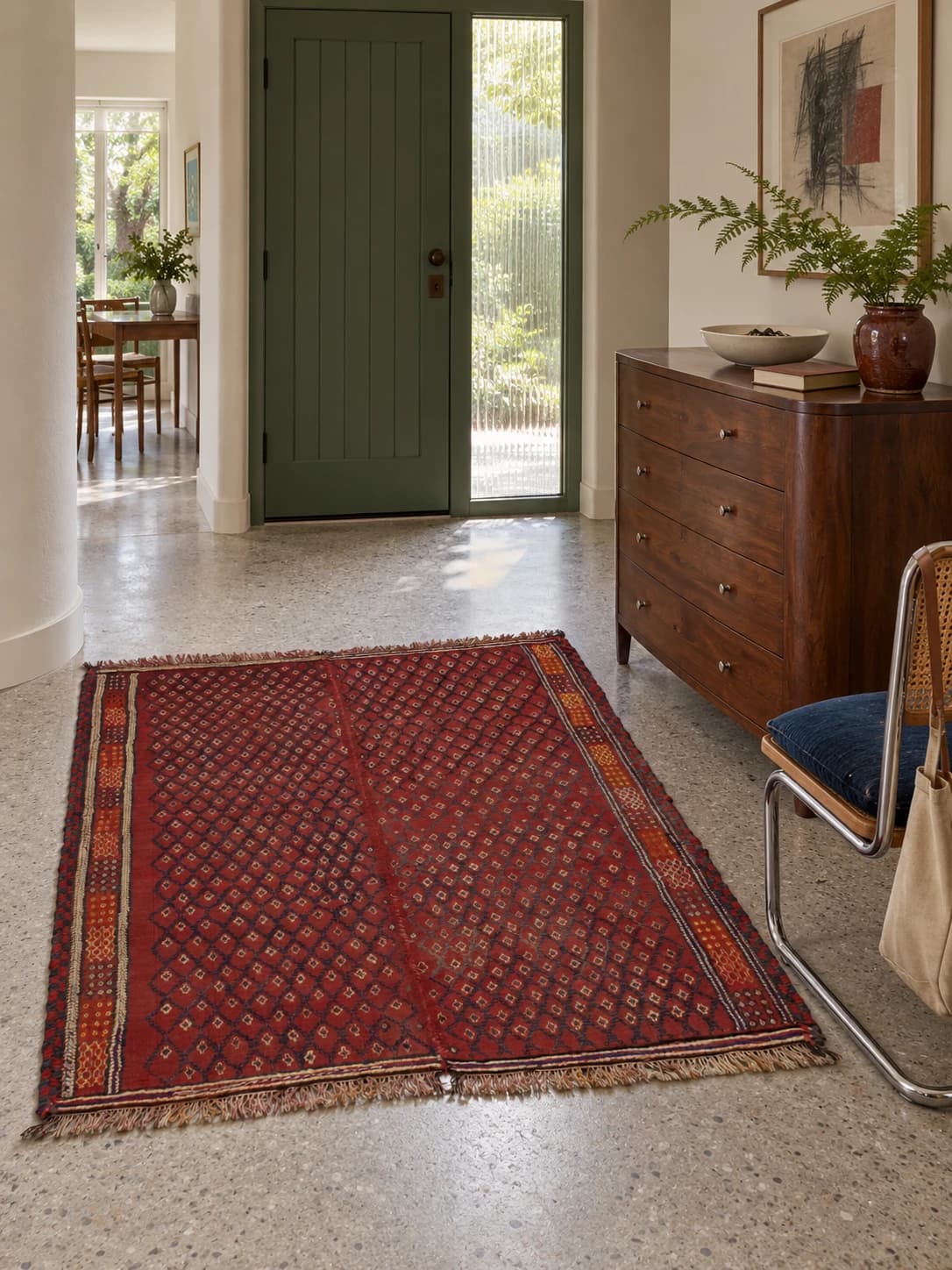
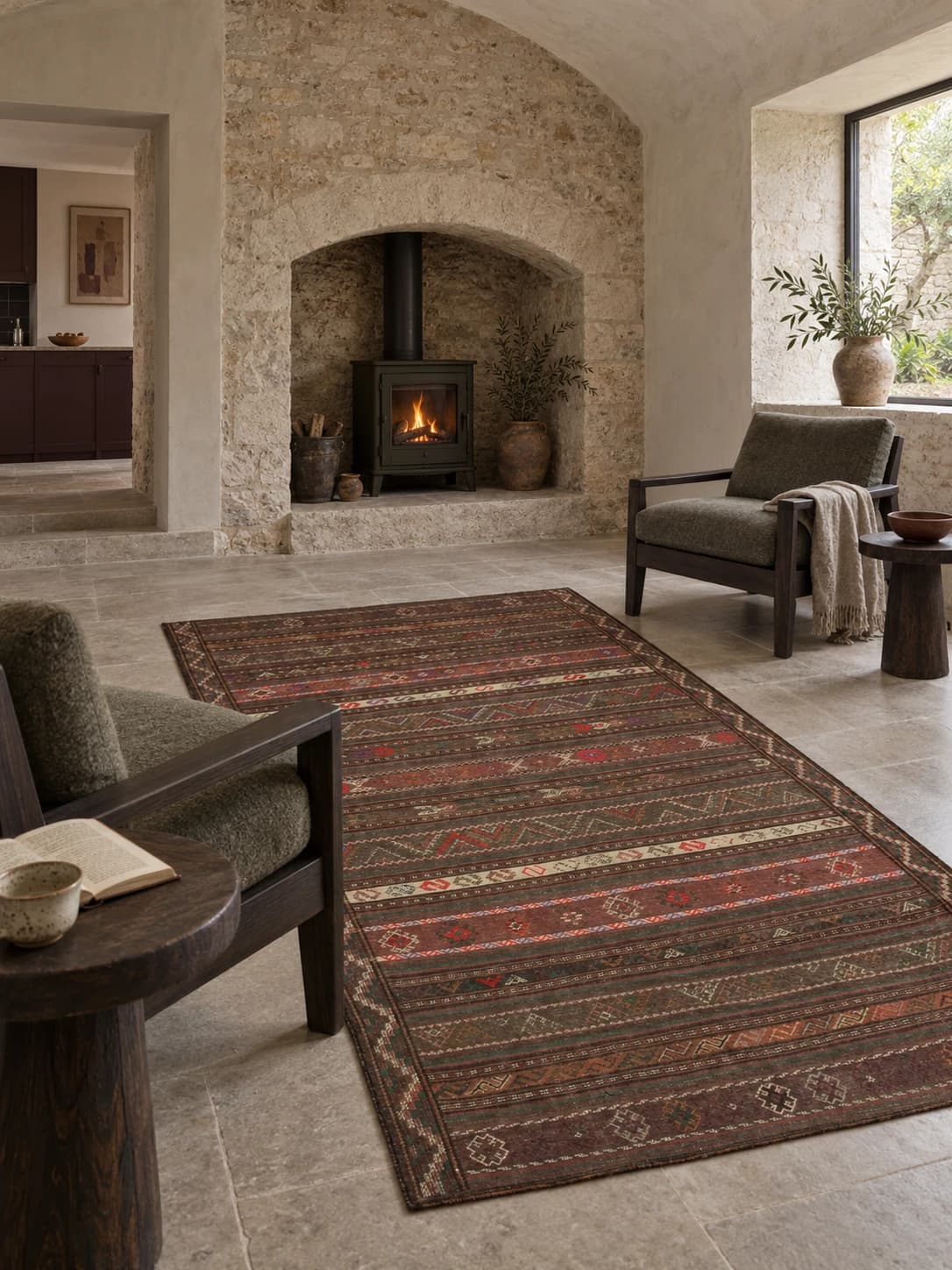
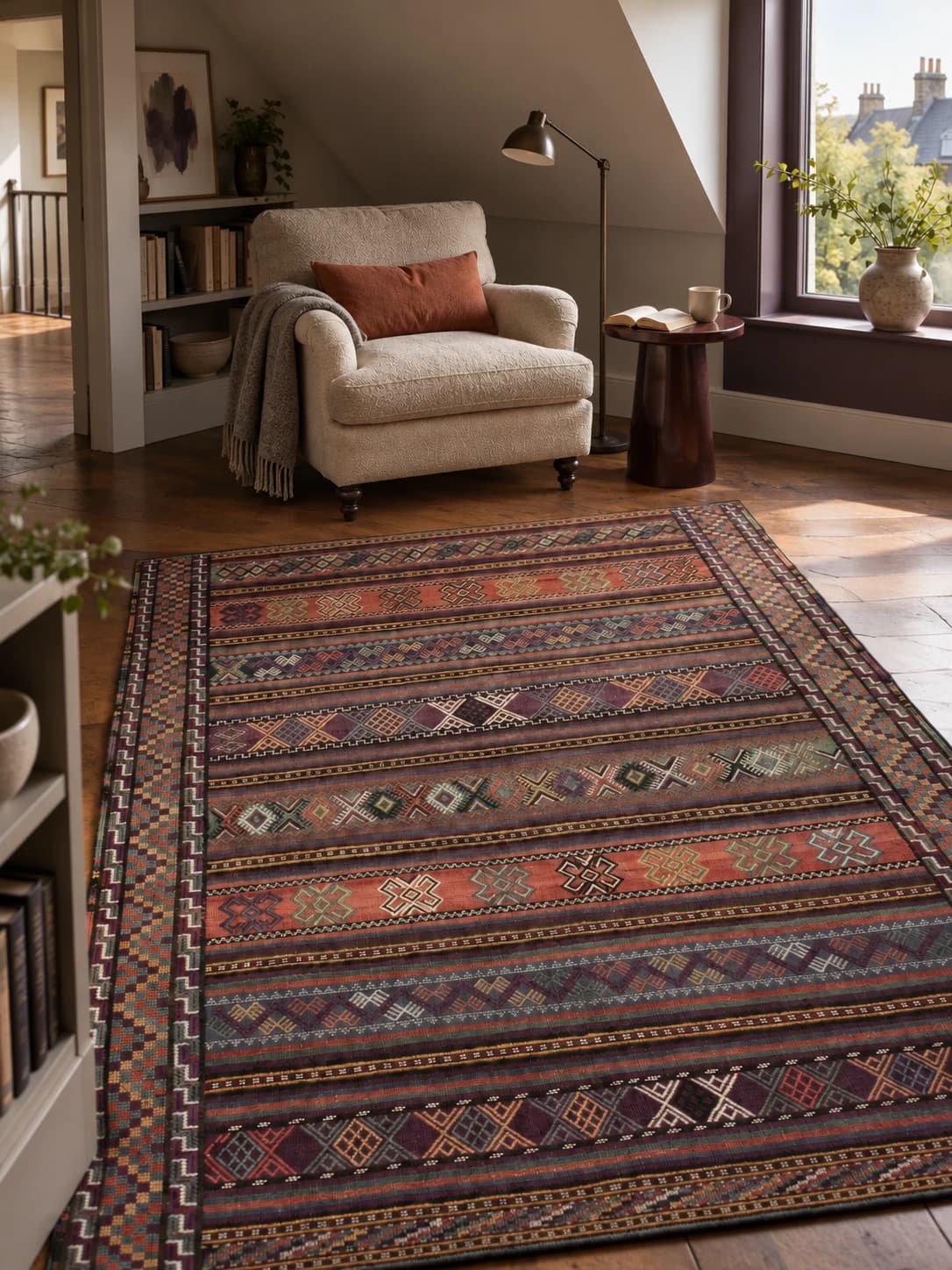
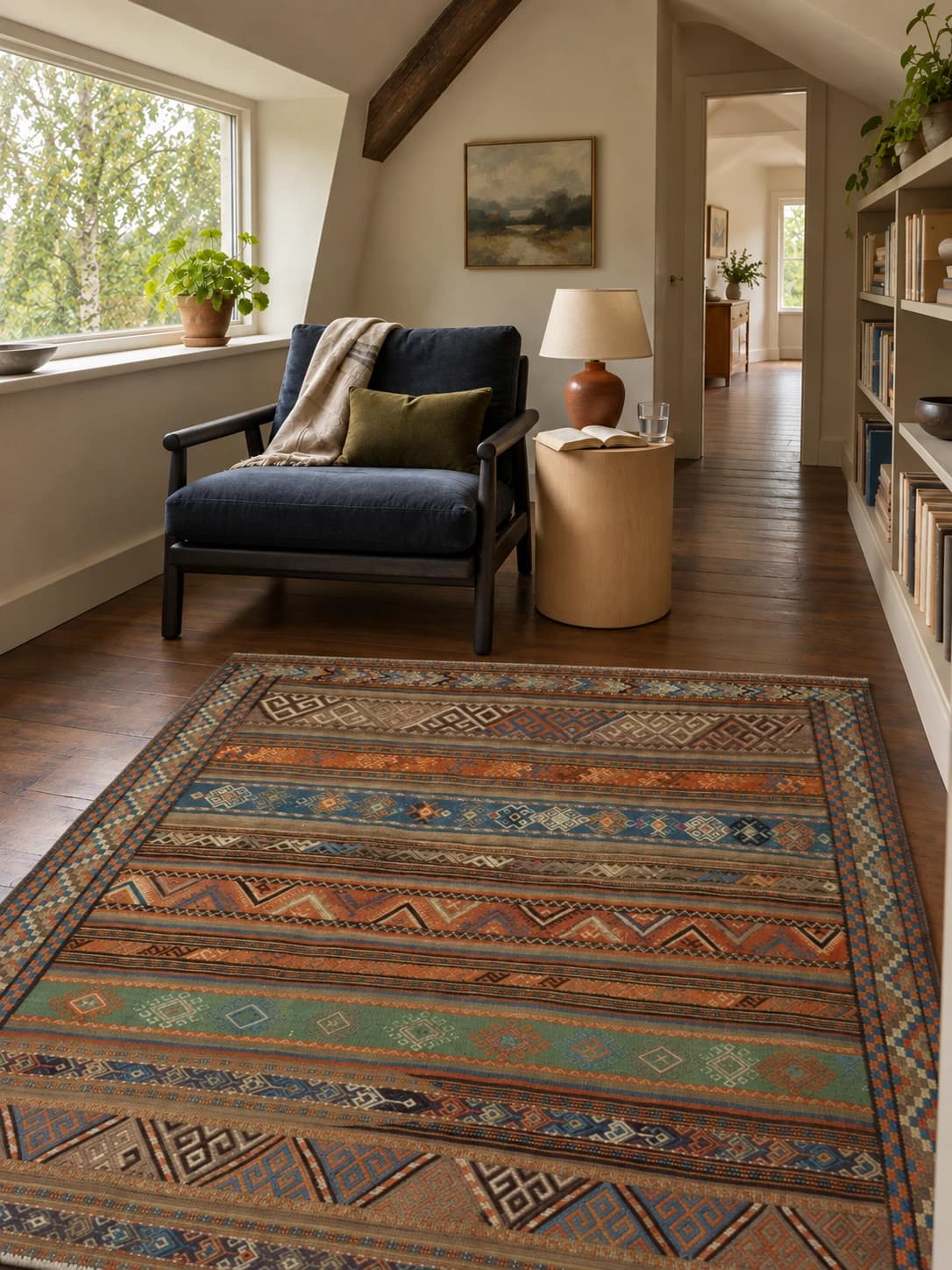
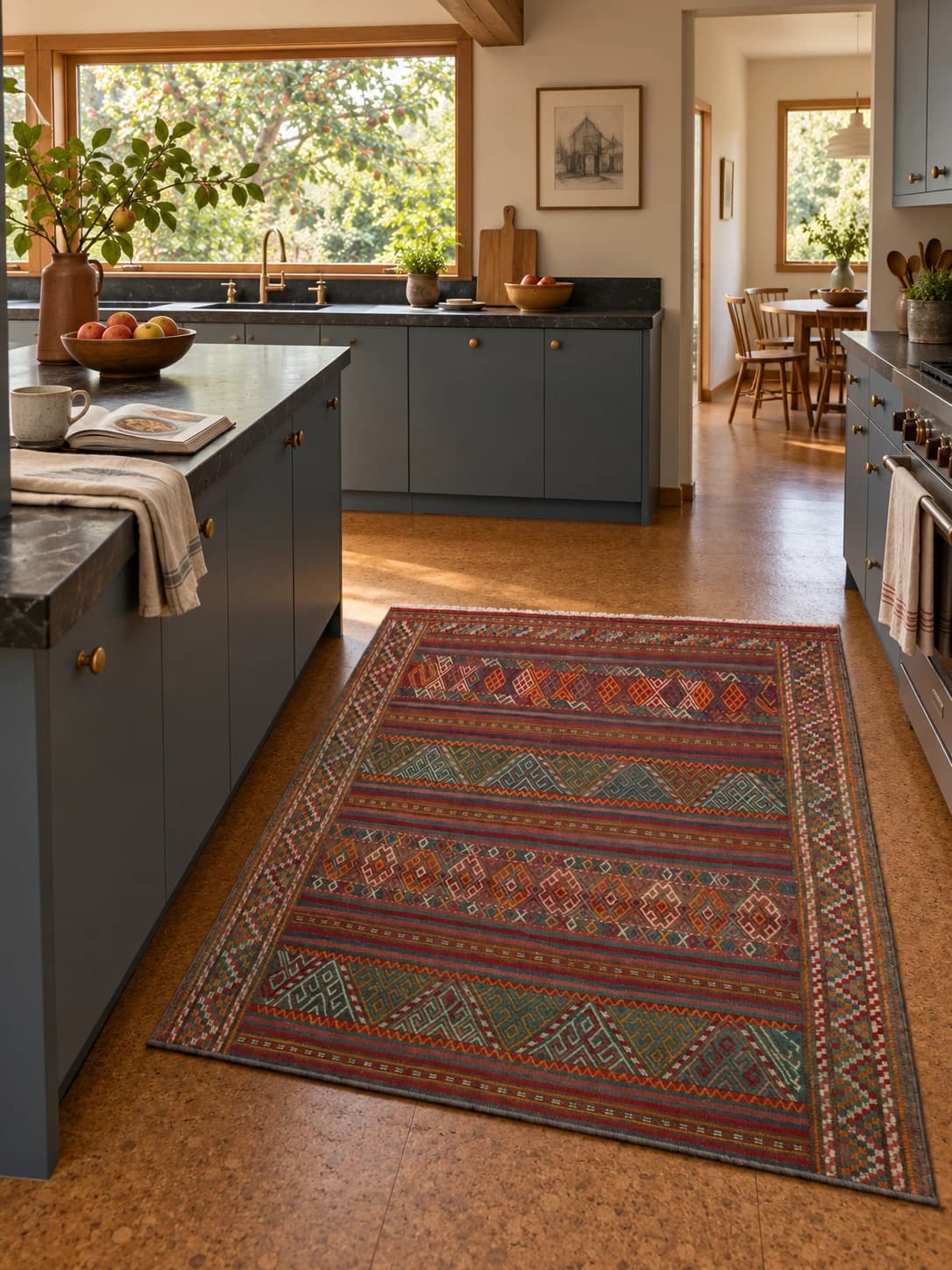
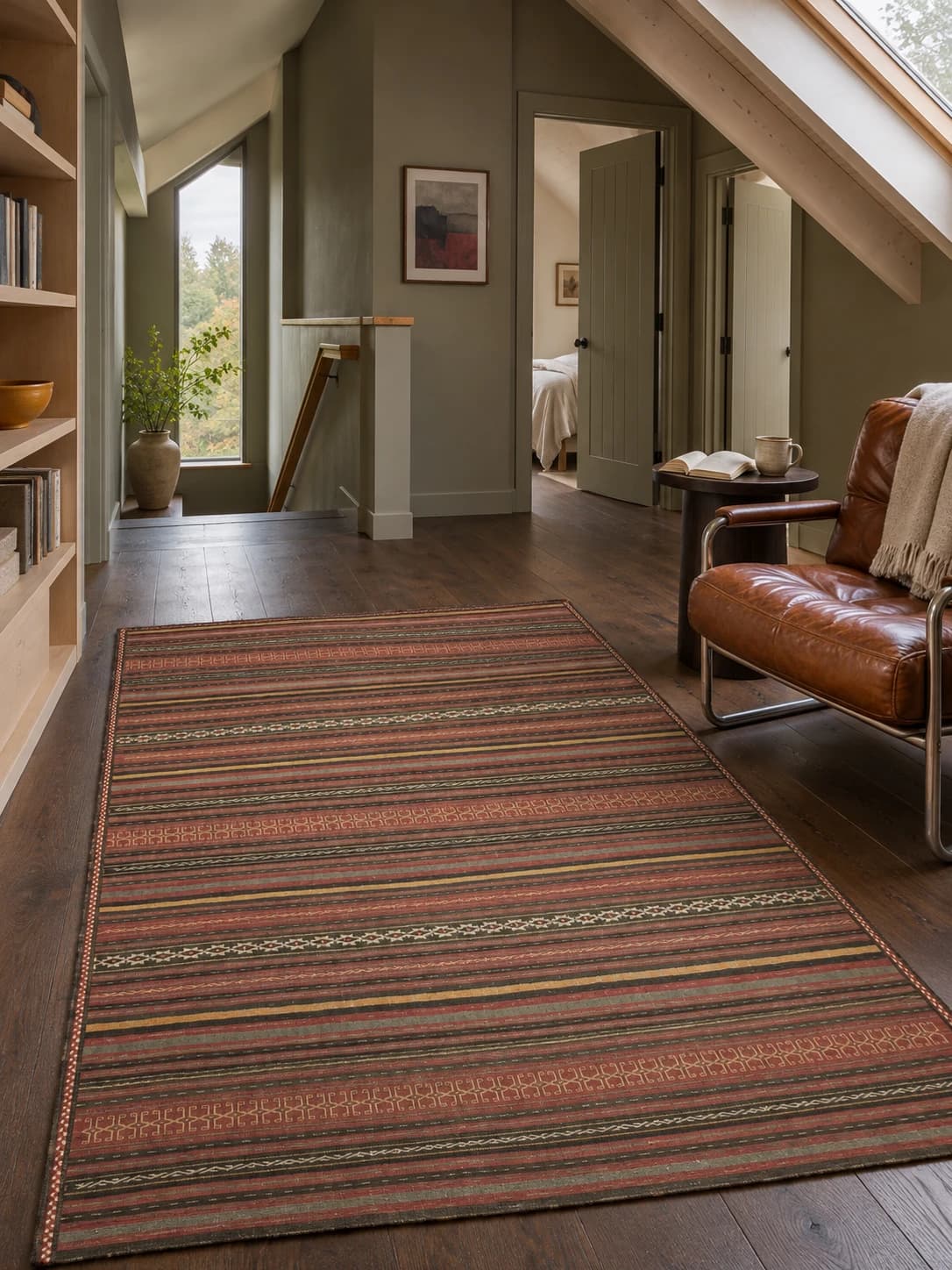
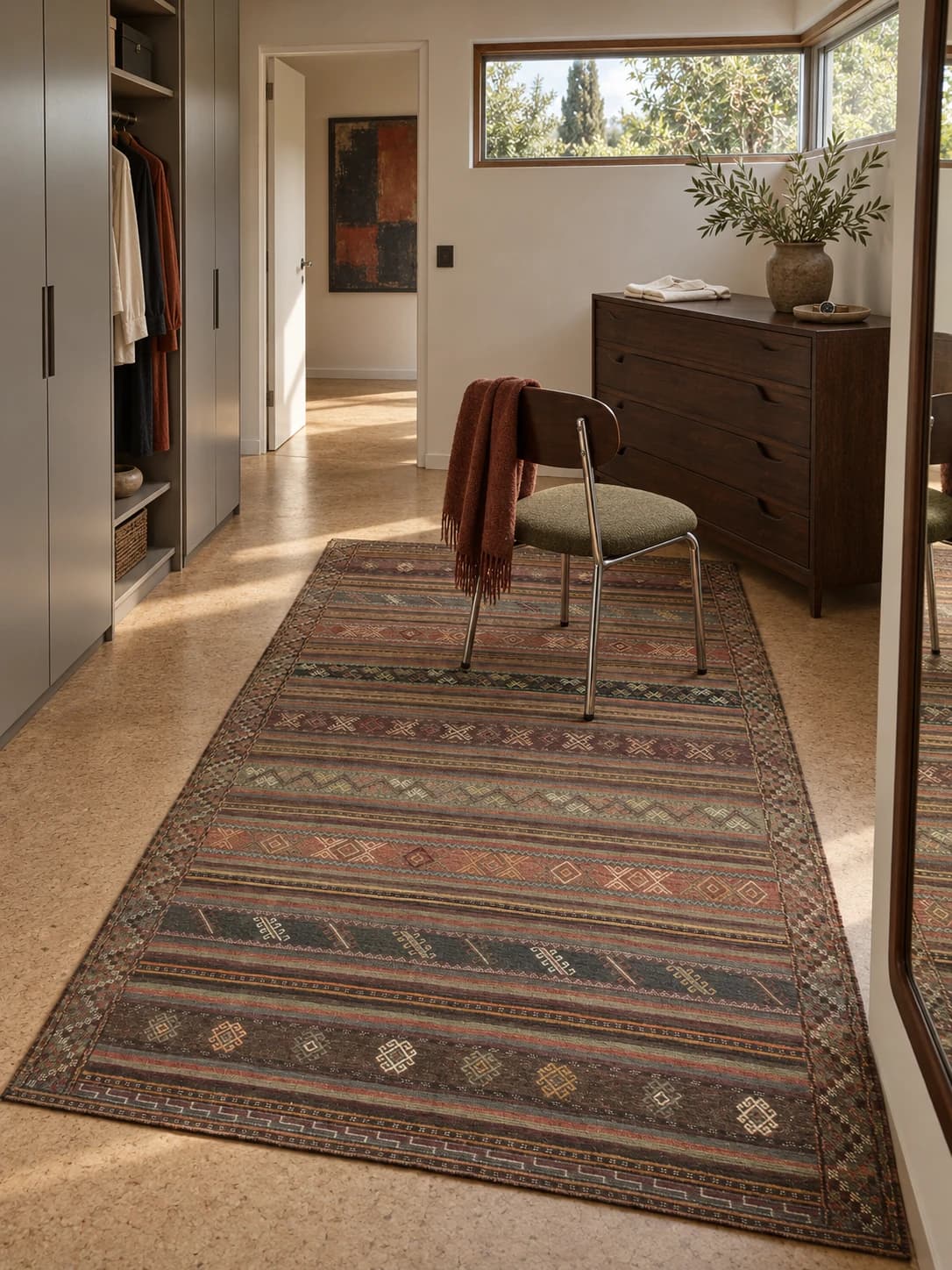
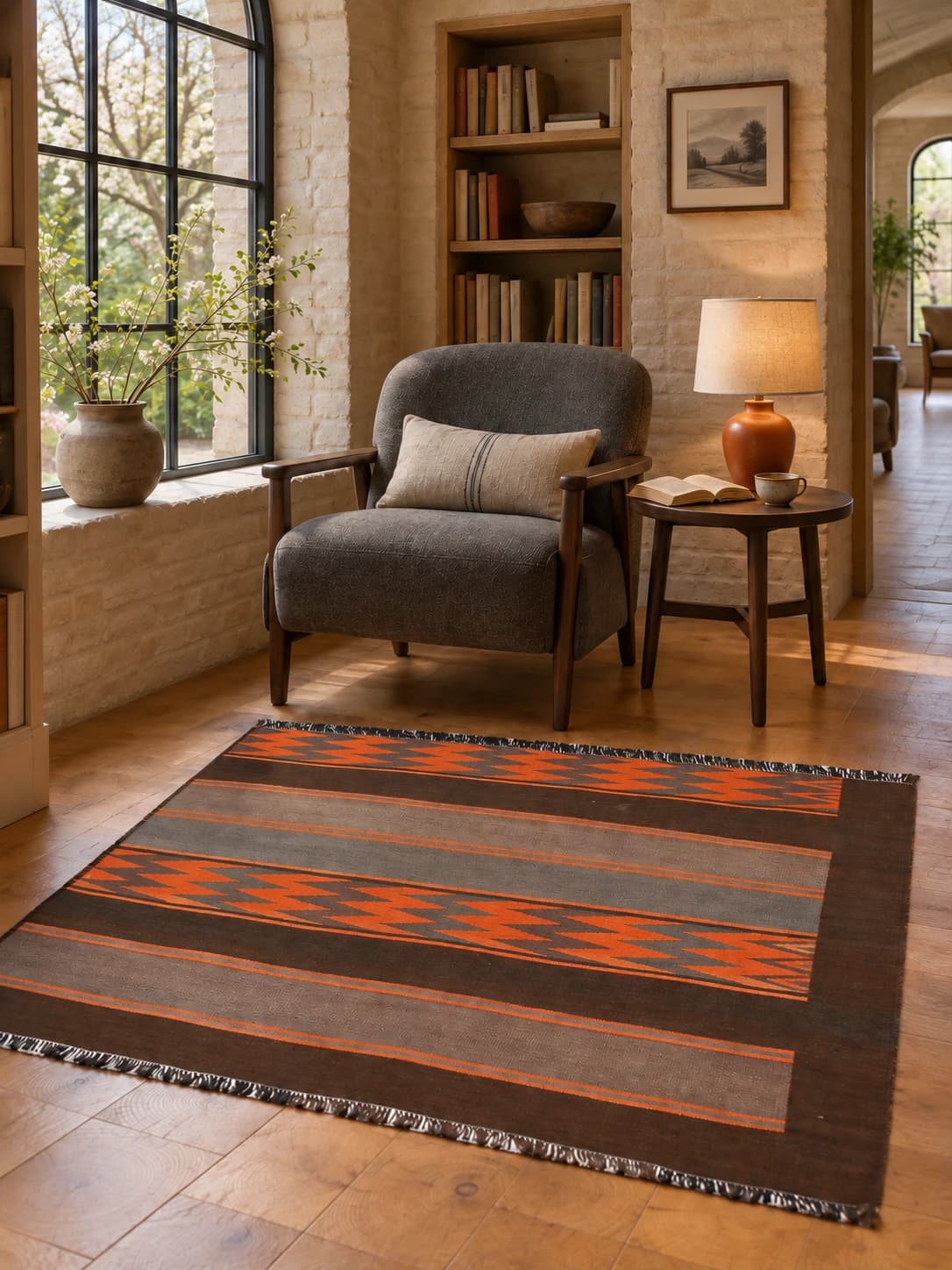
In a home these behave differently from a pile carpet. A flatweave is thin, so it will not crush or shade the way a pile does, but neither does it cushion underfoot, and a punishing traffic lane is better served by a deep-pile weave such as HerizBold village rugs from the Heriz area of northwestern Iran, near Tabriz, and the best-known of all Persian village rugs. A coarse, tough wool pile on a cotton foundation, usually double-wefted for extra thickness, and a low-to-medium knot density (commonly quoted at about 120 to 170 KPSI, roughly 1,900 to 2,600 per 10 by 10 cm) make them very durable; the wool's strength is traditionally credited to copper-bearing mountain water. The classic design is a large angular medallion with four corner pieces, sometimes an allover layout, in a rust red traditionally credited to copper minerals in the local river, with dark navy and cream. Bakshaish and Serapi, the latter now over a century old, are their older forms.See in the carpet dictionary or BijarRugs from the city of Bijar in Kurdistan province, northwestern Iran, and the villages around it; the name covers both fine and coarse double-wefted pieces, woven by Kurdish tribes and, in workshops, Afshar weavers. Nicknamed the “iron rugs” of Iran, they are among the heaviest rugs for their size: double wefts, symmetrical (Turkish) knots, and rows beaten down hard, often while the wool is kept wet, give a thick, dense pile. Designs run from floral, Herati, and medallion to geometric, drawing on Isfahan and Kashan as well as Russian, Caucasian, and European sources (a French-style rose bouquet among them), in jewel tones of rust, red, beige, and navy. Bijars are often small rugs or runners, large sizes are rare, and the flat-woven ends and fringes are typically braided.See in the carpet dictionary. A soumak earns its place under a dining table, in a hallway where a door has to clear the floor, layered over a larger plain covering, or on a wall, where the pattern can be read whole. Vacuum without a beater barThe rotating bristled roller in the head of many upright and power-head vacuum cleaners, which beats and agitates the pile to loosen dirt. On a hand-knotted rug it is too harsh: it beats the pile down and can grab and shred the fringe, which should not be vacuumed at all. The recommended alternative is suction alone from a light canister vacuum whose head has no beater bar, passed side to side across the rug's width rather than lengthwise against the pile; if only a beater-bar machine is available, the bar should be switched off.See in the carpet dictionary and turn it end to end once a year.
The Persian rug
A Persian rug is an Iranian rug — a rug hand-knottedA rug construction in which the weaver ties each knot of wool or silk pile yarn by hand around adjacent warp threads on a loom, then runs a weft through the row and beats it down. The cut knot ends form the pile, the warps and wefts form the foundation, and the warp ends become the fringe. A rug can take months or even years, and the work leaves subtle irregularities: patterns not perfectly symmetrical, opposite edges a few inches different in length, an uneven fringe. Authentic Persian, Oriental and Turkish rugs are hand-knotted, unlike hand-tufted rugs (sometimes sold as “handmade”) and machine-made ones, whose backs feel stiff and evenly aligned.See in the carpet dictionary in Iran — and the tradition behind it is the oldest documented anywhere. The earliest surviving carpet, the Pazyryk rugThe oldest known pile carpet in the world, woven around the 5th century BC and discovered in 1949 in the frozen tomb of a Scythian noble in Siberia's Altai Mountains. Grave robbers left the burial mound open, so cold and moisture froze the chamber and sealed the carpet in ice for some 2,500 years. Its symmetrical knots, about 36 per square centimeter (roughly 230 per square inch), show that carpet weaving was already a mature art in antiquity. It is often described as the oldest Persian rug and as early evidence of tribal weaving, a craft that began as protection against cold and damp. It is displayed in the Hermitage Museum in St. Petersburg.See in the carpet dictionary, was found preserved in a frozen burial mound and dates to the fifth century BC — roughly 2,500 years ago — and it is already accomplished work, not a beginner's craft. What began as warm, hard-wearing floor coverings for tribal households grew, over those centuries, into the art form that every other rug-weaving country has borrowed from.
Two later chapters shaped what a Persian carpet looks like today. Under the Safavid dynastyThe Persian ruling house that reigned from 1501, beginning with Shah Ismail, into the 1730s, whose court patronage of painting, calligraphy and weaving made this the golden age of Persian rugs. Many museum and top-auction masterpieces come from the era, with Tabriz, Herat, Kashan and Kerman the largest centers. As patterns grew more complex, designers, often miniature painters, became separate from the weavers who worked from their drawings; the large central medallion, curvilinear and geometric layouts and richer flowers and vines became hallmarks, and patterns were standardized for export to Asian and European markets. The Afghan invasion of Isfahan in 1722 interrupted weaving in the main manufacturing centers for several years, though tribes and villages carried on.See in the carpet dictionary, from 1501 to 1732, the court promoted weaving alongside painting and calligraphy, and the workshops of Tabriz, HeratRugs from Herat, a historic city in western Afghanistan that was among the largest rug-producing centers of the Safavid period (16th to early 18th century), alongside Tabriz, Kashan and Kerman. The city also gives its name to the Herati design, a repeated diamond holding a small flower or leaves, with curved leaves at its sides, which is said to have originated there and is still woven in many Persian rugs.See in the carpet dictionary, Kashan and Kerman produced the masterpieces that now sit in museums. This is when the great central medallionA large motif at the center of a rug's field, around which the rest of the design is organized; the large central medallion is said to have been introduced in the Safavid era (16th-17th centuries). Floral medallions, typical of city rugs such as Tabriz, Kashan and Sarouk, are often read as a lotus blossom, and the motif has also been read as mirroring the interior dome of a mosque; geometric ones, often hexagonal or diamond-shaped, mark village and tribal rugs such as Heriz and Zanjan. A medallion may stand alone, come with four corner pieces, be flanked by smaller medallions above and below, or repeat down a runner. Rugs with no central motif are called allover. In a well-made rug the medallion sits at the center and the corners mirror one another, as closely as handwork allows.See in the carpet dictionary appeared, and when designs grew elaborate enough that a separate designer — often a miniature painter — drew the pattern onto a cartoon for the weaver to follow. The second chapter came in the nineteenth century, under the Qajar dynastyThe era of the Qajar dynasty, which ruled Persia in the 19th century and produced the largest rug output in Persian history. Weaving revived after the turbulence of the 1700s that had halted the main manufacturing centers, and exports to Europe and America thrived, with England and Germany the biggest buyers. Newer centers such as Sultanabad and Kashan rose alongside Tabriz and Kerman, and European and American companies set up their own manufacturing hubs in Persia. Rugs from these large factories follow standardized, easily recognized designs, unlike village and tribal rugs, whose weavers still design their own patterns.See in the carpet dictionary, when production reached its historical peak, exports to Europe and America boomed, and the workshop industry whose descendants still weave today took its modern shape.
The trade sorts Persian rugs into three families. City rugs — Tabriz, Kashan, Kerman, Nain, Isfahan — are woven in workshops from a drawn design, carry the highest knot densities and come in the widest range of colours, sizes and patterns. Village rugs such as HerizBold village rugs from the Heriz area of northwestern Iran, near Tabriz, and the best-known of all Persian village rugs. A coarse, tough wool pile on a cotton foundation, usually double-wefted for extra thickness, and a low-to-medium knot density (commonly quoted at about 120 to 170 KPSI, roughly 1,900 to 2,600 per 10 by 10 cm) make them very durable; the wool's strength is traditionally credited to copper-bearing mountain water. The classic design is a large angular medallion with four corner pieces, sometimes an allover layout, in a rust red traditionally credited to copper minerals in the local river, with dark navy and cream. Bakshaish and Serapi, the latter now over a century old, are their older forms.See in the carpet dictionary, BakhtiariColorful rugs of the Bakhtiari, a Zagros Mountains tribe that was nomadic until much of it settled southwest of Isfahan in the 19th century and whose weaving now spreads across more than 200 villages; smaller pieces tend to be tribal work and larger ones come from the region's villages. The foundation is usually cotton under a wool pile from the tribe's own sheep, though some small tribal pieces are wool throughout, and every row is beaten down so hard that the pile ends up dense and long-lasting. The signature layouts are the garden panel design (Khesti, also spelled Kheshti), a grid of framed squares that each show a garden scene meant as a view of paradise, and the medallion-and-corner design with a semi-geometric center medallion. Deep red and dark navy are the usual field colors.See in the carpet dictionary and KarajaVillage rugs from a group of villages in the Azerbaijan region of Iran, at the western edge of the Heriz weaving area and named for the village of Karaja at their center. Wool pile on a cotton foundation (very old pieces may have a wool one), Turkish knot and single weft, so the pile is thinner and softer than the usually double-wefted Heriz, and knot density is low to medium. Two bold geometric medallions with hook-like edges typically alternate down a runner, often on a different ground color with each repeat, and on wide rugs the repeated medallions read as a geometric allover, in orange-reds, blues, creams and browns. Their soft, thin pile and great lengths, some over 20 feet (6 m), make them popular as hallway and stair runners.See in the carpet dictionary sit in between, mostly geometric and largely woven from memory. Tribal rugs — Baluch, TurkomanTribal rugs woven by Turkoman (Turkmen) nomads, whose forebears came from the Afghan and Uzbek region and who later settled in the Turkmen region of Iran. Rows of octagonal guls (“flowers”) cover a deep red, reddish-brown or occasionally cream field, accented in black, blue, green or beige; prayer designs also occur. Foundation and pile are usually wool, said to come from the soft undercoat of Karakul sheep, though a cotton foundation is occasionally used. In older pieces each tribe kept its own gul design, whereas newer rugs freely mix them. Turkoman designs inspired Bokhara and Khal Mohammadi rugs and are the Persian design closest to Baluchi work, which they predate; the low-to-medium pile suits places where doors swing over the rug.See in the carpet dictionary, QashqaiTribal rugs woven by the Qashqai, a nomadic tribe of southwestern Iran that unites Turkic, Arab, Kurdish and Lur groups and has lived in the region since at least the 16th century. Designs come from memory rather than written plans, pairing geometric and medallion layouts, occasionally in a simpler, sparsely detailed form, with animals, plants and household objects, in jewel-tone reds, saffron gold and indigo, often on deep red or dark navy grounds. The thick, hard-weaving wool of the tribe's own flocks is durable yet soft, forming a medium-height, dense pile on a cotton or wool foundation that suits busy areas; compact looms keep sizes small, typically 4 x 6 ft (1.2 x 1.8 m) or 5 x 7 ft (1.5 x 2.1 m) plus runners.See in the carpet dictionary, each named after the people who weave it — are made on small portable looms, so they run smaller, and their bold geometric drawing comes from the weaver's own head rather than from paper.
The design vocabulary draws on a deep stock of motifs: Shah AbbasiA classic Persian floral style named after the Safavid ruler Shah Abbas, which began as a royal court pattern about 400 years ago. Its main features are stylized, feather-like palmette leaves and lotus flowers, the lotus being an ancient symbol of long life, arranged in strict symmetry with scrolling ornament around a central medallion, often a rosette. Early examples favored deep reds and blues, while later rugs in this style often turn to muted neutral tones. The design appears in Kashan, Nain and Tabriz rugs.See in the carpet dictionary palmettes, flowing arabesques, the small repeating Herati patternA classic Persian design built on a diamond repeated across the field, with a small flower or leaves inside each diamond and curved leaves at its sides; the leaves are read as stylized fish, said to circle a lotus. The name comes from Herat, the city in Afghanistan where the design is said to originate; it is also called the fish design, and Mahi means “fish” in Persian. It is one of the three main design families, woven as an allover pattern or around a central medallion with diamonds inside and outside it, and it sometimes appears as a thin border. It is common in Tabriz, Sarouk, Mashhad, Moud, Bijar, Hamadan, Abadeh, Zanjan, Kerman and Kashan rugs.See in the carpet dictionary, medallions, garden and tree-of-life compositions. These combine with regional habits into styles a practised eye can place at a glance, from the bold geometric medallions of Heriz to the fine curvilinear florals of Isfahan.
The classic palette is built on natural dyes: madderThe root of the madder plant (Rubia tinctorum), a natural red dye and the source of the terracotta tones in Persian and Oriental rugs. Together with indigo and walnut husks it is among the plant dyes used to color the wool, bonding to its natural lanolin. Slight shade variations within one color area, known as abrash, are normal in rugs dyed this way.See in the carpet dictionary reds, indigo blues, saffron yellows and the soft whites of undyed woolWool left in its natural fleece colors, with no dye applied, so its shades run only through white, cream, brown, gray and black. Weavers combine white and black wool to reach these tones, which is how natural Gabbeh rugs, usually on a cream ground, get their palette. Many cream grounds in Persian and Oriental rugs also contain undyed wool; these areas can show slight variations of tone that shift as the rug ages, which is normal and not a defect.See in the carpet dictionary, settled into combinations refined over centuries. Natural dyes age gracefully, mellowing into the patina that older rugs are prized for, and slight shifts of tone between dye batchesA single batch of dye, together with the yarn colored with it, all of which takes the same shade. Natural dyes are made in small artisanal batches, and when one runs out the replacement cannot be matched exactly, so yarn from different lots differs slightly in tone. In a finished rug the difference shows as the color shifts known as abrash, which is read as a sign of hand dyeing, whereas a perfectly flat, uniform color suggests synthetic dyes and machine making.See in the carpet dictionary — the effect called abrashSubtle shifts in color within a handmade rug, often visible as horizontal bands across the field. They arise because successive dye batches never match exactly, because differences in the wool's fat and oil content make colors change unevenly with age, and, in cream areas woven from undyed wool, because the fiber changes tone as it ages. Abrash often grows more distinct with age, so in an older rug it counts as a sign of natural dyes and hand production rather than a fault, while a newer rug is still checked for even color. Machine-made and some new hand-knotted rugs imitate it on purpose.See in the carpet dictionary — are a mark of small-batch natural dyeing, not a flaw.
The pileThe surface of a rug or carpet, made of upright fibers in cut tufts or loops. In a hand-knotted rug it is formed by the cut ends of thousands of wool or silk knots tied onto the warp row by row, trimmed lightly during weaving and given its final height by shearing at finishing. Pile thickness, measured from the back of the rug to the top of the pile, typically runs from low, about 1/8 to 1/4 inch (3 to 6 mm), to high, about 1/2 to 5/8 inch (13 to 16 mm). Fine, dense designs are cut short to keep the pattern sharp; higher pile suits traffic and heavy furniture, lower pile suits door clearance and humid rooms.See in the carpet dictionary is almost always woolA natural animal fiber used for the pile, and in some rugs also the foundation, of high-quality rugs. It is durable, resilient, stain resistant and flame resistant, feels soft and cushioned underfoot, insulates against cold, and takes up dye readily and holds it for many years. It also traps dust particles, which helps reduce allergic reactions. Quality depends above all on where the sheep graze: high-elevation pastures and good feed give thicker, oilier wool, with Manchester, New Zealand and Ghazni wools the best-known prized examples. Early-spring shearing and hand spinning (finer, softer thread than machine spinning) improve it further, while thin, dry wool from dead sheep goes into cheaper rugs.See in the carpet dictionary, and in a Persian wool rug the wool itself decides much of the quality. The best fleece comes from high-altitude flocks, where it grows thicker and richer in natural oils; spring-sheared wool beats the autumn clip, and hand-spun yarnWool yarn spun from cleaned, carded fleece by hand or on a manual wheel rather than by machine, after which the spun threads are twisted together into thicker, stronger strands before dyeing. It gives finer, softer threads than machine spinning, so the wool feels softer and looks shinier, and hand spinning is said to preserve the wool's natural lanolin. It is usual in Kazak and Peshawar rugs woven in Pakistan and in Afghan Khal Mohammadi rugs, all of which are also colored with natural dyes.See in the carpet dictionary gives a finer, softer thread than machine spinning. Fine pieces add silk highlights to a wool pile, and at the very top sits the Persian silk rug, woven in pure silk. Foundations are usually cotton in city weaving, wool in tribal and older pieces, silk at the very top of the range.
Every knot is tied by hand, one at a time, in one of two forms: the asymmetric Persian knotThe asymmetrical knot of hand-knotted rugs, the counterpart of the symmetrical Turkish (Ghiordes) knot. The weaver wraps the yarn around one warp thread and passes it under the neighboring one, usually working by hand without a hook. On the back of the rug the knots look staggered or diagonal rather than like tidy squares, and the pile feels softer; the knot permits finer detail and higher knot density. In Iran, a rule of thumb ties it to the central, eastern, and southern rugs (Kashan, Isfahan, Nain, Kerman), while the northwest and west favor the Turkish knot, though exceptions exist. Fine curvilinear florals are often credited to it, but Turkish-knot rugs can be just as intricate.See in the carpet dictionary, usual in central and eastern Iran, or the symmetric Turkish knotOne of the two main knots of hand-knotted rugs, also called the symmetrical knot (the other being the asymmetrical Persian or Senneh knot). The yarn is looped around two adjacent warp threads with both ends emerging between them, so the back shows small, even, squarish knot heads; weavers often tie it with a hook. Named after the town of Ghiordes (modern Gördes) in Turkey, it is typical of Turkey, the Caucasus and northwestern Iran (Tabriz, Bijar, Heriz, village Hamadan), where Seljuk Turks are said to have introduced it, and gives a durable, precise pile. The Persian knot is often credited with finer detail, yet knot type is a tendency, not a limit: Tabriz rugs woven with the Turkish knot reach about 500 knots per square inch (roughly 78 per cm²).See in the carpet dictionary, common in the north-west ever since Seljuk weavers introduced it in the eleventh and twelfth centuries. A large rug holds in the region of two million knots and can occupy a weaver for about a year.
Knot densityThe number of knots in one square inch of a hand-knotted rug (KPSI; 1 KPSI is about 15.5 knots per 10 x 10 cm), counted on the back with a ruler by multiplying the knots along one inch of height by those along one inch of width, averaged over two or three areas. More knots give sharper detail, like a higher-resolution screen, and, all else equal, somewhat more durability and a higher price, but density alone does not grade quality: Heriz and Bijar are durable at low to medium counts, while floral curvilinear designs blur without enough knots. Figures run from under about 80 for coarse tribal weaves such as Gabbeh and Qashqai, through roughly 120 to 225 for many village rugs and 300 to 700 for fine city rugs such as Nain and Isfahan, to 600 to 1,000 or more for pure silk Qum.See in the carpet dictionary is the figure newcomers fixate on, and the finest silk-foundation pieces do reach as much as 1,000 knots per square inch. But densityA measure of how tightly a carpet is packed. In machine-made carpet it describes the fibers in the pile and is calculated by multiplying the face weight by 36 and dividing by the pile height; higher density generally indicates better durability and performance. In hand-knotted rugs it means knot density (KPSI, knots per square inch), counted on the back and averaged over several areas (150 KPSI is about 23 knots per cm²). Like image resolution, higher density allows finer curves and sharper designs, usually with a lower-trimmed pile and more labor, but it is not the sole measure of quality: bold geometric village rugs are made at low to medium density.See in the carpet dictionary only matters as far as the drawing demands it: a curvilinear Isfahan needs a fine weave to stay sharp, while a geometric Heriz is famously durable at a modest count. Material, symmetry, colour harmony and condition say more about quality than any single number.
Persian carpets settle into modern rooms as naturally as classical ones, as a focal point in a living room, a foundation under a dining table or a quieter accent in a bedroom. Care is undemanding: gentle vacuuming without a rotating brush, an occasional turn for even wear, and a professional wash about every five years — sooner in a hallway or entrance, less often in a quiet room.
A hand-knotted Persian rug tends to outlast its owners. Pieces a century old regularly survive in fine condition, their colours settled and their pile supple, often looking better than when they left the loomThe frame on which the warp (vertical) threads are strung first and held under tension so the weft (horizontal) threads can be interlaced through them and the knots tied onto them. Hand-knotted rugs are made on simple looms, from those set up in weavers' homes to the compact, transportable ones of nomadic weavers, where every knot is tied by hand. Loom size sets rug size: nomads' small looms typically yield rugs no larger than about 4 x 6 or 5 x 7 ft (1.2 x 1.8 m or 1.5 x 2.1 m), city workshops with very large looms weave palace sizes, and the number of looms a workshop runs gauges its scale. Wooden looms in tribal and village weaving expand and contract over time, one cause of crooked rugs. Power looms such as Wilton, Axminster, and Jacquard, the industrial descendants, make machine-woven carpet.See in the carpet dictionary. A well-chosen, well-kept rug holds its worth and passes down as a family heirloom rather than being replaced — which is precisely what the knots, the wool and the dyes were always for.
Questions about this carpet?
Our family has traded carpets for two generations. Ask us anything — photos, video calls, advice on sizes.
Message us
Keep exploring
Guides from our family workshop: how to clean, place and care for handmade rugs.